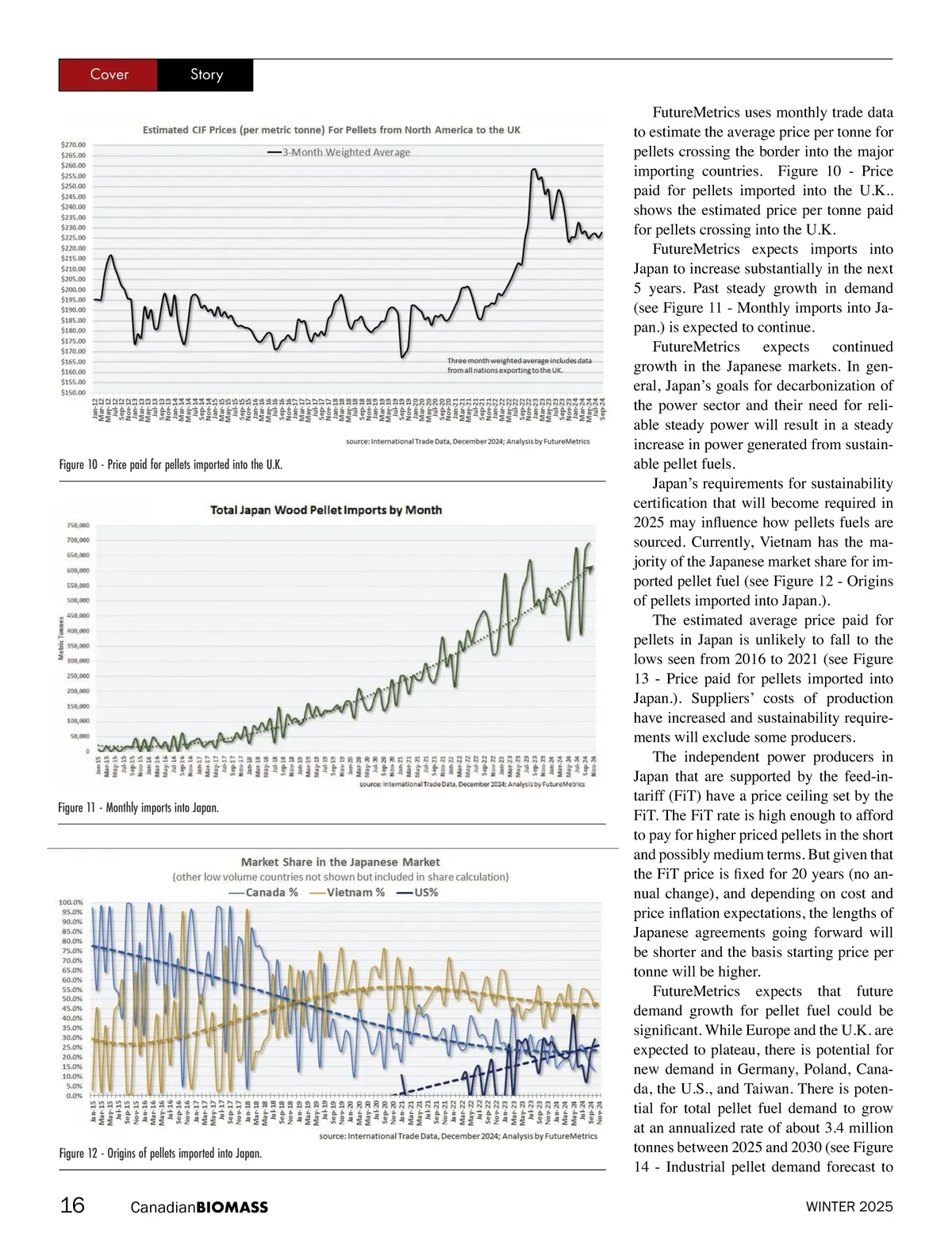
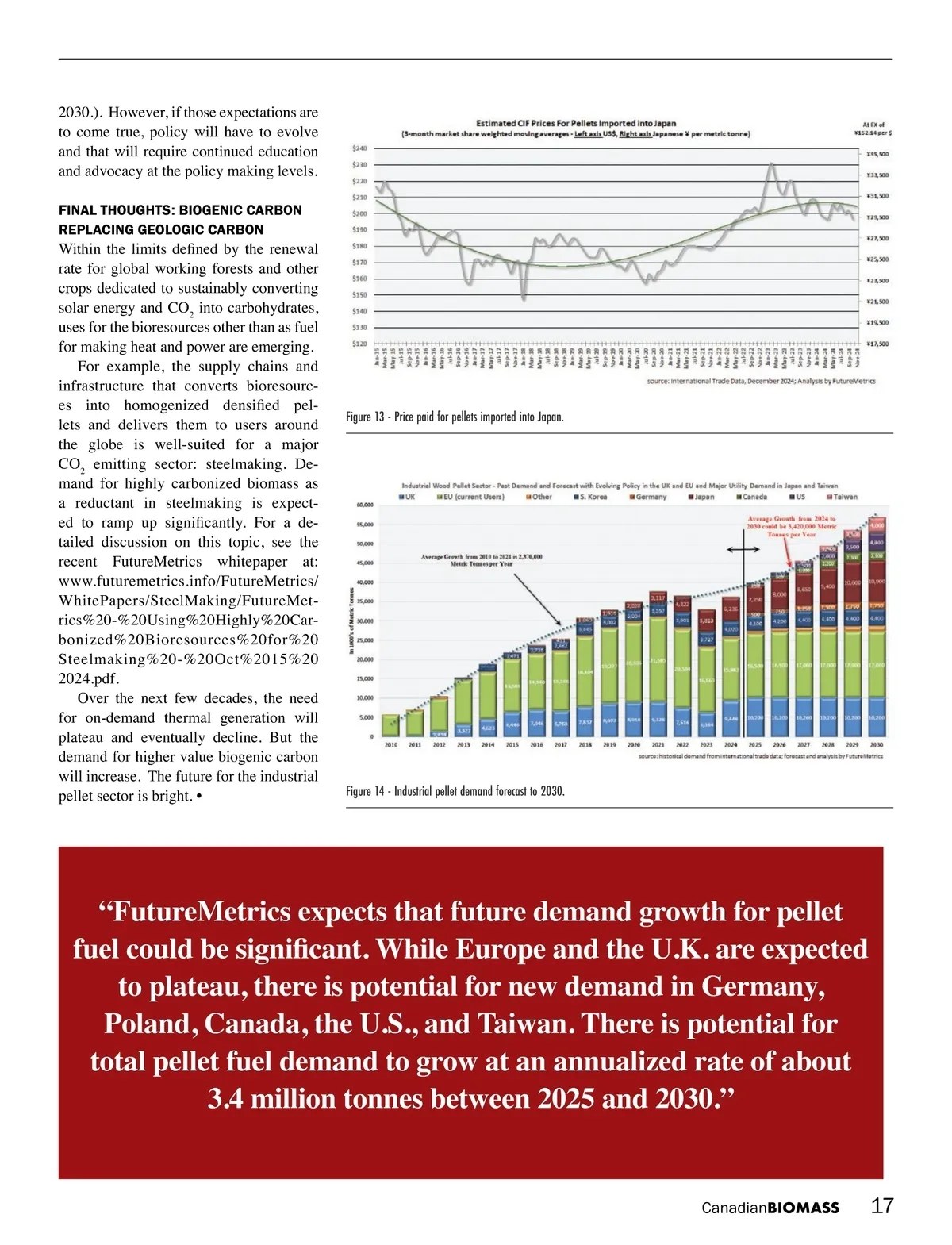
Cover Story FutureMetrics uses monthly trade data to estimate the average price per tonne for pellets crossing the border into the major importing countries. Figure 10 -Price paid for pellets imported into the U.K.. shows the estimated price per tonne paid for pellets crossing into the U.K. FutureMetrics expects imports into Japan to increase substantially in the next 5 years. Past steady growth in demand (see Figure 11 -Monthly imports into Ja -pan.) is expected to continue. FutureMetrics expects continued growth in the Japanese markets. In gen -eral, Japan’s goals for decarbonization of the power sector and their need for reli -able steady power will result in a steady increase in power generated from sustain -able pellet fuels. Japan’s requirements for sustainability certification that will become required in 2025 may influence how pellets fuels are sourced. Currently, Vietnam has the ma -jority of the Japanese market share for im -ported pellet fuel (see Figure 12 -Origins of pellets imported into Japan.). The estimated average price paid for pellets in Japan is unlikely to fall to the lows seen from 2016 to 2021 (see Figure 13 -Price paid for pellets imported into Japan.). Suppliers’ costs of production have increased and sustainability require -ments will exclude some producers. The independent power producers in Japan that are supported by the feed-in-tariff (FiT) have a price ceiling set by the FiT. The FiT rate is high enough to afford to pay for higher priced pellets in the short and possibly medium terms. But given that the FiT price is fixed for 20 years (no an -nual change), and depending on cost and price inflation expectations, the lengths of Japanese agreements going forward will be shorter and the basis starting price per tonne will be higher. FutureMetrics expects that future demand growth for pellet fuel could be significant. While Europe and the U.K. are expected to plateau, there is potential for new demand in Germany, Poland, Cana -da, the U.S., and Taiwan. There is poten -tial for total pellet fuel demand to grow at an annualized rate of about 3.4 million tonnes between 2025 and 2030 (see Figure 14 -Industrial pellet demand forecast to WINTER 2025 Figure 10 -Price paid for pellets imported into the U.K. Figure 11 -Monthly imports into Japan. Figure 12 -Origins of pellets imported into Japan. 16 Canadian BIOMASS
Canadian Biomass Winter 2025: Page 16