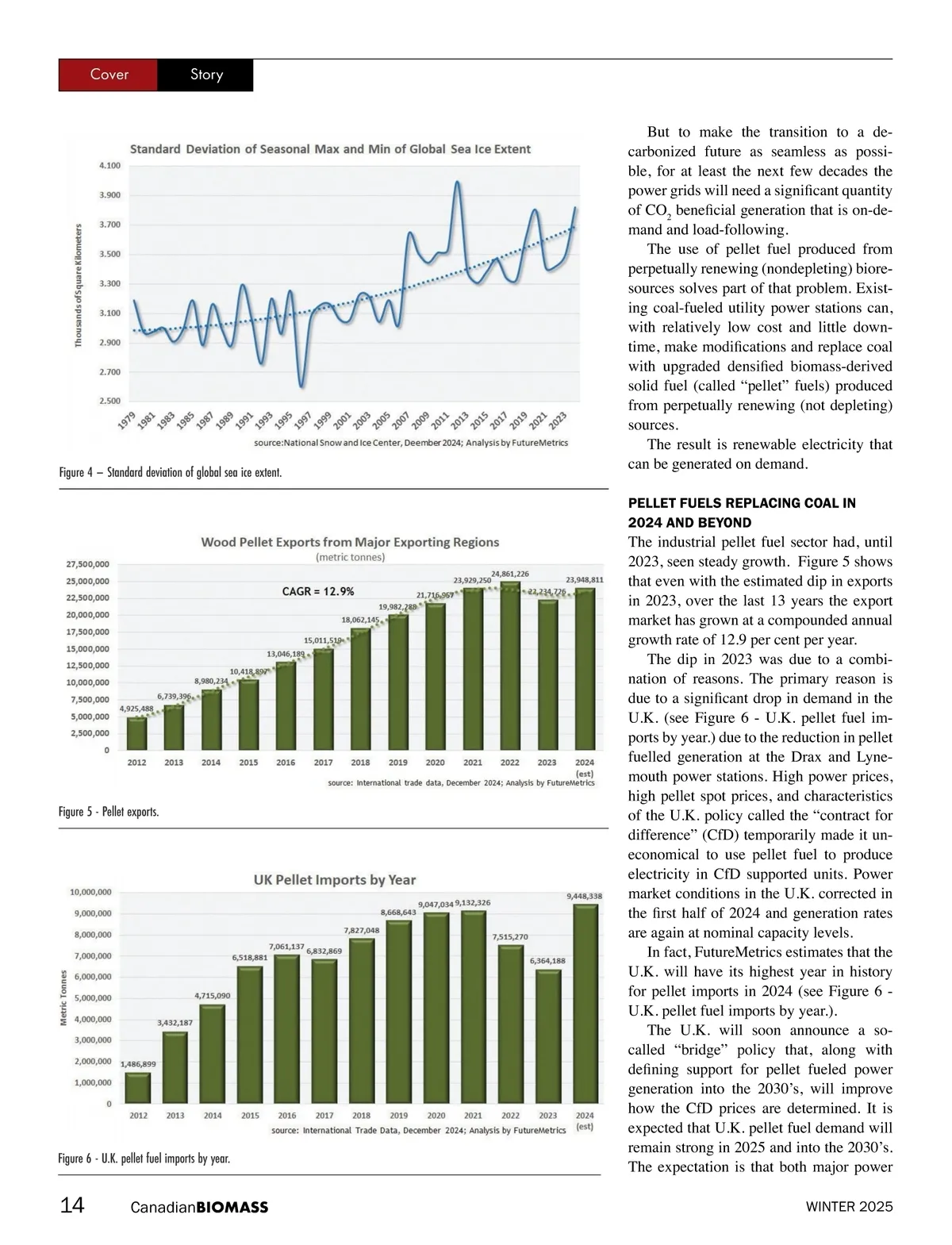
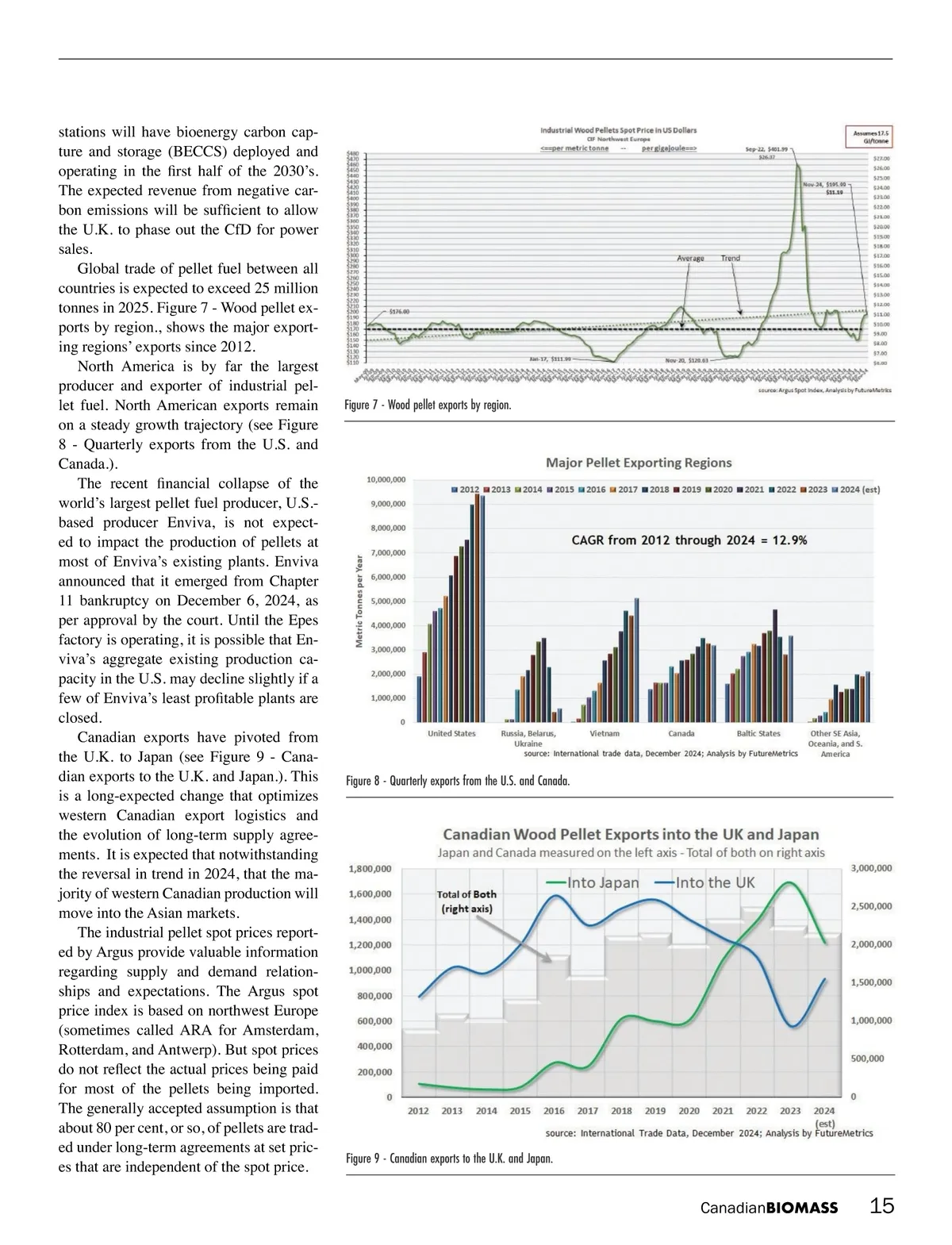
Cover Story But to make the transition to a de -carbonized future as seamless as possi -ble, for at least the next few decades the power grids will need a significant quantity of CO 2 beneficial generation that is on-de -mand and load-following. The use of pellet fuel produced from perpetually renewing (nondepleting) biore -sources solves part of that problem. Exist -ing coal-fueled utility power stations can, with relatively low cost and little down -time, make modifications and replace coal with upgraded densified biomass-derived solid fuel (called “pellet” fuels) produced from perpetually renewing (not depleting) sources. The result is renewable electricity that can be generated on demand. PELLET FUELS REPLACING COAL IN 2024 AND BEYOND Figure 4 – Standard deviation of global sea ice extent. Figure 5 -Pellet exports. Figure 6 -U.K. pellet fuel imports by year. The industrial pellet fuel sector had, until 2023, seen steady growth. Figure 5 shows that even with the estimated dip in exports in 2023, over the last 13 years the export market has grown at a compounded annual growth rate of 12.9 per cent per year. The dip in 2023 was due to a combi -nation of reasons. The primary reason is due to a significant drop in demand in the U.K. (see Figure 6 -U.K. pellet fuel im -ports by year.) due to the reduction in pellet fuelled generation at the Drax and Lyne -mouth power stations. High power prices, high pellet spot prices, and characteristics of the U.K. policy called the “contract for difference” (CfD) temporarily made it un -economical to use pellet fuel to produce electricity in CfD supported units. Power market conditions in the U.K. corrected in the first half of 2024 and generation rates are again at nominal capacity levels. In fact, FutureMetrics estimates that the U.K. will have its highest year in history for pellet imports in 2024 (see Figure 6 -U.K. pellet fuel imports by year.). The U.K. will soon announce a so-called “bridge” policy that, along with defining support for pellet fueled power generation into the 2030’s, will improve how the CfD prices are determined. It is expected that U.K. pellet fuel demand will remain strong in 2025 and into the 2030’s. The expectation is that both major power WINTER 2025 14 Canadian BIOMASS
Canadian Biomass Winter 2025: Page 14