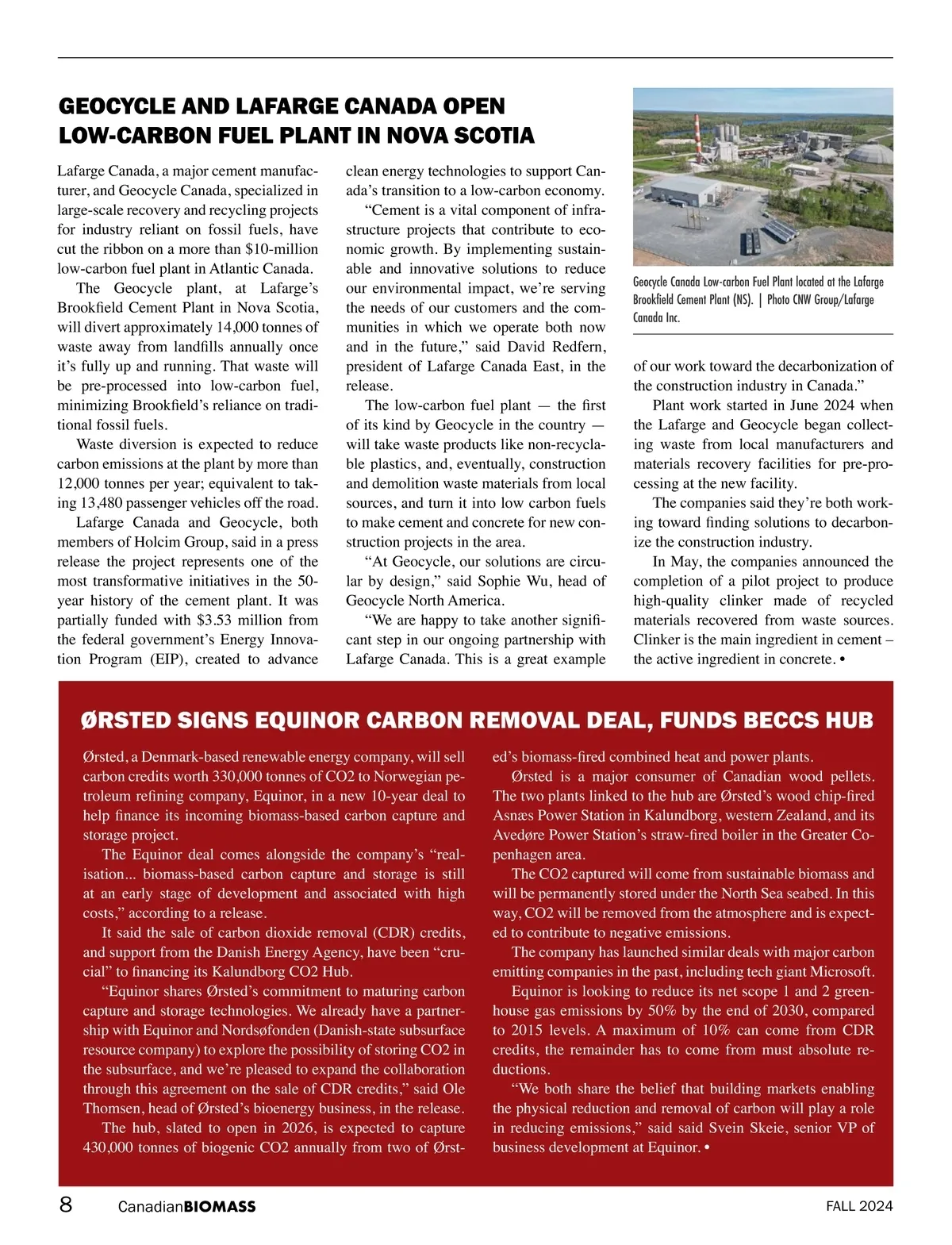
GEOCYCLE AND LAFARGE CANADA OPEN LOW-CARBON FUEL PLANT IN NOVA SCOTIA Lafarge Canada, a major cement manufac-turer, and Geocycle Canada, specialized in large-scale recovery and recycling projects for industry reliant on fossil fuels, have cut the ribbon on a more than $10-million low-carbon fuel plant in Atlantic Canada. The Geocycle plant, at Lafarge’s Brookfield Cement Plant in Nova Scotia, will divert approximately 14,000 tonnes of waste away from landfills annually once it’s fully up and running. That waste will be pre-processed into low-carbon fuel, minimizing Brookfield’s reliance on tradi -tional fossil fuels. Waste diversion is expected to reduce carbon emissions at the plant by more than 12,000 tonnes per year; equivalent to tak-ing 13,480 passenger vehicles off the road. Lafarge Canada and Geocycle, both members of Holcim Group, said in a press release the project represents one of the most transformative initiatives in the 50-year history of the cement plant. It was partially funded with $3.53 million from the federal government’s Energy Innova-tion Program (EIP), created to advance clean energy technologies to support Can-ada’s transition to a low-carbon economy. “Cement is a vital component of infra-structure projects that contribute to eco-nomic growth. By implementing sustain-able and innovative solutions to reduce our environmental impact, we’re serving the needs of our customers and the com-munities in which we operate both now and in the future,” said David Redfern, president of Lafarge Canada East, in the release. The low-carbon fuel plant — the first of its kind by Geocycle in the country — will take waste products like non-recycla-ble plastics, and, eventually, construction and demolition waste materials from local sources, and turn it into low carbon fuels to make cement and concrete for new con-struction projects in the area. “At Geocycle, our solutions are circu-lar by design,” said Sophie Wu, head of Geocycle North America. “We are happy to take another signifi -cant step in our ongoing partnership with Lafarge Canada. This is a great example Geocycle Canada Low-carbon Fuel Plant located at the Lafarge Brookfield Cement Plant (NS). | Photo CNW Group/Lafarge Canada Inc. of our work toward the decarbonization of the construction industry in Canada.” Plant work started in June 2024 when the Lafarge and Geocycle began collect-ing waste from local manufacturers and materials recovery facilities for pre-pro-cessing at the new facility. The companies said they’re both work-ing toward finding solutions to decarbon -ize the construction industry. In May, the companies announced the completion of a pilot project to produce high-quality clinker made of recycled materials recovered from waste sources. Clinker is the main ingredient in cement – the active ingredient in concrete. • ØRSTED SIGNS EQUINOR CARBON REMOVAL DEAL, FUNDS BECCS HUB Ørsted, a Denmark-based renewable energy company, will sell carbon credits worth 330,000 tonnes of CO2 to Norwegian pe-troleum refining company, Equinor, in a new 10-year deal to help finance its incoming biomass-based carbon capture and HEADING GOES HERE storage project. The Equinor deal comes on alongside “real-The Ontario government March the 28 company’s announced a isation... biomass-based capture and storage is still $682,529 investment in carbon six economic development projects at in an early Ont., stage of development associated with high Hearst, including $35,808 and for wood pellet producer costs,” according to a release. I.C.S. (Lacroix) Lumber. It said sale of I.C.S. carbon dioxide removal (CDR) credits, The funds the will help (Lacroix) purchase new equipment and support from the Danish Energy Agency, have been “cru-that will help it increase its production capacity and expand cial” to financing its Kalundborg CO2 Hub. operations. “Equinor shares Ørsted’s partnerships commitment to are maturing carbon “Through the collaborative we announcing capture storage technologies. We already have a contin-partner-today, and our government is ensuring Hearst’s economy ship Equinor and Nordsøfonden (Danish-state ues with to grow,” said Greg Rickford, Ontario Minister subsurface of North-resource company) Mines, to explore the possibility of storing CO2 in ern Development, Natural Resources and Forestry, in a the subsurface, and we’re expand the collaboration statement. “By investing in pleased projects to from varied sectors, we are through this a agreement on the sale of CDR credits,” said Ole promoting more diverse, dynamic and innovative economic Thomsen, climate.” head of Ørsted’s bioenergy business, in the release. The (Lacroix) hub, slated to open in 2026, is expected to capture I.C.S. produces premium wood pellets under the 430,000 tonnes of biogenic CO2 annually from two of Ørst-LacWood brand. ed’s biomass-fired combined heat and power plants. Ørsted is a major consumer of Canadian wood pellets. The two plants linked to the hub are Ørsted’s wood chip-fired Asnæs Power Station in Kalundborg, western Zealand, and its Avedøre Power Station’s straw-fired boiler in the Greater Co -penhagen area. The CO2 captured will come from sustainable biomass and will be permanently stored under the North Sea seabed. In this way, CO2 will be removed from the atmosphere and is expect-ed to contribute to negative emissions. The company has launched similar deals with major carbon emitting companies in the past, including tech giant Microsoft. Equinor is looking to reduce its net scope 1 and 2 green-house gas emissions by 50% by the end of 2030, compared to 2015 levels. A maximum of 10% can come from CDR credits, the remainder has to come from must absolute re-ductions. “We both share the belief that building markets enabling the physical reduction and removal of carbon will play a role in reducing emissions,” said said Svein Skeie, senior VP of business development at Equinor. • FALL 2024 8 Canadian BIOMASS
Canadian Biomass Fall 2024: Page 8