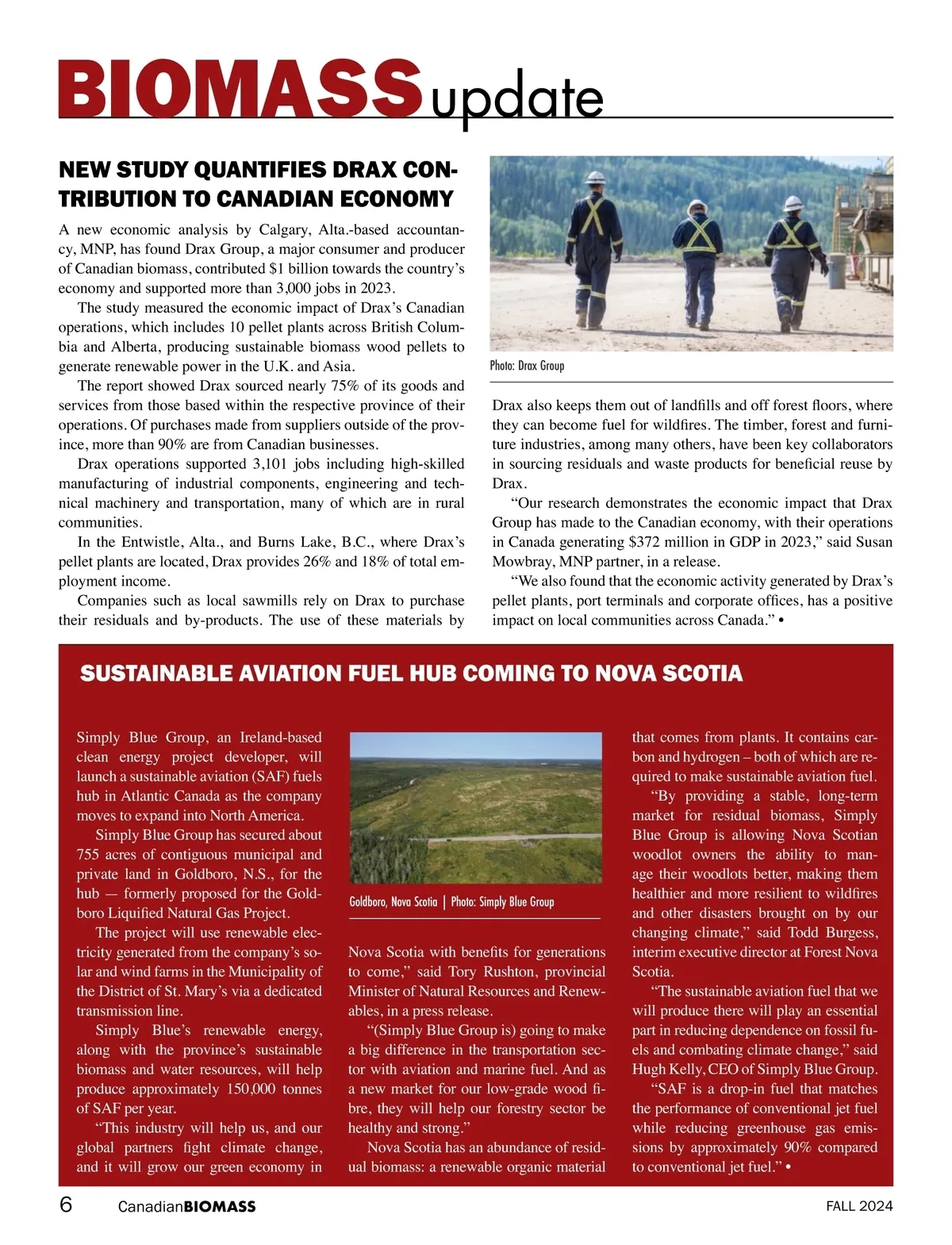
NEW STUDY QUANTIFIES DRAX CON-TRIBUTION TO CANADIAN ECONOMY A new economic analysis by Calgary, Alta.-based accountan-cy, MNP, has found Drax Group, a major consumer and producer of Canadian biomass, contributed $1 billion towards the country’s economy and supported more than 3,000 jobs in 2023. The study measured the economic impact of Drax’s Canadian operations, which includes 10 pellet plants across British Colum-bia and Alberta, producing sustainable biomass wood pellets to generate renewable power in the U.K. and Asia. The report showed Drax sourced nearly 75% of its goods and services from those based within the respective province of their operations. Of purchases made from suppliers outside of the prov-ince, more than 90% are from Canadian businesses. Drax operations supported 3,101 jobs including high-skilled manufacturing of industrial components, engineering and tech-nical machinery and transportation, many of which are in rural communities. In the Entwistle, Alta., and Burns Lake, B.C., where Drax’s pellet plants are located, Drax provides 26% and 18% of total em-ployment income. Companies such as local sawmills rely on Drax to purchase their residuals and by-products. The use of these materials by Photo: Drax Group Drax also keeps them out of landfills and off forest floors, where they can become fuel for wildfires. The timber, forest and furni -ture industries, among many others, have been key collaborators in sourcing residuals and waste products for beneficial reuse by Drax. “Our research demonstrates the economic impact that Drax Group has made to the Canadian economy, with their operations in Canada generating $372 million in GDP in 2023,” said Susan Mowbray, MNP partner, in a release. “We also found that the economic activity generated by Drax’s pellet plants, port terminals and corporate offices, has a positive impact on local communities across Canada.” • SUSTAINABLE AVIATION FUEL HUB COMING TO NOVA SCOTIA Simply Blue Group, an Ireland-based clean energy project developer, will launch a sustainable aviation (SAF) fuels hub in Atlantic Canada as the company moves to expand into North America. Simply Blue Group has secured about 755 acres of contiguous municipal and private land in Goldboro, N.S., for the hub — formerly proposed for the Gold-boro Liquified Natural Gas Project. The project will use renewable elec-tricity generated from the company’s so-lar and wind farms in the Municipality of the District of St. Mary’s via a dedicated transmission line. Simply Blue’s renewable energy, along with the province’s sustainable biomass and water resources, will help produce approximately 150,000 tonnes of SAF per year. “This industry will help us, and our global partners fight climate change, and it will grow our green economy in that comes from plants. It contains car-bon and hydrogen – both of which are re-quired to make sustainable aviation fuel. “By providing a stable, long-term market for residual biomass, Simply Blue Group is allowing Nova Scotian woodlot owners the ability to man-age their woodlots better, making them healthier and more resilient to wildfires and other disasters brought on by our changing climate,” said Todd Burgess, interim executive director at Forest Nova Scotia. “The sustainable aviation fuel that we will produce there will play an essential part in reducing dependence on fossil fu-els and combating climate change,” said Hugh Kelly, CEO of Simply Blue Group. “SAF is a drop-in fuel that matches the performance of conventional jet fuel while reducing greenhouse gas emis-sions by approximately 90% compared to conventional jet fuel.” • FALL 2024 Goldboro, Nova Scotia | Photo: Simply Blue Group Nova Scotia with benefits for generations to come,” said Tory Rushton, provincial Minister of Natural Resources and Renew-ables, in a press release. “(Simply Blue Group is) going to make a big difference in the transportation sec-tor with aviation and marine fuel. And as a new market for our low-grade wood fi -bre, they will help our forestry sector be healthy and strong.” Nova Scotia has an abundance of resid-ual biomass: a renewable organic material 6 Canadian BIOMASS
Canadian Biomass Fall 2024: Page 6