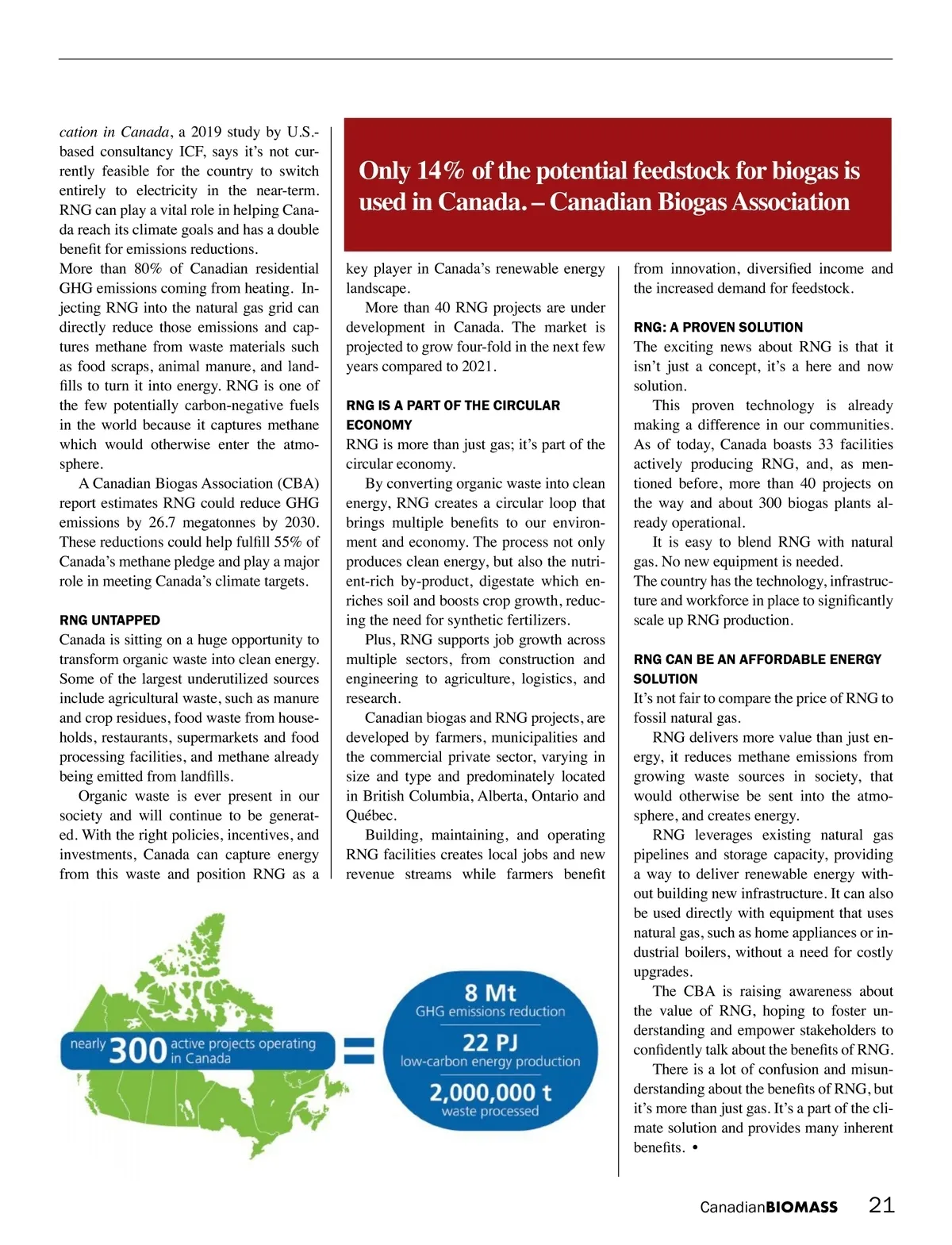
cation in Canada , a 2019 study by U.S.-based consultancy ICF, says it’s not cur-rently feasible for the country to switch entirely to electricity in the near-term. RNG can play a vital role in helping Cana-da reach its climate goals and has a double benefit for emissions reductions. More than 80% of Canadian residential GHG emissions coming from heating. In-jecting RNG into the natural gas grid can directly reduce those emissions and cap-tures methane from waste materials such as food scraps, animal manure, and land-fills to turn it into energy. RNG is one of the few potentially carbon-negative fuels in the world because it captures methane which would otherwise enter the atmo-sphere. A Canadian Biogas Association (CBA) report estimates RNG could reduce GHG emissions by 26.7 megatonnes by 2030. These reductions could help fulfill 55% of Canada’s methane pledge and play a major role in meeting Canada’s climate targets. RNG UNTAPPED Only 14% of the potential feedstock for biogas is used in Canada. – Canadian Biogas Association key player in Canada’s renewable energy landscape. More than 40 RNG projects are under development in Canada. The market is projected to grow four-fold in the next few years compared to 2021. RNG IS A PART OF THE CIRCULAR ECONOMY from innovation, diversified income and the increased demand for feedstock. RNG: A PROVEN SOLUTION Canada is sitting on a huge opportunity to transform organic waste into clean energy. Some of the largest underutilized sources include agricultural waste, such as manure and crop residues, food waste from house-holds, restaurants, supermarkets and food processing facilities, and methane already being emitted from landfills. Organic waste is ever present in our society and will continue to be generat-ed. With the right policies, incentives, and investments, Canada can capture energy from this waste and position RNG as a RNG is more than just gas; it’s part of the circular economy. By converting organic waste into clean energy, RNG creates a circular loop that brings multiple benefits to our environ -ment and economy. The process not only produces clean energy, but also the nutri-ent-rich by-product, digestate which en-riches soil and boosts crop growth, reduc-ing the need for synthetic fertilizers. Plus, RNG supports job growth across multiple sectors, from construction and engineering to agriculture, logistics, and research. Canadian biogas and RNG projects, are developed by farmers, municipalities and the commercial private sector, varying in size and type and predominately located in British Columbia, Alberta, Ontario and Québec. Building, maintaining, and operating RNG facilities creates local jobs and new revenue streams while farmers benefit The exciting news about RNG is that it isn’t just a concept, it’s a here and now solution. This proven technology is already making a difference in our communities. As of today, Canada boasts 33 facilities actively producing RNG, and, as men-tioned before, more than 40 projects on the way and about 300 biogas plants al-ready operational. It is easy to blend RNG with natural gas. No new equipment is needed. The country has the technology, infrastruc-ture and workforce in place to significantly scale up RNG production. RNG CAN BE AN AFFORDABLE ENERGY SOLUTION It’s not fair to compare the price of RNG to fossil natural gas. RNG delivers more value than just en-ergy, it reduces methane emissions from growing waste sources in society, that would otherwise be sent into the atmo-sphere, and creates energy. RNG leverages existing natural gas pipelines and storage capacity, providing a way to deliver renewable energy with-out building new infrastructure. It can also be used directly with equipment that uses natural gas, such as home appliances or in-dustrial boilers, without a need for costly upgrades. The CBA is raising awareness about the value of RNG, hoping to foster un-derstanding and empower stakeholders to confidently talk about the benefits of RNG. There is a lot of confusion and misun-derstanding about the benefits of RNG, but it’s more than just gas. It’s a part of the cli-mate solution and provides many inherent benefits. • Canadian BIOMASS 21
Canadian Biomass Fall 2024: Page 21