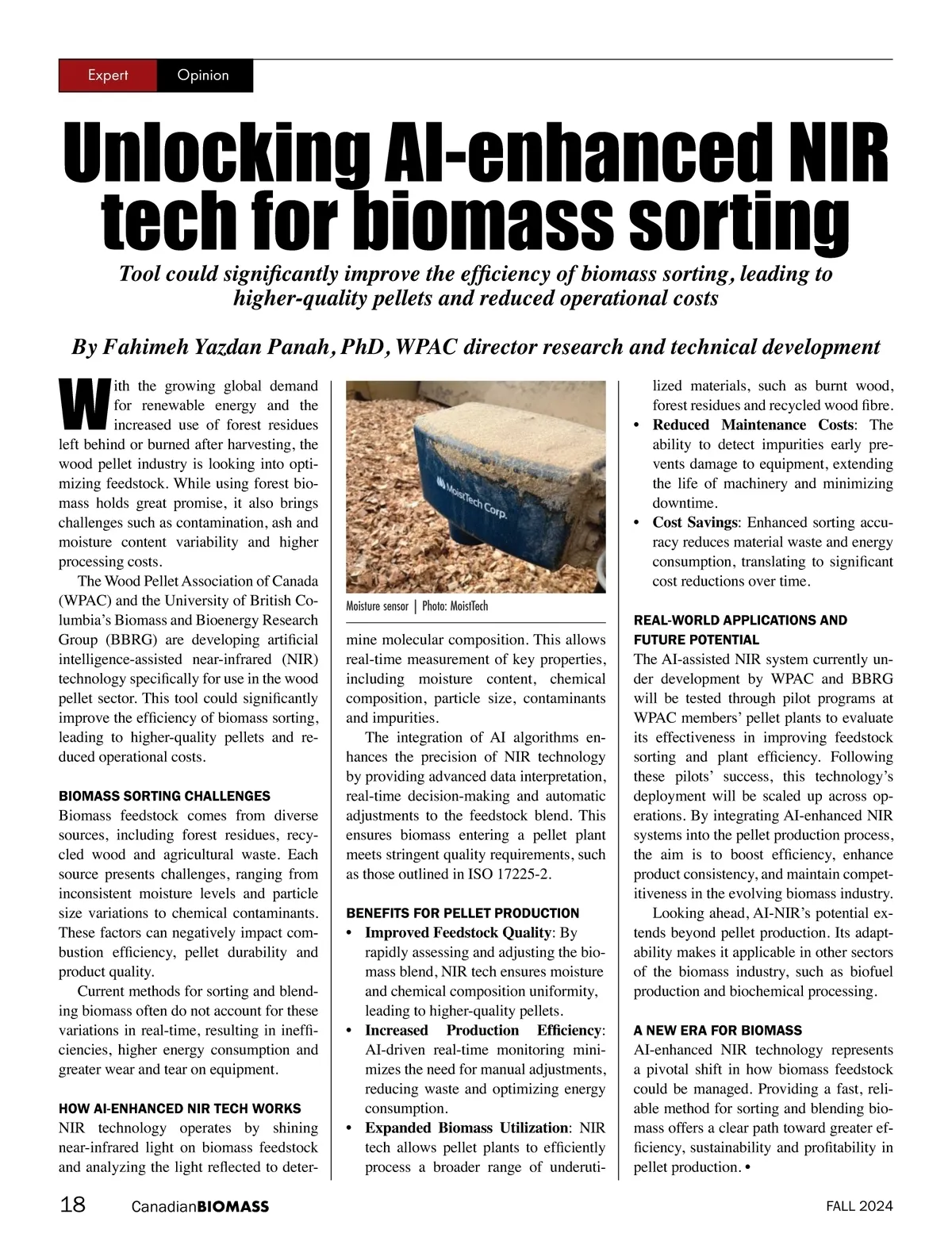
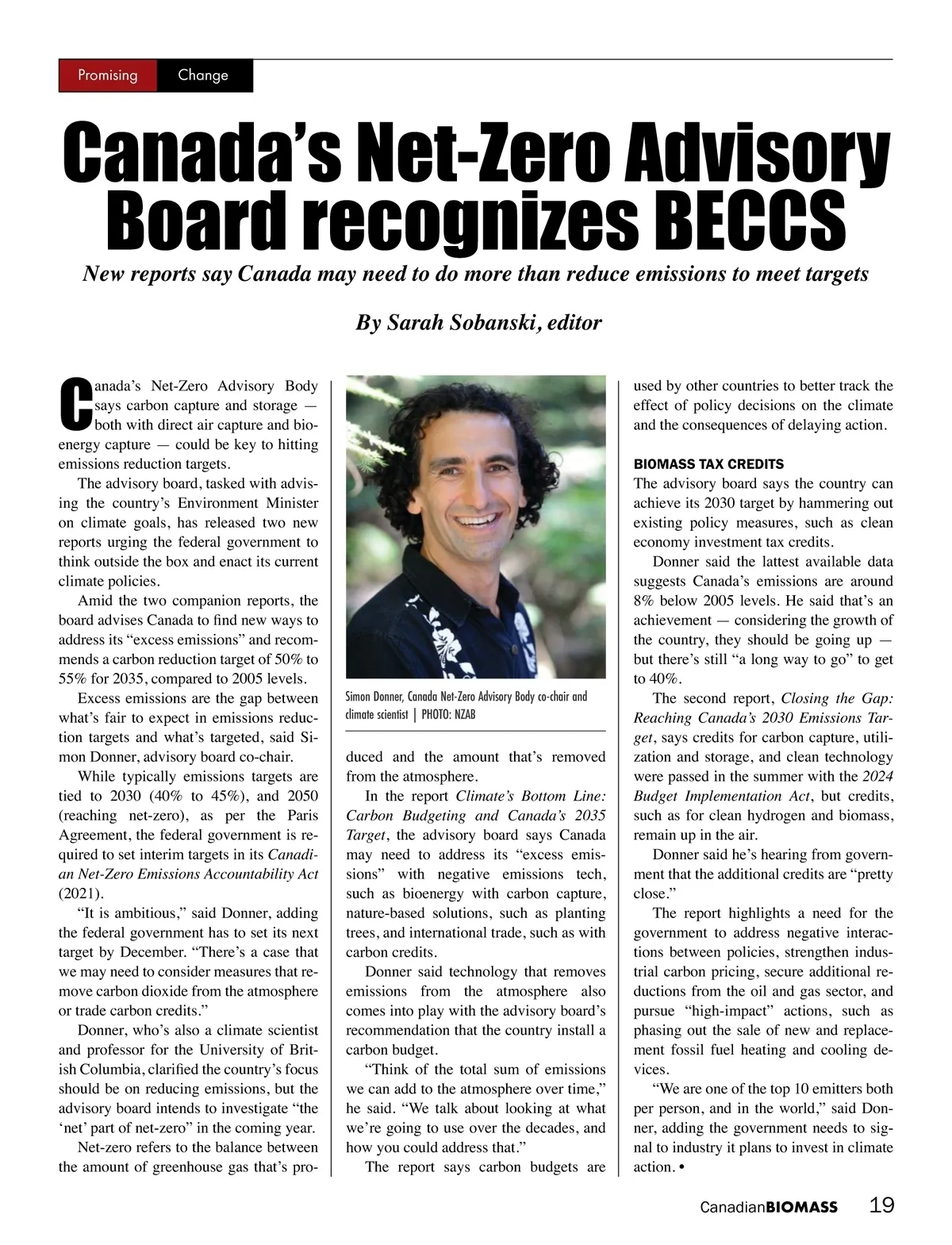
Promising Change Canada’s Net-Zero Advisory Board recognizes BECCS New reports say Canada may need to do more than reduce emissions to meet targets By Sarah Sobanski, editor C anada’s Net-Zero Advisory Body says carbon capture and storage — both with direct air capture and bio-energy capture — could be key to hitting emissions reduction targets. The advisory board, tasked with advis-ing the country’s Environment Minister on climate goals, has released two new reports urging the federal government to think outside the box and enact its current climate policies. Amid the two companion reports, the board advises Canada to find new ways to address its “excess emissions” and recom-mends a carbon reduction target of 50% to 55% for 2035, compared to 2005 levels. Excess emissions are the gap between what’s fair to expect in emissions reduc-tion targets and what’s targeted, said Si-mon Donner, advisory board co-chair. While typically emissions targets are tied to 2030 (40% to 45%), and 2050 (reaching net-zero), as per the Paris Agreement, the federal government is re-quired to set interim targets in its Canadi-an Net-Zero Emissions Accountability Act (2021). “It is ambitious,” said Donner, adding the federal government has to set its next target by December. “There’s a case that we may need to consider measures that re-move carbon dioxide from the atmosphere or trade carbon credits.” Donner, who’s also a climate scientist and professor for the University of Brit-ish Columbia, clarified the country’s focus should be on reducing emissions, but the advisory board intends to investigate “the ‘net’ part of net-zero” in the coming year. Net-zero refers to the balance between the amount of greenhouse gas that’s pro-used by other countries to better track the effect of policy decisions on the climate and the consequences of delaying action. BIOMASS TAX CREDITS Simon Donner, Canada Net-Zero Advisory Body co-chair and climate scientist | PHOTO: NZAB duced and the amount that’s removed from the atmosphere. In the report Climate’s Bottom Line: Carbon Budgeting and Canada’s 2035 Target , the advisory board says Canada may need to address its “excess emis-sions” with negative emissions tech, such as bioenergy with carbon capture, nature-based solutions, such as planting trees, and international trade, such as with carbon credits. Donner said technology that removes emissions from the atmosphere also comes into play with the advisory board’s recommendation that the country install a carbon budget. “Think of the total sum of emissions we can add to the atmosphere over time,” he said. “We talk about looking at what we’re going to use over the decades, and how you could address that.” The report says carbon budgets are The advisory board says the country can achieve its 2030 target by hammering out existing policy measures, such as clean economy investment tax credits. Donner said the lattest available data suggests Canada’s emissions are around 8% below 2005 levels. He said that’s an achievement — considering the growth of the country, they should be going up — but there’s still “a long way to go” to get to 40%. The second report, Closing the Gap: Reaching Canada’s 2030 Emissions Tar-get , says credits for carbon capture, utili-zation and storage, and clean technology were passed in the summer with the 2024 Budget Implementation Act , but credits, such as for clean hydrogen and biomass, remain up in the air. Donner said he’s hearing from govern-ment that the additional credits are “pretty close.” The report highlights a need for the government to address negative interac-tions between policies, strengthen indus-trial carbon pricing, secure additional re-ductions from the oil and gas sector, and pursue “high-impact” actions, such as phasing out the sale of new and replace-ment fossil fuel heating and cooling de-vices. “We are one of the top 10 emitters both per person, and in the world,” said Don-ner, adding the government needs to sig-nal to industry it plans to invest in climate action. • Canadian BIOMASS 19
Canadian Biomass Fall 2024: Page 19