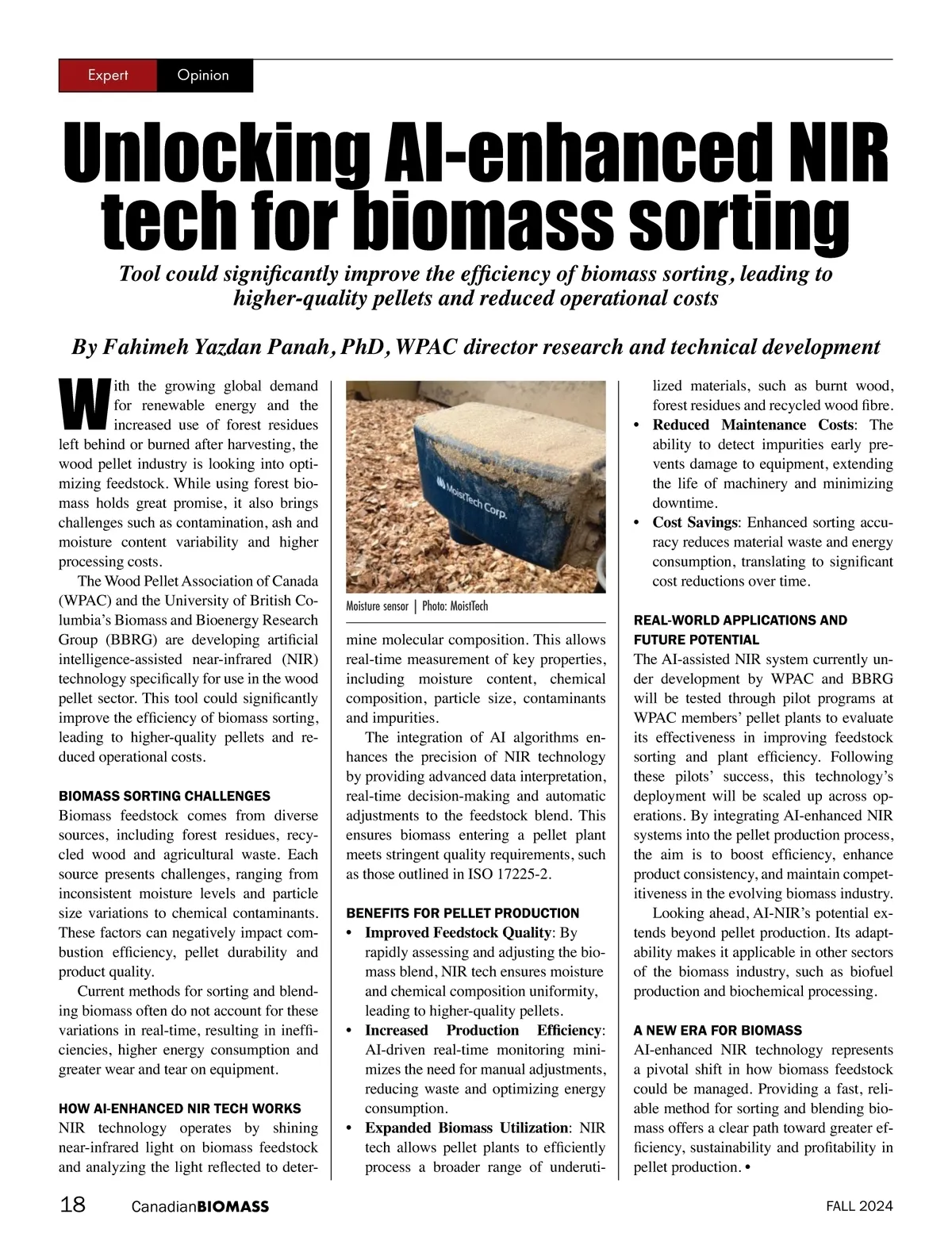
Expert Opinion Unlocking AI-enhanced NIR tech for biomass sorting Tool could significantly improve the efficiency of biomass sorting, leading to higher-quality pellets and reduced operational costs W By Fahimeh Yazdan Panah, PhD, WPAC director research and technical development lized materials, such as burnt wood, forest residues and recycled wood fibre. • Reduced Maintenance Costs : The ability to detect impurities early pre-vents damage to equipment, extending the life of machinery and minimizing downtime. • Cost Savings : Enhanced sorting accu-racy reduces material waste and energy consumption, translating to significant cost reductions over time. Moisture sensor | Photo: MoistTech ith the growing global demand for renewable energy and the increased use of forest residues left behind or burned after harvesting, the wood pellet industry is looking into opti-mizing feedstock. While using forest bio-mass holds great promise, it also brings challenges such as contamination, ash and moisture content variability and higher processing costs. The Wood Pellet Association of Canada (WPAC) and the University of British Co-lumbia’s Biomass and Bioenergy Research Group (BBRG) are developing artificial intelligence-assisted near-infrared (NIR) technology specifically for use in the wood pellet sector. This tool could significantly improve the efficiency of biomass sorting, leading to higher-quality pellets and re-duced operational costs. BIOMASS SORTING CHALLENGES Biomass feedstock comes from diverse sources, including forest residues, recy-cled wood and agricultural waste. Each source presents challenges, ranging from inconsistent moisture levels and particle size variations to chemical contaminants. These factors can negatively impact com-bustion efficiency, pellet durability and product quality. Current methods for sorting and blend-ing biomass often do not account for these variations in real-time, resulting in ineffi -ciencies, higher energy consumption and greater wear and tear on equipment. HOW AI-ENHANCED NIR TECH WORKS mine molecular composition. This allows real-time measurement of key properties, including moisture content, chemical composition, particle size, contaminants and impurities. The integration of AI algorithms en-hances the precision of NIR technology by providing advanced data interpretation, real-time decision-making and automatic adjustments to the feedstock blend. This ensures biomass entering a pellet plant meets stringent quality requirements, such as those outlined in ISO 17225-2. BENEFITS FOR PELLET PRODUCTION REAL-WORLD APPLICATIONS AND FUTURE POTENTIAL NIR technology operates by shining near-infrared light on biomass feedstock and analyzing the light reflected to deter -• Improved Feedstock Quality : By rapidly assessing and adjusting the bio-mass blend, NIR tech ensures moisture and chemical composition uniformity, leading to higher-quality pellets. • Increased Production Efficiency : AI-driven real-time monitoring mini-mizes the need for manual adjustments, reducing waste and optimizing energy consumption. • Expanded Biomass Utilization : NIR tech allows pellet plants to efficiently process a broader range of underuti-The AI-assisted NIR system currently un-der development by WPAC and BBRG will be tested through pilot programs at WPAC members’ pellet plants to evaluate its effectiveness in improving feedstock sorting and plant efficiency. Following these pilots’ success, this technology’s deployment will be scaled up across op-erations. By integrating AI-enhanced NIR systems into the pellet production process, the aim is to boost efficiency, enhance product consistency, and maintain compet-itiveness in the evolving biomass industry. Looking ahead, AI-NIR’s potential ex-tends beyond pellet production. Its adapt-ability makes it applicable in other sectors of the biomass industry, such as biofuel production and biochemical processing. A NEW ERA FOR BIOMASS AI-enhanced NIR technology represents a pivotal shift in how biomass feedstock could be managed. Providing a fast, reli-able method for sorting and blending bio-mass offers a clear path toward greater ef-ficiency, sustainability and profitability in pellet production. • FALL 2024 18 Canadian BIOMASS
Canadian Biomass Fall 2024: Page 18