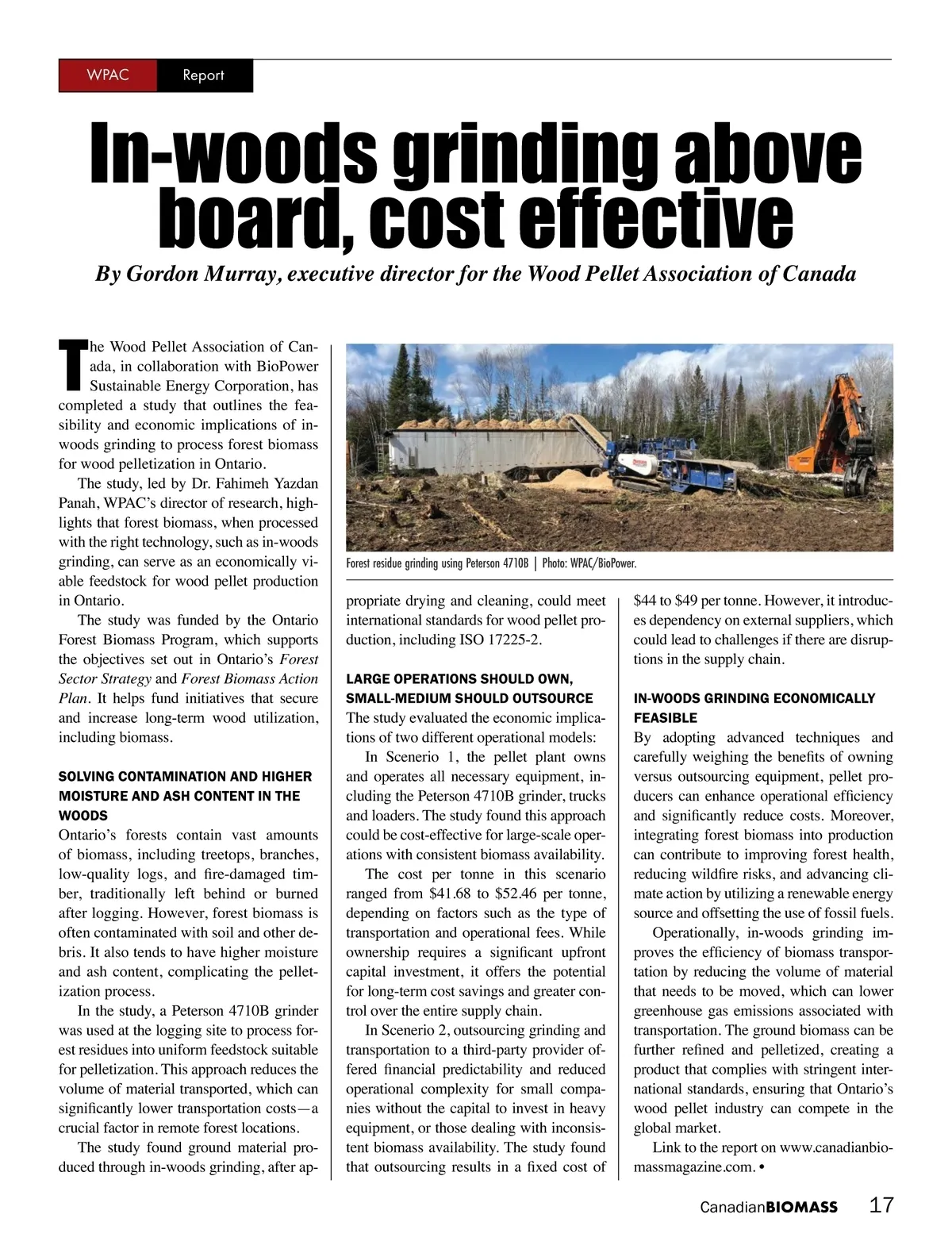
WPAC Report In-woods grinding above board, cost effective By Gordon Murray, executive director for the Wood Pellet Association of Canada he Wood Pellet Association of Can-ada, in collaboration with BioPower Sustainable Energy Corporation, has completed a study that outlines the fea-sibility and economic implications of in-woods grinding to process forest biomass for wood pelletization in Ontario. The study, led by Dr. Fahimeh Yazdan Panah, WPAC’s director of research, high-lights that forest biomass, when processed with the right technology, such as in-woods grinding, can serve as an economically vi-able feedstock for wood pellet production in Ontario. The study was funded by the Ontario Forest Biomass Program, which supports the objectives set out in Ontario’s Forest Sector Strategy and Forest Biomass Action Plan . It helps fund initiatives that secure and increase long-term wood utilization, including biomass. SOLVING CONTAMINATION AND HIGHER MOISTURE AND ASH CONTENT IN THE WOODS T Forest residue grinding using Peterson 4710B | Photo: WPAC/BioPower. propriate drying and cleaning, could meet international standards for wood pellet pro-duction, including ISO 17225-2. LARGE OPERATIONS SHOULD OWN, SMALL-MEDIUM SHOULD OUTSOURCE $44 to $49 per tonne . However, it introduc-es dependency on external suppliers, which could lead to challenges if there are disrup-tions in the supply chain. IN-WOODS GRINDING ECONOMICALLY FEASIBLE Ontario’s forests contain vast amounts of biomass, including treetops, branches, low-quality logs, and fire-damaged tim -ber, traditionally left behind or burned after logging. However, forest biomass is often contaminated with soil and other de-bris. It also tends to have higher moisture and ash content, complicating the pellet-ization process. In the study, a Peterson 4710B grinder was used at the logging site to process for-est residues into uniform feedstock suitable for pelletization. This approach reduces the volume of material transported, which can significantly lower transportation costs—a crucial factor in remote forest locations. The study found ground material pro-duced through in-woods grinding, after ap-The study evaluated the economic implica-tions of two different operational models: In Scenerio 1, the pellet plant owns and operates all necessary equipment, in-cluding the Peterson 4710B grinder, trucks and loaders. The study found this approach could be cost-effective for large-scale oper-ations with consistent biomass availability. The cost per tonne in this scenario ranged from $41.68 to $52.46 per tonne, depending on factors such as the type of transportation and operational fees . While ownership requires a significant upfront capital investment, it offers the potential for long-term cost savings and greater con-trol over the entire supply chain. In Scenerio 2, outsourcing grinding and transportation to a third-party provider of-fered financial predictability and reduced operational complexity for small compa-nies without the capital to invest in heavy equipment, or those dealing with inconsis-tent biomass availability. The study found that outsourcing results in a fixed cost of By adopting advanced techniques and carefully weighing the benefits of owning versus outsourcing equipment, pellet pro-ducers can enhance operational efficiency and significantly reduce costs. Moreover, integrating forest biomass into production can contribute to improving forest health, reducing wildfire risks, and advancing cli -mate action by utilizing a renewable energy source and offsetting the use of fossil fuels. Operationally, in-woods grinding im-proves the efficiency of biomass transpor -tation by reducing the volume of material that needs to be moved, which can lower greenhouse gas emissions associated with transportation. The ground biomass can be further refined and pelletized, creating a product that complies with stringent inter-national standards, ensuring that Ontario’s wood pellet industry can compete in the global market. Link to the report on www.canadianbio-massmagazine.com. • Canadian BIOMASS 17
Canadian Biomass Fall 2024: Page 17