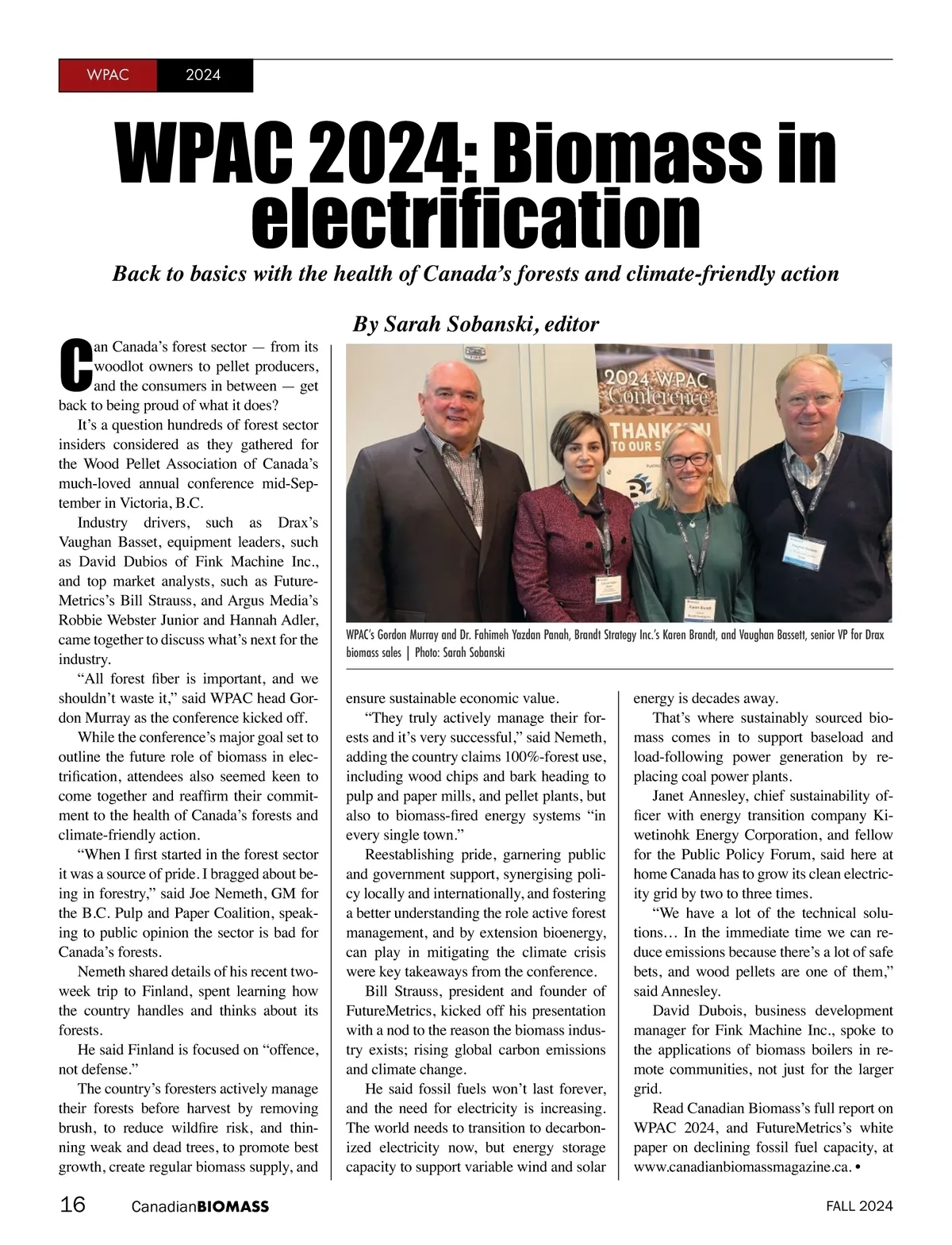
WPAC 2024 Back to basics with the health of Canada’s forests and climate-friendly action WPAC 2024: Biomass in electrification By Sarah Sobanski, editor C an Canada’s forest sector — from its woodlot owners to pellet producers, and the consumers in between — get back to being proud of what it does? It’s a question hundreds of forest sector insiders considered as they gathered for the Wood Pellet Association of Canada’s much-loved annual conference mid-Sep-tember in Victoria, B.C. Industry drivers, such as Drax’s Vaughan Basset, equipment leaders, such as David Dubios of Fink Machine Inc., and top market analysts, such as Future-Metrics’s Bill Strauss, and Argus Media’s Robbie Webster Junior and Hannah Adler, came together to discuss what’s next for the industry. “All forest fiber is important, and we shouldn’t waste it,” said WPAC head Gor-don Murray as the conference kicked off. While the conference’s major goal set to outline the future role of biomass in elec-trification, attendees also seemed keen to come together and reaffirm their commit -ment to the health of Canada’s forests and climate-friendly action. “When I first started in the forest sector it was a source of pride. I bragged about be-ing in forestry,” said Joe Nemeth, GM for the B.C. Pulp and Paper Coalition, speak-ing to public opinion the sector is bad for Canada’s forests. Nemeth shared details of his recent two-week trip to Finland, spent learning how the country handles and thinks about its forests. He said Finland is focused on “offence, not defense.” The country’s foresters actively manage their forests before harvest by removing brush, to reduce wildfire risk, and thin -ning weak and dead trees, to promote best growth, create regular biomass supply, and WPAC’s Gordon Murray and Dr. Fahimeh Yazdan Panah, Brandt Strategy Inc.’s Karen Brandt, and Vaughan Bassett, senior VP for Drax biomass sales | Photo: Sarah Sobanski ensure sustainable economic value. “They truly actively manage their for-ests and it’s very successful,” said Nemeth, adding the country claims 100%-forest use, including wood chips and bark heading to pulp and paper mills, and pellet plants, but also to biomass-fired energy systems “in every single town.” Reestablishing pride, garnering public and government support, synergising poli-cy locally and internationally, and fostering a better understanding the role active forest management, and by extension bioenergy, can play in mitigating the climate crisis were key takeaways from the conference. Bill Strauss, president and founder of FutureMetrics, kicked off his presentation with a nod to the reason the biomass indus-try exists; rising global carbon emissions and climate change. He said fossil fuels won’t last forever, and the need for electricity is increasing. The world needs to transition to decarbon-ized electricity now, but energy storage capacity to support variable wind and solar energy is decades away. That’s where sustainably sourced bio-mass comes in to support baseload and load-following power generation by re-placing coal power plants. Janet Annesley, chief sustainability of-ficer with energy transition company Ki -wetinohk Energy Corporation, and fellow for the Public Policy Forum, said here at home Canada has to grow its clean electric-ity grid by two to three times. “We have a lot of the technical solu-tions… In the immediate time we can re-duce emissions because there’s a lot of safe bets, and wood pellets are one of them,” said Annesley. David Dubois, business development manager for Fink Machine Inc., spoke to the applications of biomass boilers in re-mote communities, not just for the larger grid. Read Canadian Biomass’s full report on WPAC 2024, and FutureMetrics’s white paper on declining fossil fuel capacity, at www.canadianbiomassmagazine.ca. • FALL 2024 16 Canadian BIOMASS
Canadian Biomass Fall 2024: Page 16