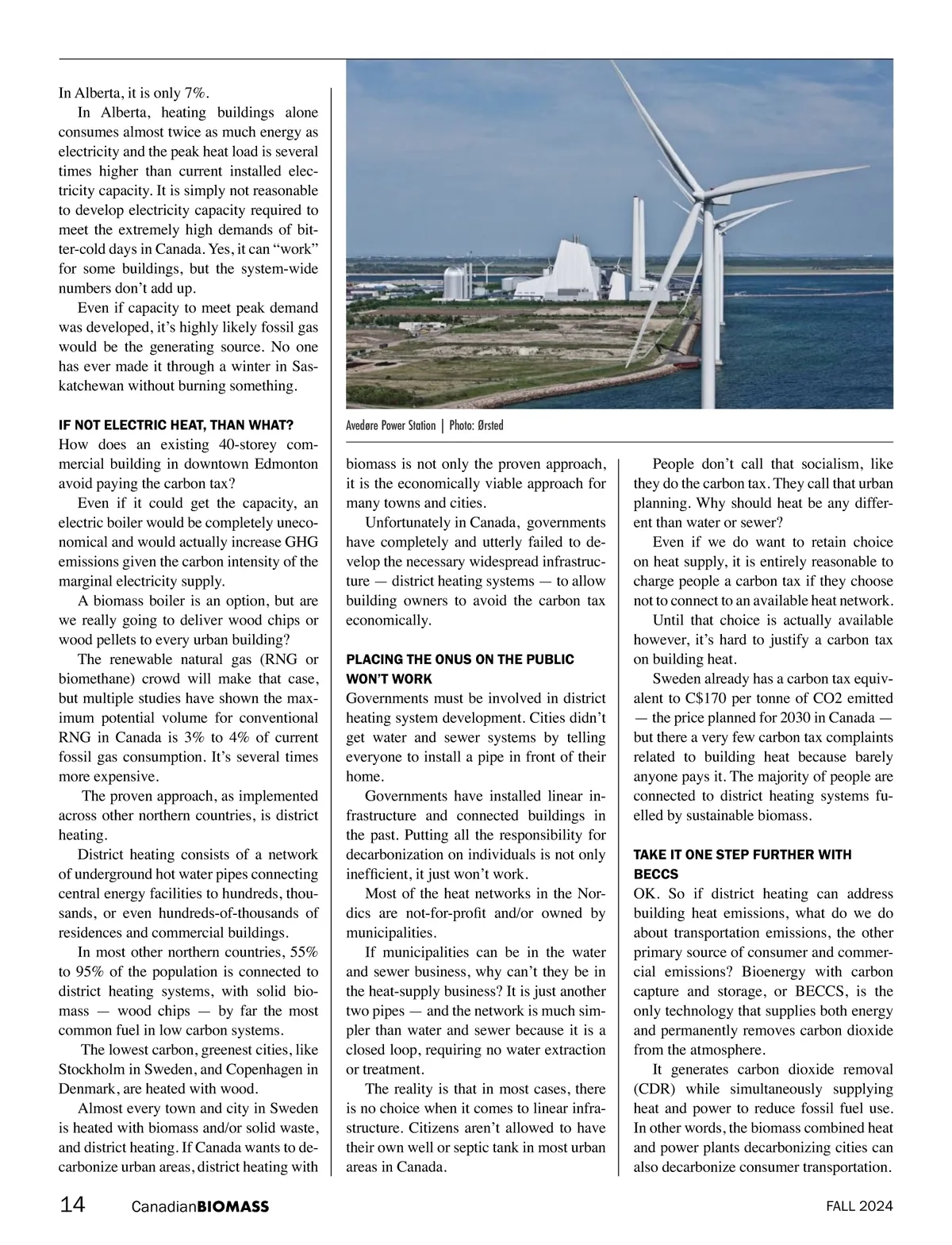
It harnesses the awesome power of plants — principally trees — to store both solar energy and carbon. By adding carbon capture and stor-age to biomass combined heat and power plants, heating (via district heating) and supplying electricity to urban areas, energy supply becomes negative carbon. Is heating cities with wood chips, trans-ported from rural areas, and then captur-ing the CO2 and transporting it for storage 2-to 3 kilometres below the surface of the Earth, too complicated to be implemented? In the Nordics urban biomass combined heat and power plants already exist, and capture additions are in construction. In Copenhagen, tech giant Microsoft has entered into a purchase agreement with renewable energy company, Ørsted, for a large portion of its incoming carbon diox-ide removal credits through a BECCS proj-ect attached to its Avedøre Power Station. Microsoft is targeting zero carbon for its entire history. CO2 will be liquefied and shipped by marine tanker to the North Sea for perma-nent storage below the seabed. Through the sale of CDRs, the local cost of heat and power can actually become lower due to the additional revenue – and income – from CDRs. (See related news Page 8). GOODBYE CARBON TAX, HELLO CARBON REMOVAL CHARGE portation fuels, such as gasoline sold in urban areas where there is a viable com-mercial alternative to gasoline-fuelled in-ternal combustion engine vehicles, such as light-duty electric vehicles. Unlike the carbon tax, which applies to all fuels but does not necessarily lead to a GHG reduction, a Carbon Removal Charge would only be charged in propor-tion to the GHG emissions actually re-moved via BECCS. Ultimately, the CDR industry — as well as the broader carbon capture and storage industry — must be viewed as a garbage disposal service. Paying for garbage removal is some-thing the public understands. It fits with the North American world view of choice, but paying for the consequences. It’s also in stark contrast to policies designed to manipulate behaviour without actually re-ducing emissions. By having a source of revenue for the CO2 (garbage) removal, the BECCS in-dustry can grow. It will be small at first. A microscopic Carbon Removal Charge per litre of gaso-line, because another major problem with the current carbon tax policy design is its rapid pace. Carbon price increases have not been consistent with the rate of vehicle and heating system turnover. Abandoning a three-year-old fossil gas furnace or mini-van is not a realistic option for most Ca-nadians. A Carbon Removal Charge, linked to growth of the domestic BECCS industry, would inherently rise more slowly than the current carbon tax has done and better align with the turnover of vehicles. A Carbon Removal Charge is not a get out of jail free card. It is an econom-ically-efficient means of reducing national fossil fuel emissions while providing crit-ical revenue for biomass combined heat and power plants and linked district heat-ing infrastructure. It would also provide an essential, valu-able market for the low-grade biomass generated by Climate Smart Forestry, ac-tive forest management operations neces-sary to reduce our nation’s largest source of GHG emissions: wildfires. • Canadians must come to grips with the no-tion meeting climate goals will have costs, but higher energy costs are OK if we also have higher income and per capita GDP. Canada can be the world leader in BEC-CS due to its abundant biomass resources, attractive onshore CO2 storage geology, and climate regulations with rule of law. By becoming a BECCS carbon dioxide removal exporter, we can grow the Cana-dian economy and lower the carbon inten-sity of our economically-critical exports of oil, gas, and derivatives. A Canadian BECCS industry must start with the home market, and beyond provin-cial industrial carbon markets, there must be a source of funds to purchase CDRs. Canada needs a Carbon Removal Charge on consumer fossil fuels as a re-alistic and impactful alternative to the car-bon tax. The charge would initially target trans-Combustible Dust Specialists NFPA68 NFPA69 NFPA77 NFPA91 NFPA499 NFPA654 NFPA664 Allied brings 49 years experience to help you meet current NFPA Standards with: system design/documentation, spark detection, isolation, grounding, PLC, venting, blast path management, clean-up systems and duct audits — CWB certified and member SMACNA. Sawmill – Biomass – Boardplants – Pulp & Paper – Power Generation – Mining www.alliedblower.com Phone: 800-576-3611 Surrey,BC Vernon,BC WilliamsLake,BC Edmonton,Alberta PrinceAlbert,Sask Mobile, Alabama 50 years of Industrial Air Systems CFI_AlliedBlower_JanFeb24_MLD.indd 1 Canadian BIOMASS 2024-01-23 1:51 PM 15
Canadian Biomass Fall 2024: Page 15