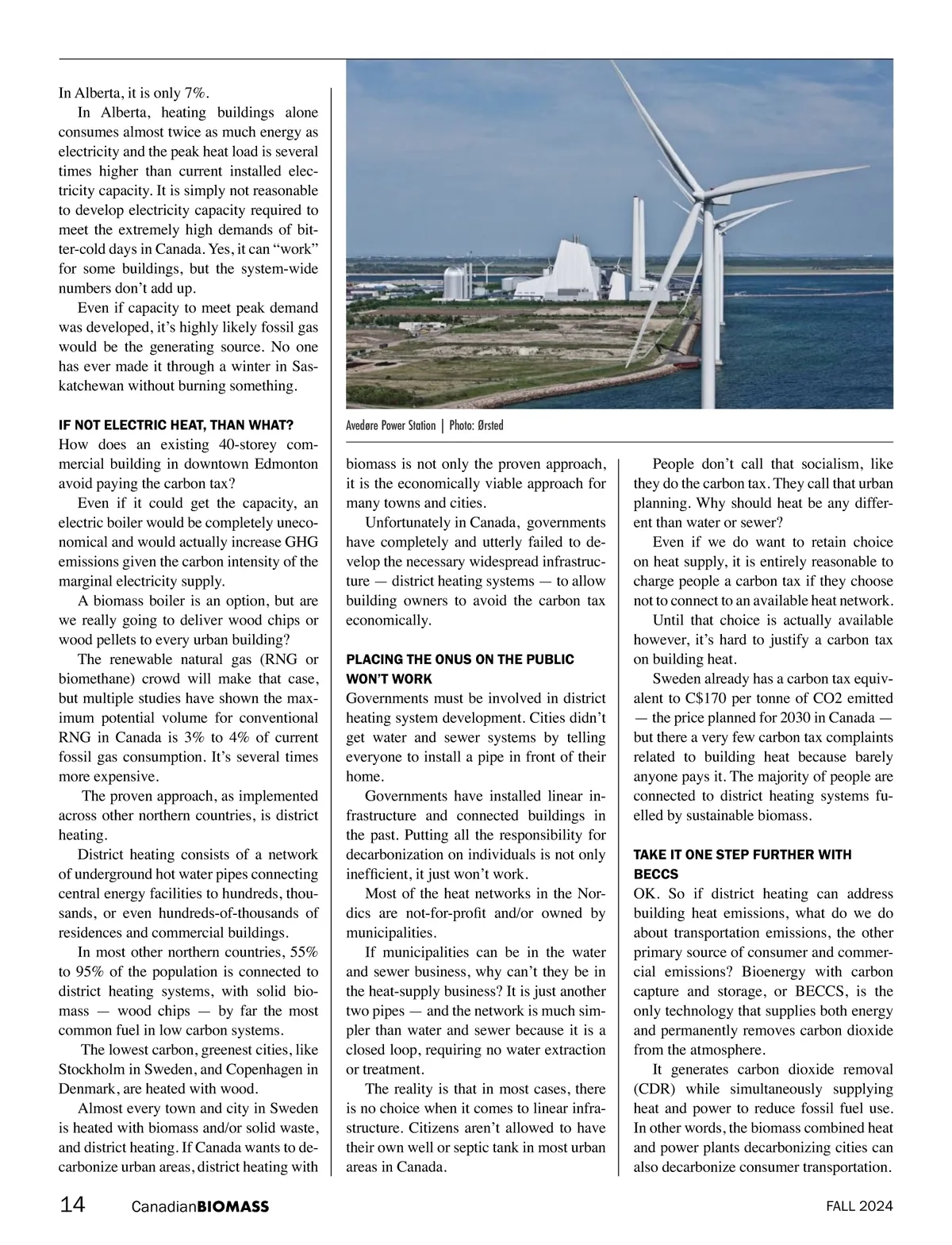
In Alberta, it is only 7%. In Alberta, heating buildings alone consumes almost twice as much energy as electricity and the peak heat load is several times higher than current installed elec-tricity capacity. It is simply not reasonable to develop electricity capacity required to meet the extremely high demands of bit-ter-cold days in Canada. Yes, it can “work” for some buildings, but the system-wide numbers don’t add up. Even if capacity to meet peak demand was developed, it’s highly likely fossil gas would be the generating source. No one has ever made it through a winter in Sas-katchewan without burning something. IF NOT ELECTRIC HEAT, THAN WHAT? How does an existing 40-storey com-mercial building in downtown Edmonton avoid paying the carbon tax? Even if it could get the capacity, an electric boiler would be completely uneco-nomical and would actually increase GHG emissions given the carbon intensity of the marginal electricity supply. A biomass boiler is an option, but are we really going to deliver wood chips or wood pellets to every urban building? The renewable natural gas (RNG or biomethane) crowd will make that case, but multiple studies have shown the max-imum potential volume for conventional RNG in Canada is 3% to 4% of current fossil gas consumption. It’s several times more expensive. The proven approach, as implemented across other northern countries, is district heating. District heating consists of a network of underground hot water pipes connecting central energy facilities to hundreds, thou-sands, or even hundreds-of-thousands of residences and commercial buildings. In most other northern countries, 55% to 95% of the population is connected to district heating systems, with solid bio-mass — wood chips — by far the most common fuel in low carbon systems. The lowest carbon, greenest cities, like Stockholm in Sweden, and Copenhagen in Denmark, are heated with wood. Almost every town and city in Sweden is heated with biomass and/or solid waste, and district heating. If Canada wants to de-carbonize urban areas, district heating with Avedøre Power Station | Photo: Ørsted biomass is not only the proven approach, it is the economically viable approach for many towns and cities. Unfortunately in Canada, governments have completely and utterly failed to de-velop the necessary widespread infrastruc-ture — district heating systems — to allow building owners to avoid the carbon tax economically. PLACING THE ONUS ON THE PUBLIC WON’T WORK Governments must be involved in district heating system development. Cities didn’t get water and sewer systems by telling everyone to install a pipe in front of their home. Governments have installed linear in-frastructure and connected buildings in the past. Putting all the responsibility for decarbonization on individuals is not only inefficient, it just won’t work. Most of the heat networks in the Nor-dics are not-for-profit and/or owned by municipalities. If municipalities can be in the water and sewer business, why can’t they be in the heat-supply business? It is just another two pipes — and the network is much sim-pler than water and sewer because it is a closed loop, requiring no water extraction or treatment. The reality is that in most cases, there is no choice when it comes to linear infra-structure. Citizens aren’t allowed to have their own well or septic tank in most urban areas in Canada. People don’t call that socialism, like they do the carbon tax. They call that urban planning. Why should heat be any differ-ent than water or sewer? Even if we do want to retain choice on heat supply, it is entirely reasonable to charge people a carbon tax if they choose not to connect to an available heat network. Until that choice is actually available however, it’s hard to justify a carbon tax on building heat. Sweden already has a carbon tax equiv-alent to C$170 per tonne of CO2 emitted — the price planned for 2030 in Canada — but there a very few carbon tax complaints related to building heat because barely anyone pays it. The majority of people are connected to district heating systems fu-elled by sustainable biomass. TAKE IT ONE STEP FURTHER WITH BECCS OK. So if district heating can address building heat emissions, what do we do about transportation emissions, the other primary source of consumer and commer-cial emissions? Bioenergy with carbon capture and storage, or BECCS, is the only technology that supplies both energy and permanently removes carbon dioxide from the atmosphere. It generates carbon dioxide removal (CDR) while simultaneously supplying heat and power to reduce fossil fuel use. In other words, the biomass combined heat and power plants decarbonizing cities can also decarbonize consumer transportation. FALL 2024 14 Canadian BIOMASS
Canadian Biomass Fall 2024: Page 14