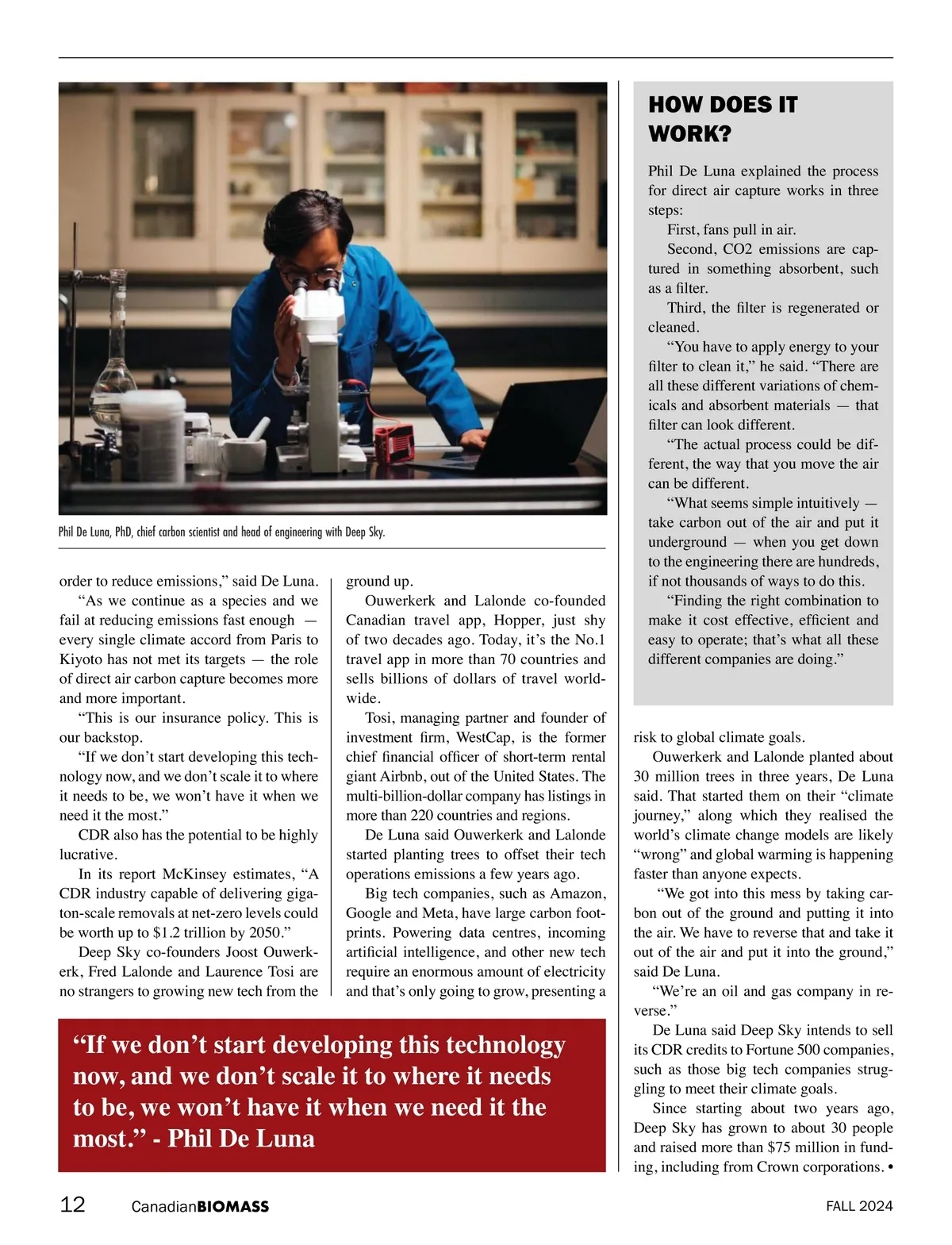
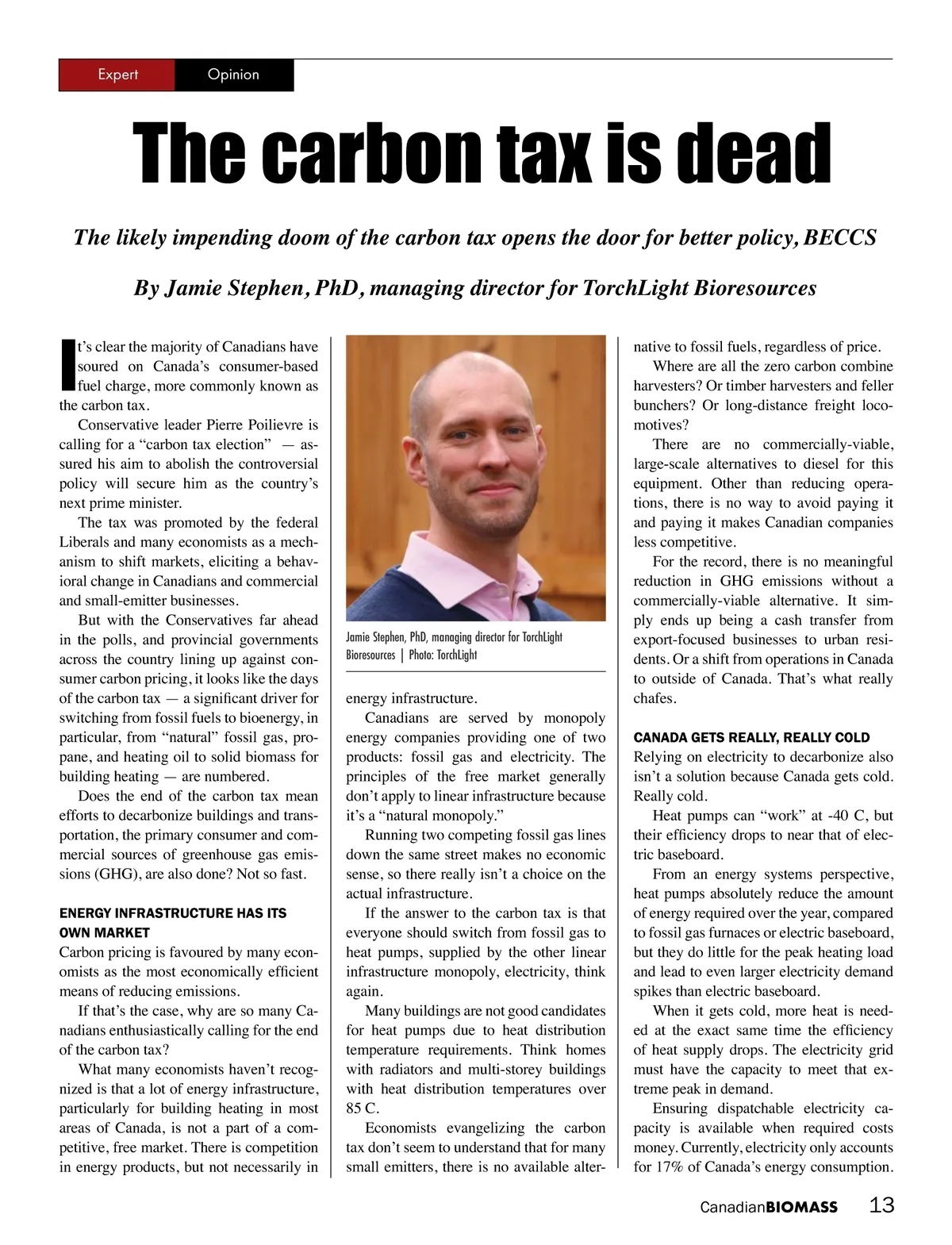
Expert Opinion The carbon tax is dead The likely impending doom of the carbon tax opens the door for better policy, BECCS By Jamie Stephen, PhD, managing director for TorchLight Bioresources t’s clear the majority of Canadians have soured on Canada’s consumer-based fuel charge, more commonly known as the carbon tax. Conservative leader Pierre Poilievre is calling for a “carbon tax election” — as-sured his aim to abolish the controversial policy will secure him as the country’s next prime minister. The tax was promoted by the federal Liberals and many economists as a mech-anism to shift markets, eliciting a behav-ioral change in Canadians and commercial and small-emitter businesses. But with the Conservatives far ahead in the polls, and provincial governments across the country lining up against con-sumer carbon pricing, it looks like the days of the carbon tax — a significant driver for switching from fossil fuels to bioenergy, in particular, from “natural” fossil gas, pro-pane, and heating oil to solid biomass for building heating — are numbered. Does the end of the carbon tax mean efforts to decarbonize buildings and trans-portation, the primary consumer and com-mercial sources of greenhouse gas emis-sions (GHG), are also done? Not so fast. ENERGY INFRASTRUCTURE HAS ITS OWN MARKET I Jamie Stephen, PhD, managing director for TorchLight Bioresources | Photo: TorchLight Carbon pricing is favoured by many econ-omists as the most economically efficient means of reducing emissions. If that’s the case, why are so many Ca-nadians enthusiastically calling for the end of the carbon tax? What many economists haven’t recog-nized is that a lot of energy infrastructure, particularly for building heating in most areas of Canada, is not a part of a com-petitive, free market. There is competition in energy products, but not necessarily in energy infrastructure. Canadians are served by monopoly energy companies providing one of two products: fossil gas and electricity. The principles of the free market generally don’t apply to linear infrastructure because it’s a “natural monopoly.” Running two competing fossil gas lines down the same street makes no economic sense, so there really isn’t a choice on the actual infrastructure. If the answer to the carbon tax is that everyone should switch from fossil gas to heat pumps, supplied by the other linear infrastructure monopoly, electricity, think again. Many buildings are not good candidates for heat pumps due to heat distribution temperature requirements. Think homes with radiators and multi-storey buildings with heat distribution temperatures over 85 C. Economists evangelizing the carbon tax don’t seem to understand that for many small emitters, there is no available alter-native to fossil fuels, regardless of price. Where are all the zero carbon combine harvesters? Or timber harvesters and feller bunchers? Or long-distance freight loco-motives? There are no commercially-viable, large-scale alternatives to diesel for this equipment. Other than reducing opera-tions, there is no way to avoid paying it and paying it makes Canadian companies less competitive. For the record, there is no meaningful reduction in GHG emissions without a commercially-viable alternative. It sim-ply ends up being a cash transfer from export-focused businesses to urban resi-dents. Or a shift from operations in Canada to outside of Canada. That’s what really chafes. CANADA GETS REALLY, REALLY COLD Relying on electricity to decarbonize also isn’t a solution because Canada gets cold. Really cold. Heat pumps can “work” at -40 C, but their efficiency drops to near that of elec -tric baseboard. From an energy systems perspective, heat pumps absolutely reduce the amount of energy required over the year, compared to fossil gas furnaces or electric baseboard, but they do little for the peak heating load and lead to even larger electricity demand spikes than electric baseboard. When it gets cold, more heat is need-ed at the exact same time the efficiency of heat supply drops. The electricity grid must have the capacity to meet that ex-treme peak in demand. Ensuring dispatchable electricity ca-pacity is available when required costs money. Currently, electricity only accounts for 17% of Canada’s energy consumption. Canadian BIOMASS 13
Canadian Biomass Fall 2024: Page 13