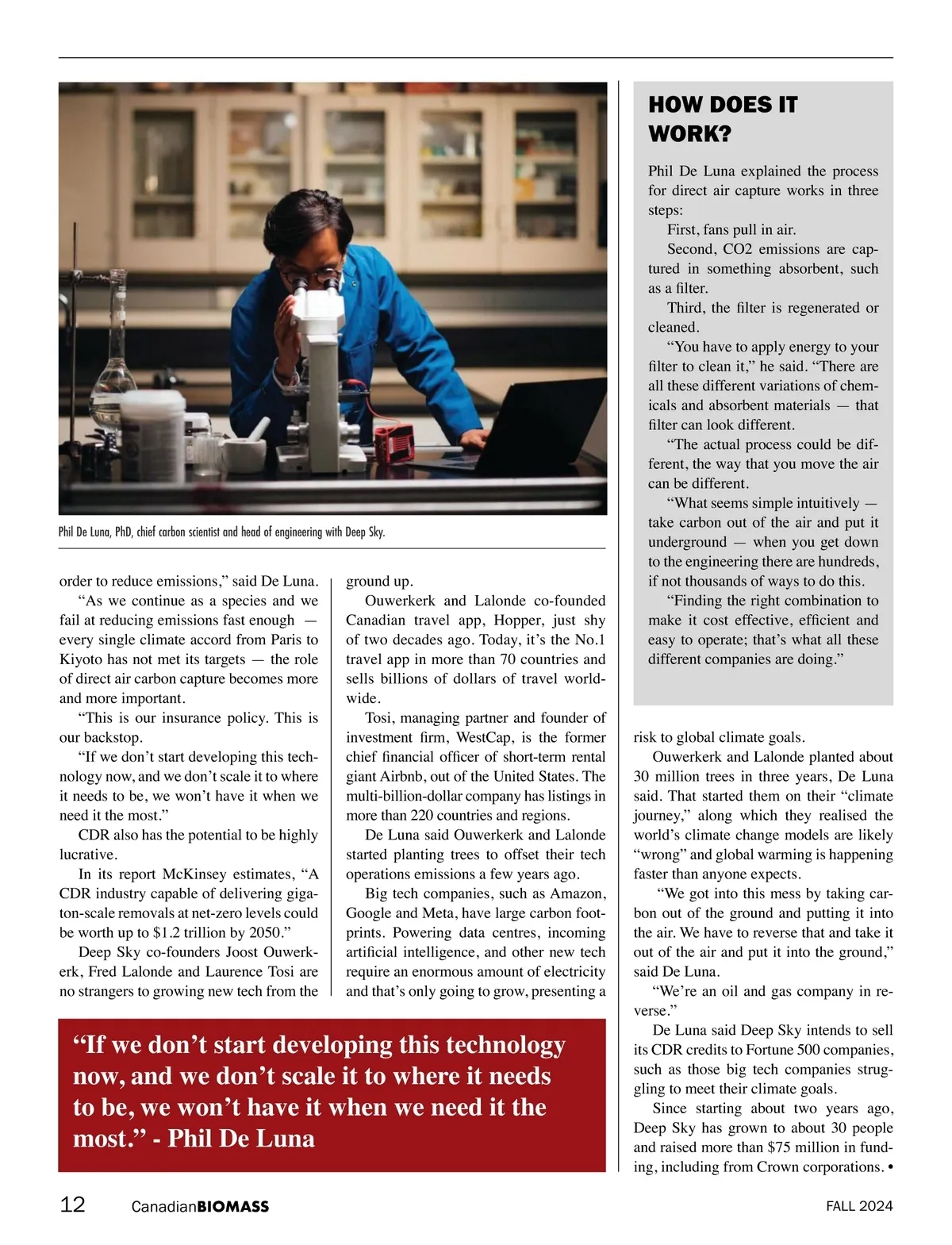
HOW DOES IT WORK? Phil De Luna explained the process for direct air capture works in three steps: First, fans pull in air. Second, CO2 emissions are cap-tured in something absorbent, such as a filter. Third, the filter is regenerated or cleaned. “You have to apply energy to your filter to clean it,” he said. “There are all these different variations of chem-icals and absorbent materials — that filter can look different. “The actual process could be dif-ferent, the way that you move the air can be different. “What seems simple intuitively — take carbon out of the air and put it underground — when you get down to the engineering there are hundreds, if not thousands of ways to do this. “Finding the right combination to make it cost effective, efficient and easy to operate; that’s what all these different companies are doing.” Phil De Luna, PhD, chief carbon scientist and head of engineering with Deep Sky. order to reduce emissions,” said De Luna. “As we continue as a species and we fail at reducing emissions fast enough — every single climate accord from Paris to Kiyoto has not met its targets — the role of direct air carbon capture becomes more and more important. “This is our insurance policy. This is our backstop. “If we don’t start developing this tech-nology now, and we don’t scale it to where it needs to be, we won’t have it when we need it the most.” CDR also has the potential to be highly lucrative. In its report McKinsey estimates, “A CDR industry capable of delivering giga-ton-scale removals at net-zero levels could be worth up to $1.2 trillion by 2050.” Deep Sky co-founders Joost Ouwerk-erk, Fred Lalonde and Laurence Tosi are no strangers to growing new tech from the ground up. Ouwerkerk and Lalonde co-founded Canadian travel app, Hopper, just shy of two decades ago. Today, it’s the No.1 travel app in more than 70 countries and sells billions of dollars of travel world-wide. Tosi, managing partner and founder of investment firm, WestCap, is the former chief financial officer of short-term rental giant Airbnb, out of the United States. The multi-billion-dollar company has listings in more than 220 countries and regions. De Luna said Ouwerkerk and Lalonde started planting trees to offset their tech operations emissions a few years ago. Big tech companies, such as Amazon, Google and Meta, have large carbon foot-prints. Powering data centres, incoming artificial intelligence, and other new tech require an enormous amount of electricity and that’s only going to grow, presenting a “If we don’t start developing this technology now, and we don’t scale it to where it needs to be, we won’t have it when we need it the most.” -Phil De Luna 12 Canadian BIOMASS risk to global climate goals. Ouwerkerk and Lalonde planted about 30 million trees in three years, De Luna said. That started them on their “climate journey,” along which they realised the world’s climate change models are likely “wrong” and global warming is happening faster than anyone expects. “We got into this mess by taking car-bon out of the ground and putting it into the air. We have to reverse that and take it out of the air and put it into the ground,” said De Luna. “We’re an oil and gas company in re-verse.” De Luna said Deep Sky intends to sell its CDR credits to Fortune 500 companies, such as those big tech companies strug-gling to meet their climate goals. Since starting about two years ago, Deep Sky has grown to about 30 people and raised more than $75 million in fund-ing, including from Crown corporations. • FALL 2024
Canadian Biomass Fall 2024: Page 12