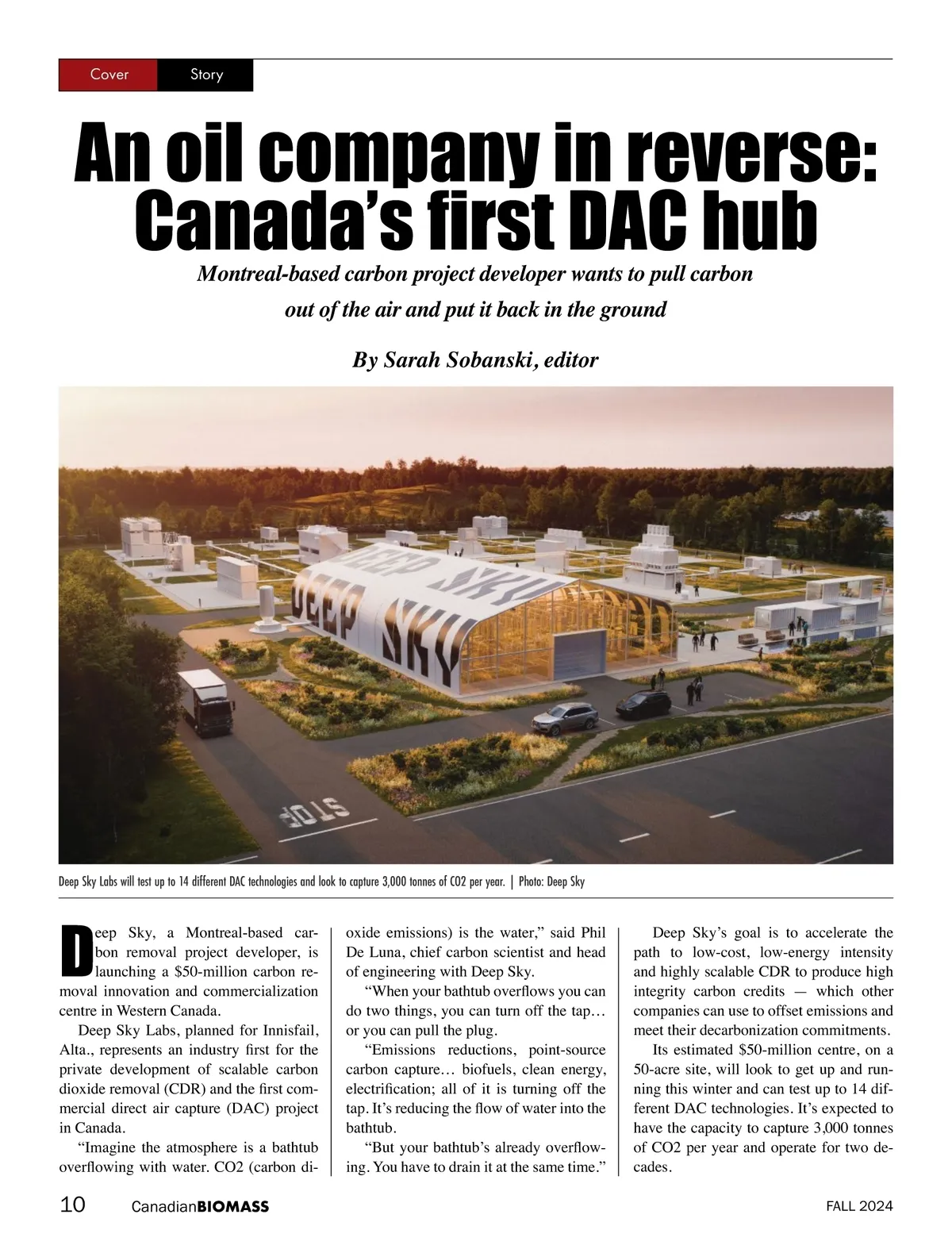
Airhive, Avnos, Phlair (formerly Car-bon Atlantis), Greenlyte Carbon Technol-ogies, Mission Zero, NEG8 Carbon, Sky-renu, and Skytree are eight tech firms from around the world that have already been selected for the project. “It’s a new space. There are these dif-ferent kinds of technologies that are being commercialized. They all say they’re the best, but no one has tried them side-by-side,” said De Luna. “Before we build a large-scale com-mercial facility, we want to try before we buy.” De Luna said Deep Sky would build commercial facilities for each DAC start-up if they all worked, but the likelihood of that is very low. The best tech will be chosen for a pro-posed $100-million facility aiming to pull 50,000 to 200,000 tonnes of CO2 from the air annually. Deep Sky is currently sourc-ing locations in proximity to places it can safely store carbon. The Innisfail facility, for example, will store the carbon it pulls out of the air at the Meadowbrook Carbon Storage Hub, north of Edmonton. Deep Sky’s storage partner, Bison Low Carbon Ventures, is moving the hub through the province’s regulatory approval process. Deep Sky is also looking at its own storage projects, including investigating situ mineralization at Thetford Mines and sedimentary storage in Bécancour, Que. “The idea is that we’re going to build DAC facilities right on top of the storage so that we no longer have to transport it,” said De Luna. “We literally suck it out of the air and pump it into the ground in the exact same place.” Deep Sky wants to reach a commercial agreement for the $100-million facility as soon as possible, he said. Construction is targeted for 2027 and operations for 2028. “We hope to be able to have enough facilities that we’re removing 1 million tonnes of CO2 out of the atmosphere by 2030,” said De Luna. Scaling up from capturing and storing up to 3,000 tonnes of CO2 per year, to 1 million tonnes of CO2 per year, in a little more than six years, is a massive under-taking, but De Luna said the world can’t afford to wait. “There’s a delay in when temperature occurs from when CO2 is emitted. Even if we were to completely turn off the tap today, we would still have 10 to 20 years of warming baked in. “So we have to take care of the CO2 that’s already in the atmosphere. We’re at this temperature now with this amount of CO2, and it’s already getting really bad.” Climate science agencies estimate up to 10 billion tonnes of CO2 must be re-moved from the atmosphere annually to keep global warming below the 1.5 C tar-get set in the Paris Agreement. A late 2023 report by multi-national consultancy, McKinsey and Company, says, “CDR could play a vital role in neu-tralizing residual emissions” and is like-ly needed to meet the Paris Agreement’s net-zero goal by mid-century. Here at home, Canada is emitting about 700 million tonnes of carbon dioxide an-nually. “(CDR) is not a silver bullet, this is just part of an approach that we need to take in Your expert for sustainable wood heating Versatile Powerful Compact Wood chip boilers 50–330 kW / 170,000–1,125,000 BTU in a cascade up to 2 MW / 6,700,000 BTU 30 % TA X CREDIT ON BIOMASS FEDERAL TA X EXEMPT CARBON HEATING WITH WOOD – Pellets, wood chips or wood logs: When it comes to heating with biomass, Hargassner has the ideal solution on hand. Our innovative solid fuel boilers guarantee highest efficiency levels and lowest emission values. Visit us CB_Hargassner_FAll24_CSA.indd 1 GREENBUILD | November 12-15, 2024 Pennsylvania Convention Center Philadelphia, PA Canadian BIOMASS Hargassner North America Inc. | 2100-181 University Avenue | Toronto | ON M5H 3M7 | hargassner.com 11 2024-10-09 7:38 AM
Canadian Biomass Fall 2024: Page 11