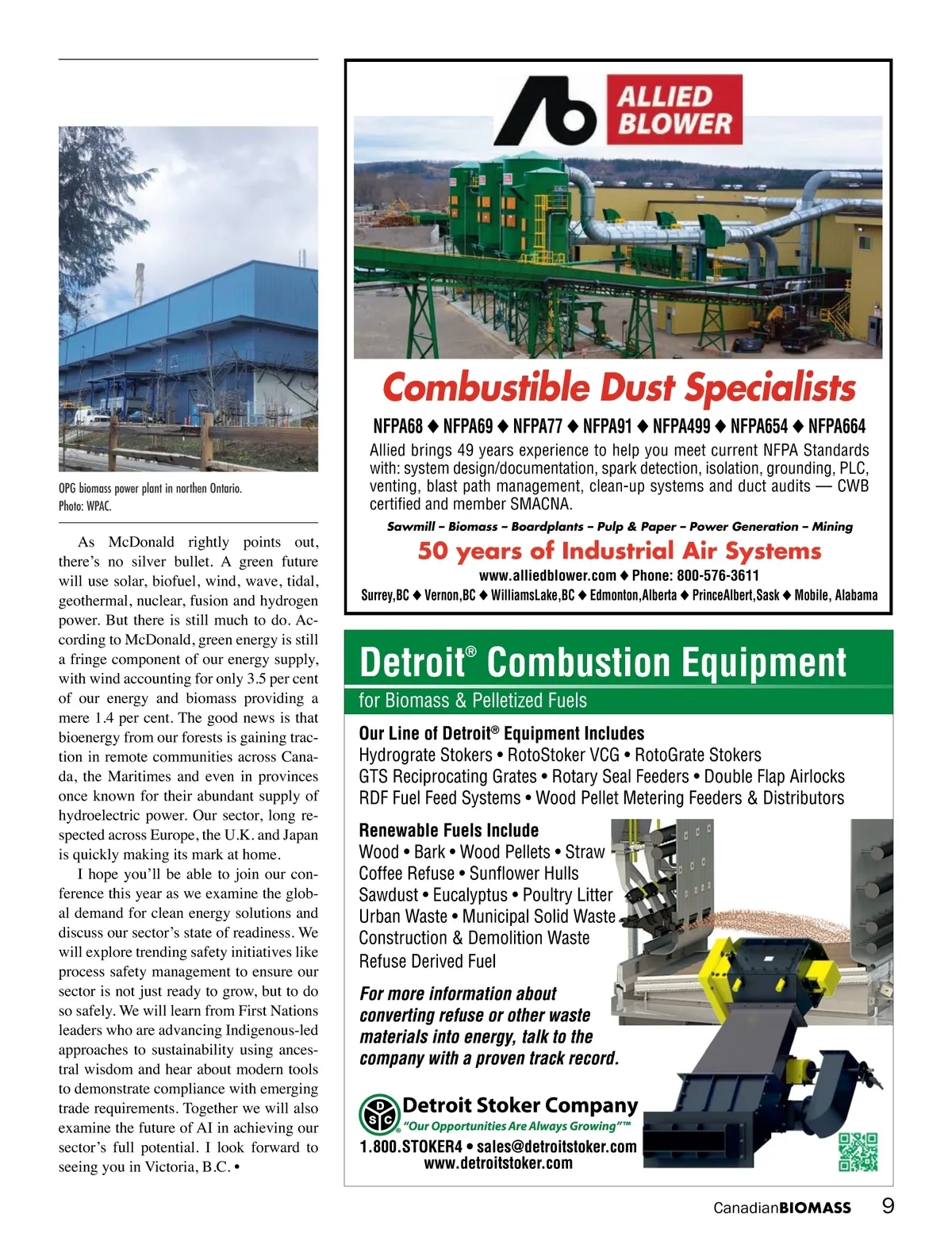
WPAC Report Powering sustainability The role of biomass in electrification By Gord Murray cross Canada and around the globe there’s an electrification revolution. Reducing our reliance on fossil fuels and shifting to emissions-free elec-tricity to propel our cars, heat our homes and run our factories will require dou-bling, or possibly tripling, the amount of power we make now. According to the Public Policy Fo-rum’s Project of the Century: A Blueprint for Growing Canada’s Clean Energy Sup-ply – And Fast, Canada must build more electricity generation in the next 25 years than it has over the last century to support a net-zero emissions economy by 2050. Powering the shift from fossil fuels to clean, renewable and responsible energy will require new innovations and solu-tions. Biomass and wood pellets have a critical role to play in the transition to a greener and brighter future. While there are varying opinions on what technologies will be needed, one thing everyone can agree on is that achiev-ing our goals will require smart combina-tions of renewable resources and effective policies to reduce emissions. We’re also not the only nation grappling with this catch-22 scenario of both establishing an emissions-free grid and expanding current grid capacities. In 2012, Sweden reached their target of 50-per-cent renewable energy eight years ahead of schedule on their 2040 goal of 100-per-cent fossil-free renewable elec-tricity production. They achieved this A The BioNorth Energy biomass power generation facility in Fort St. James, B.C. Photo: Arrow Group of Companies. by leveraging their natural assets, using a combination of wind, bioenergy, and so-lar. Like Canada, Sweden has a rich sup -ply of moving water and biomass, which contributes to the country’s high share of renewable energy. The largest source of bioenergy in Sweden is the forest. The Swedes have proven what many of us have long believed: bioenergy isn’t just good for our bottom lines; it’s also good for our forests. In Sweden, 37 per cent of its energy is from biomass; and since 1990, they have doubled their bio-energy consumption while increasing their standing timber volume by 40 per cent; resulting in a 70-per-cent reduction in GHG emissions. Imagine the potential for bioenergy in Canada with 367 million hectares of forests compared to Sweden’s 28 million hectares. This combined with "The Swedes have proven what many of us have long believed: bioenergy isn’t just good for our bottom lines; it’s also good for our forests." 8 Canadian BIOMASS the fact that we still leave tens of millions cubic metres of forest residuals on the ground following harvesting or natural disturbances – residuals that could go to-wards bioenergy, keep communities safer and reduce carbon emissions from fires. Talk about a missed opportunity! This September, WPAC will host its annual conference in Victoria, B.C. from September 17 to 18, where we will gath-er experts from across the country and around the globe to explore the role of bio-mass in electrification, and what we need to do to help our sector reach its highest potential. One such expert that you won’t want to miss at our conference is longtime CBC reporter and author Bob McDonald, who believes that humans have already invented everything they need to solve the climate crisis. However, he says tran-sitioning to a greener economy will re-quire political will, economic investment and public acceptance. McDonald is the author of The Future Is Now: Solving the Climate Crisis with Today’s Technologies and the host of CBC Radio’s award-win-ning science program, Quirks & Quarks . SUMMER 2024
Canadian Biomass Summer 2024: Page 8