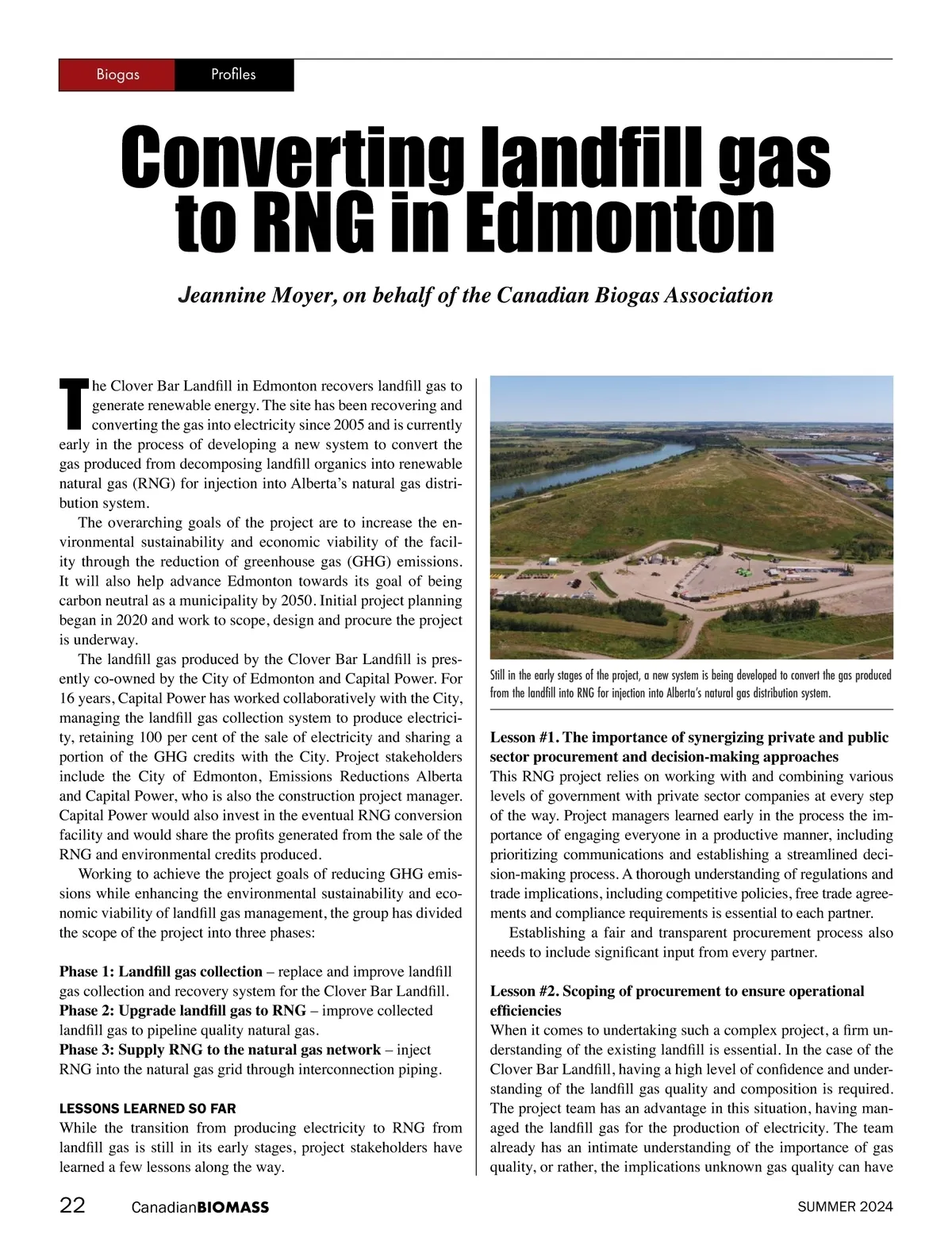
Biogas Profiles Converting landfill gas to RNG in Edmonton J eannine Moyer, on behalf of the Canadian Biogas Association he Clover Bar Landfill in Edmonton recovers landfill gas to generate renewable energy. The site has been recovering and converting the gas into electricity since 2005 and is currently early in the process of developing a new system to convert the gas produced from decomposing landfill organics into renewable natural gas (RNG) for injection into Alberta’s natural gas distri-bution system. The overarching goals of the project are to increase the en-vironmental sustainability and economic viability of the facil-ity through the reduction of greenhouse gas (GHG) emissions. It will also help advance Edmonton towards its goal of being carbon neutral as a municipality by 2050. Initial project planning began in 2020 and work to scope, design and procure the project is underway. The landfill gas produced by the Clover Bar Landfill is pres -ently co-owned by the City of Edmonton and Capital Power. For 16 years, Capital Power has worked collaboratively with the City, managing the landfill gas collection system to produce electrici -ty, retaining 100 per cent of the sale of electricity and sharing a portion of the GHG credits with the City. Project stakeholders include the City of Edmonton, Emissions Reductions Alberta and Capital Power, who is also the construction project manager. Capital Power would also invest in the eventual RNG conversion facility and would share the profits generated from the sale of the RNG and environmental credits produced. Working to achieve the project goals of reducing GHG emis -sions while enhancing the environmental sustainability and eco-nomic viability of landfill gas management, the group has divided the scope of the project into three phases: Phase 1: Landfill gas collection – replace and improve landfill gas collection and recovery system for the Clover Bar Landfill. Phase 2: Upgrade landfill gas to RNG – improve collected landfill gas to pipeline quality natural gas. Phase 3: Supply RNG to the natural gas network – inject RNG into the natural gas grid through interconnection piping. LESSONS LEARNED SO FAR T Still in the early stages of the project, a new system is being developed to convert the gas produced from the landfill into RNG for injection into Alberta’s natural gas distribution system. Lesson #1. The importance of synergizing private and public sector procurement and decision-making approaches This RNG project relies on working with and combining various levels of government with private sector companies at every step of the way. Project managers learned early in the process the im-portance of engaging everyone in a productive manner, including prioritizing communications and establishing a streamlined deci-sion-making process. A thorough understanding of regulations and trade implications, including competitive policies, free trade agree-ments and compliance requirements is essential to each partner. Establishing a fair and transparent procurement process also needs to include significant input from every partner. Lesson #2. Scoping of procurement to ensure operational efficiencies When it comes to undertaking such a complex project, a firm un -derstanding of the existing landfill is essential. In the case of the Clover Bar Landfill, having a high level of confidence and under -standing of the landfill gas quality and composition is required. The project team has an advantage in this situation, having man-aged the landfill gas for the production of electricity. The team already has an intimate understanding of the importance of gas quality, or rather, the implications unknown gas quality can have SUMMER 2024 While the transition from producing electricity to RNG from landfill gas is still in its early stages, project stakeholders have learned a few lessons along the way. 22 Canadian BIOMASS
Canadian Biomass Summer 2024: Page 22