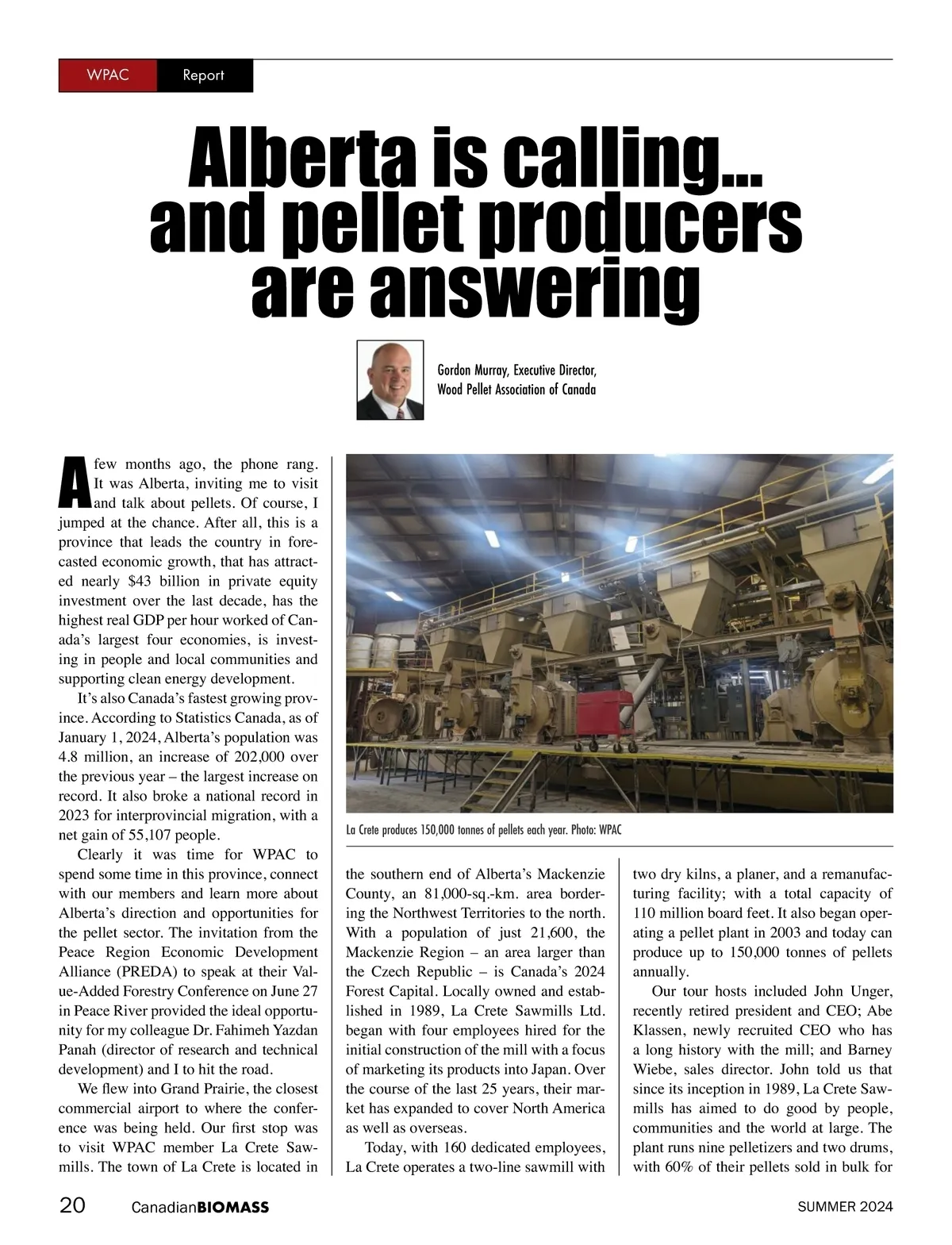
WPAC Report Alberta is calling… and pellet producers are answering Gordon Murray, Executive Director, Wood Pellet Association of Canada few months ago, the phone rang. It was Alberta, inviting me to visit and talk about pellets. Of course, I jumped at the chance. After all, this is a province that leads the country in fore-casted economic growth, that has attract-ed nearly $43 billion in private equity investment over the last decade, has the highest real GDP per hour worked of Can -ada’s largest four economies, is invest-ing in people and local communities and supporting clean energy development. It’s also Canada’s fastest growing prov-ince. According to Statistics Canada, as of January 1, 2024, Alberta’s population was 4.8 million, an increase of 202,000 over the previous year – the largest increase on record. It also broke a national record in 2023 for interprovincial migration, with a net gain of 55,107 people. Clearly it was time for WPAC to spend some time in this province, connect with our members and learn more about Alberta’s direction and opportunities for the pellet sector. The invitation from the Peace Region Economic Development Alliance (PREDA) to speak at their Val -ue-Added Forestry Conference on June 27 in Peace River provided the ideal opportu-nity for my colleague Dr. Fahimeh Yazdan Panah (director of research and technical development) and I to hit the road. We flew into Grand Prairie, the closest commercial airport to where the confer-ence was being held. Our first stop was to visit WPAC member La Crete Saw-mills. The town of La Crete is located in A La Crete produces 150,000 tonnes of pellets each year. Photo: WPAC the southern end of Alberta’s Mackenzie County, an 81,000-sq.-km. area border -ing the Northwest Territories to the north. With a population of just 21,600, the Mackenzie Region – an area larger than the Czech Republic – is Canada’s 2024 Forest Capital. Locally owned and estab-lished in 1989, La Crete Sawmills Ltd. began with four employees hired for the initial construction of the mill with a focus of marketing its products into Japan. Over the course of the last 25 years, their mar-ket has expanded to cover North America as well as overseas. Today, with 160 dedicated employees, La Crete operates a two-line sawmill with two dry kilns, a planer, and a remanufac -turing facility; with a total capacity of 110 million board feet. It also began oper-ating a pellet plant in 2003 and today can produce up to 150,000 tonnes of pellets annually. Our tour hosts included John Unger, recently retired president and CEO; Abe Klassen, newly recruited CEO who has a long history with the mill; and Barney Wiebe, sales director. John told us that since its inception in 1989, La Crete Saw-mills has aimed to do good by people, communities and the world at large. The plant runs nine pelletizers and two drums, with 60% of their pellets sold in bulk for SUMMER 2024 20 Canadian BIOMASS
Canadian Biomass Summer 2024: Page 20