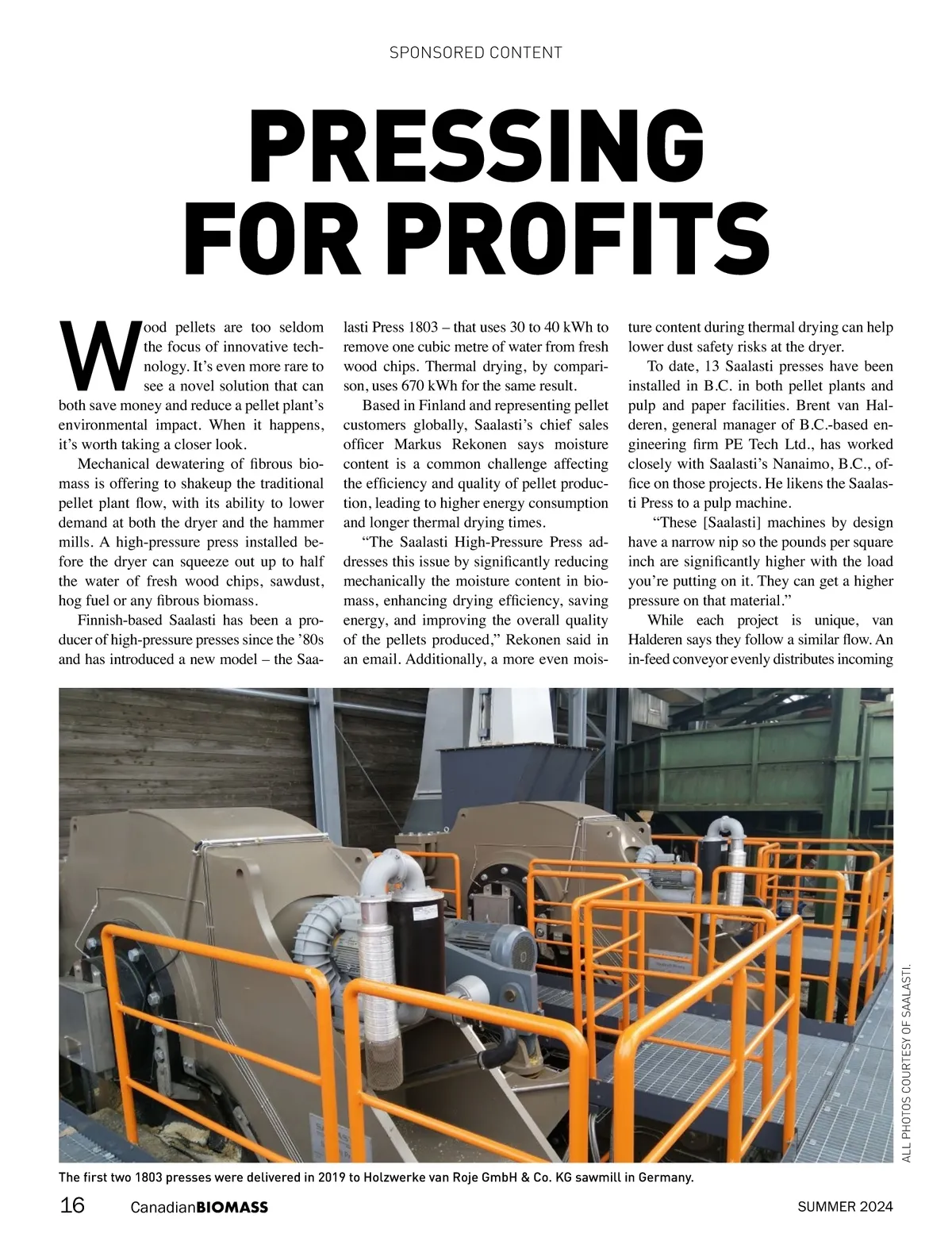
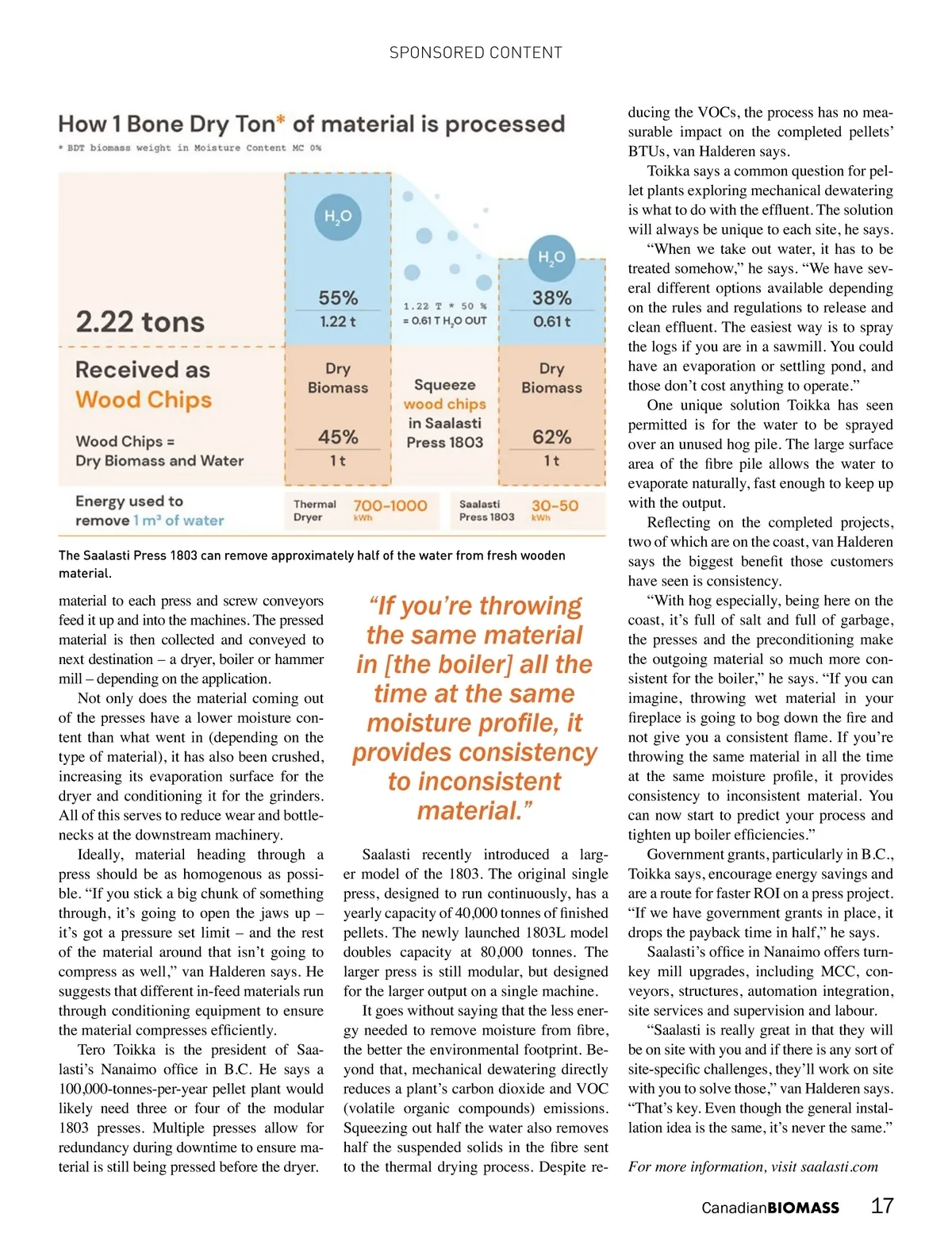
SPONSORED CONTENT ducing the VOCs, the process has no mea-surable impact on the completed pellets’ BTUs, van Halderen says. Toikka says a common question for pel-let plants exploring mechanical dewatering is what to do with the effluent. The solution will always be unique to each site, he says. “When we take out water, it has to be treated somehow,” he says. “We have sev-eral different options available depending on the rules and regulations to release and clean effluent. The easiest way is to spray the logs if you are in a sawmill. You could have an evaporation or settling pond, and those don’t cost anything to operate.” One unique solution Toikka has seen permitted is for the water to be sprayed over an unused hog pile. The large surface area of the fibre pile allows the water to evaporate naturally, fast enough to keep up with the output. Reflecting on the completed projects, two of which are on the coast, van Halderen says the biggest benefit those customers have seen is consistency. “With hog especially, being here on the coast, it’s full of salt and full of garbage, the presses and the preconditioning make the outgoing material so much more con-sistent for the boiler,” he says. “If you can imagine, throwing wet material in your fireplace is going to bog down the fire and not give you a consistent flame. If you’re throwing the same material in all the time at the same moisture profile, it provides consistency to inconsistent material. You can now start to predict your process and tighten up boiler efficiencies.” Government grants, particularly in B.C., Toikka says, encourage energy savings and are a route for faster ROI on a press project. “If we have government grants in place, it drops the payback time in half,” he says. Saalasti’s office in Nanaimo offers turn -key mill upgrades, including MCC, con-veyors, structures, automation integration, site services and supervision and labour. “Saalasti is really great in that they will be on site with you and if there is any sort of site-specific challenges, they’ll work on site with you to solve those,” van Halderen says. “That’s key. Even though the general instal -lation idea is the same, it’s never the same.” For more information, visit saalasti.com The Saalasti Press 1803 can remove approximately half of the water from fresh wooden material. material to each press and screw conveyors feed it up and into the machines. The pressed material is then collected and conveyed to next destination – a dryer, boiler or hammer mill – depending on the application. Not only does the material coming out of the presses have a lower moisture con-tent than what went in (depending on the type of material), it has also been crushed, increasing its evaporation surface for the dryer and conditioning it for the grinders. All of this serves to reduce wear and bottle-necks at the downstream machinery. Ideally, material heading through a press should be as homogenous as possi-ble. “If you stick a big chunk of something through, it’s going to open the jaws up – it’s got a pressure set limit – and the rest of the material around that isn’t going to compress as well,” van Halderen says. He suggests that different in-feed materials run through conditioning equipment to ensure the material compresses efficiently. Tero Toikka is the president of Saa-lasti’s Nanaimo office in B.C. He says a 100,000-tonnes-per-year pellet plant would likely need three or four of the modular 1803 presses. Multiple presses allow for redundancy during downtime to ensure ma-terial is still being pressed before the dryer. “If you’re throwing the same material in [the boiler] all the time at the same moisture profile, it provides consistency to inconsistent material.” Saalasti recently introduced a larg-er model of the 1803. The original single press, designed to run continuously, has a yearly capacity of 40,000 tonnes of finished pellets. The newly launched 1803L model doubles capacity at 80,000 tonnes. The larger press is still modular, but designed for the larger output on a single machine. It goes without saying that the less ener-gy needed to remove moisture from fibre, the better the environmental footprint. Be-yond that, mechanical dewatering directly reduces a plant’s carbon dioxide and VOC (volatile organic compounds) emissions. Squeezing out half the water also removes half the suspended solids in the fibre sent to the thermal drying process. Despite re-Canadian BIOMASS 17
Canadian Biomass Summer 2024: Page 17