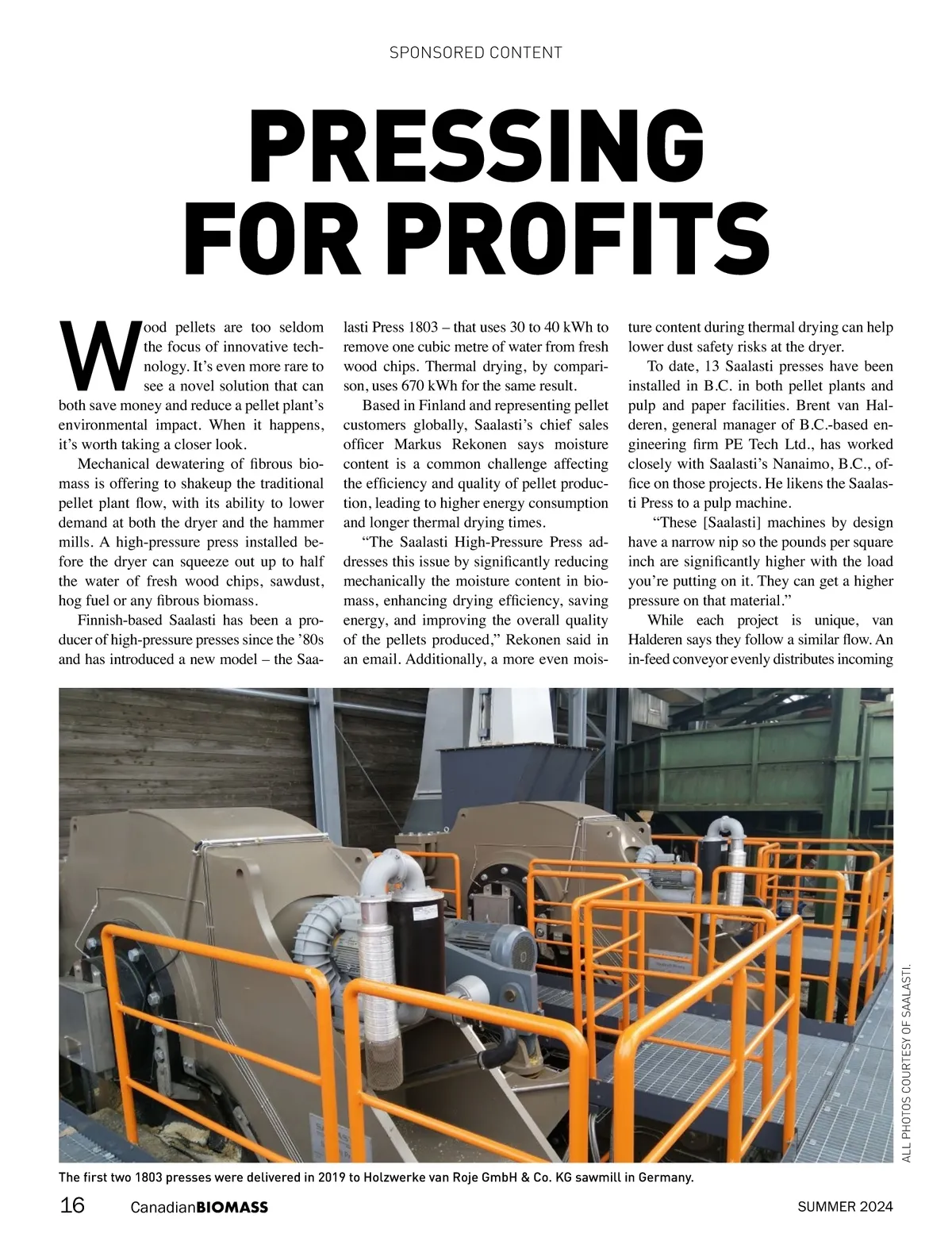
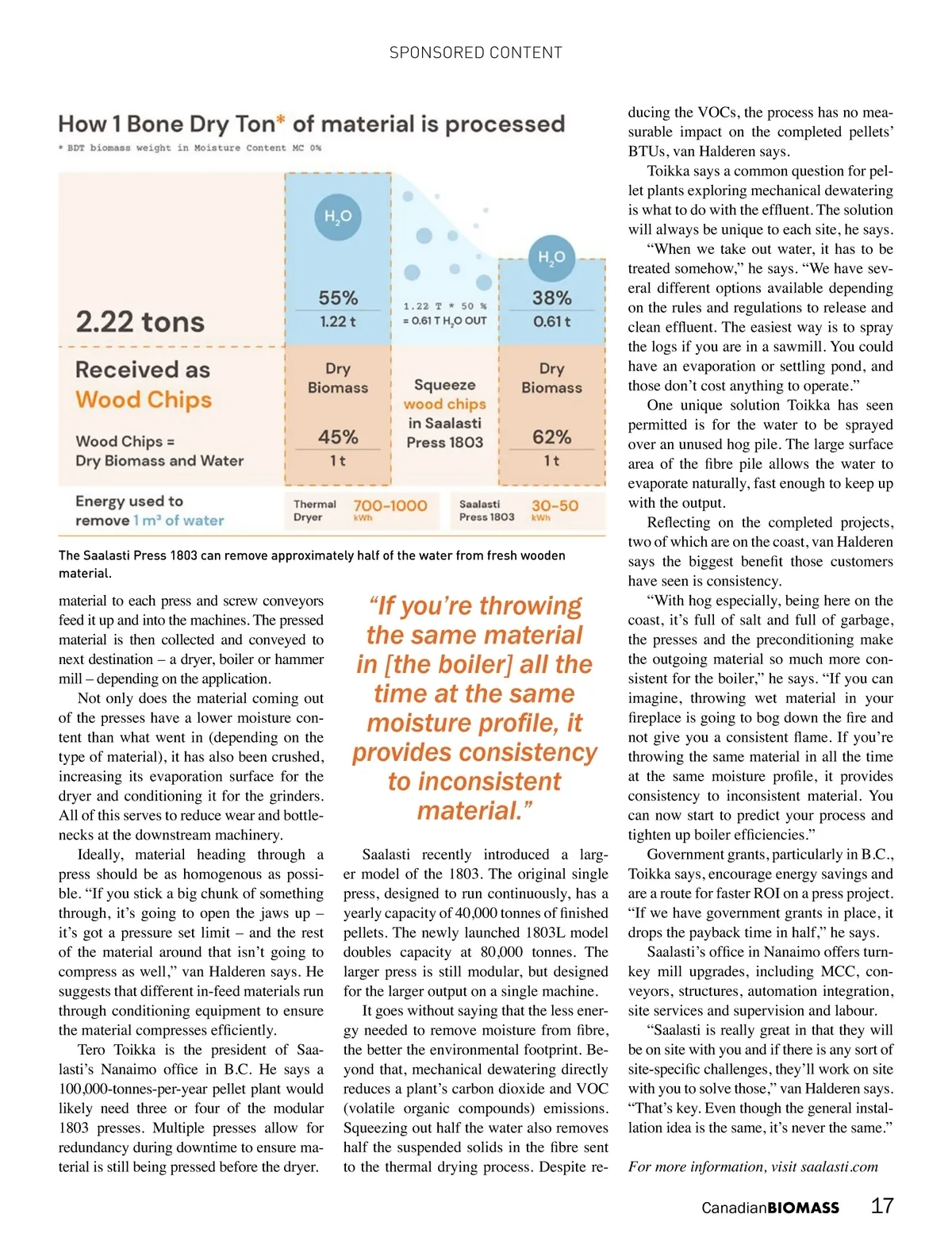
SPONSORED CONTENT ood pellets are too seldom the focus of innovative tech-nology. It’s even more rare to see a novel solution that can both save money and reduce a pellet plant’s environmental impact. When it happens, it’s worth taking a closer look. Mechanical dewatering of fibrous bio -mass is offering to shakeup the traditional pellet plant flow, with its ability to lower demand at both the dryer and the hammer mills. A high-pressure press installed be-fore the dryer can squeeze out up to half the water of fresh wood chips, sawdust, hog fuel or any fibrous biomass. Finnish-based Saalasti has been a pro-ducer of high-pressure presses since the ’80s and has introduced a new model – the Saa-W PRESSING FOR PROFITS lasti Press 1803 – that uses 30 to 40 kWh to remove one cubic metre of water from fresh wood chips. Thermal drying, by compari-son, uses 670 kWh for the same result. Based in Finland and representing pellet customers globally, Saalasti’s chief sales officer Markus Rekonen says moisture content is a common challenge affecting the efficiency and quality of pellet produc -tion, leading to higher energy consumption and longer thermal drying times. “The Saalasti High-Pressure Press ad-dresses this issue by significantly reducing mechanically the moisture content in bio-mass, enhancing drying efficiency, saving energy, and improving the overall quality of the pellets produced,” Rekonen said in an email. Additionally, a more even mois-ture content during thermal drying can help lower dust safety risks at the dryer. To date, 13 Saalasti presses have been installed in B.C. in both pellet plants and pulp and paper facilities. Brent van Hal-deren, general manager of B.C.-based en-gineering firm PE Tech Ltd., has worked closely with Saalasti’s Nanaimo, B.C., of-fice on those projects. He likens the Saalas -ti Press to a pulp machine. “These [Saalasti] machines by design have a narrow nip so the pounds per square inch are significantly higher with the load you’re putting on it. They can get a higher pressure on that material.” While each project is unique, van Halderen says they follow a similar flow. An in-feed conveyor evenly distributes incoming The first two 1803 presses were delivered in 2019 to Holzwerke van Roje GmbH & Co. KG sawmill in Germany. 16 Canadian BIOMASS SUMMER 2024 ALL PHOTOS COURTESY OF SAALASTI.
Canadian Biomass Summer 2024: Page 16