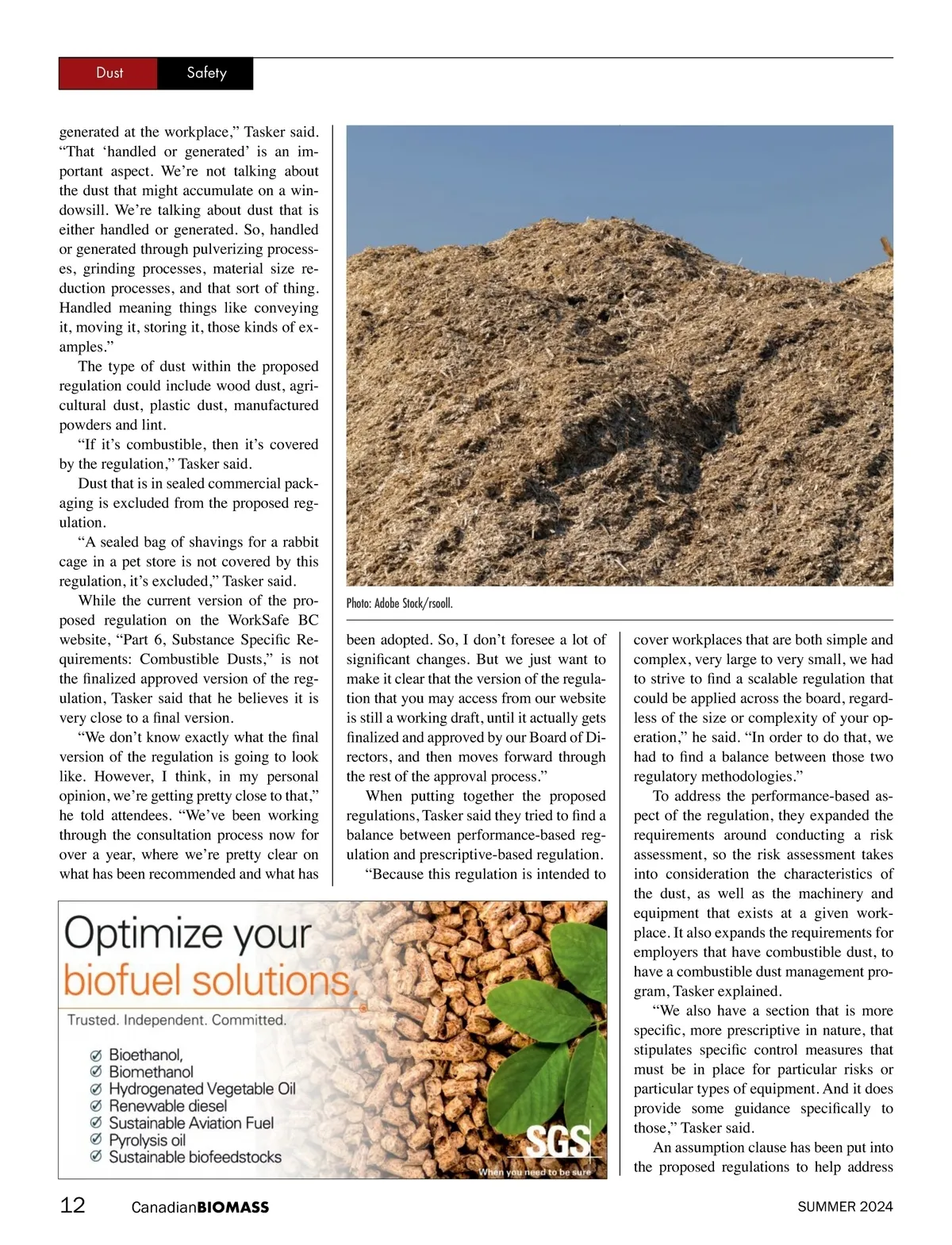
Dust Safety generated at the workplace,” Tasker said. “That ‘handled or generated’ is an im-portant aspect. We’re not talking about the dust that might accumulate on a win-dowsill. We’re talking about dust that is either handled or generated. So, handled or generated through pulverizing process-es, grinding processes, material size re-duction processes, and that sort of thing. Handled meaning things like conveying it, moving it, storing it, those kinds of ex -amples.” The type of dust within the proposed regulation could include wood dust, agri-cultural dust, plastic dust, manufactured powders and lint. “If it’s combustible, then it’s covered by the regulation,” Tasker said. Dust that is in sealed commercial pack -aging is excluded from the proposed reg-ulation. “A sealed bag of shavings for a rabbit cage in a pet store is not covered by this regulation, it’s excluded,” Tasker said. While the current version of the pro-posed regulation on the WorkSafe BC website, “Part 6, Substance Specific Re -quirements: Combustible Dusts,” is not the finalized approved version of the reg -ulation, Tasker said that he believes it is very close to a final version. “We don’t know exactly what the final version of the regulation is going to look like. However, I think, in my personal opinion, we’re getting pretty close to that,” he told attendees. “We’ve been working through the consultation process now for over a year, where we’re pretty clear on what has been recommended and what has Photo: Adobe Stock/rsooll. been adopted. So, I don’t foresee a lot of significant changes. But we just want to make it clear that the version of the regula -tion that you may access from our website is still a working draft, until it actually gets finalized and approved by our Board of Di -rectors, and then moves forward through the rest of the approval process.” When putting together the proposed regulations, Tasker said they tried to find a balance between performance-based reg-ulation and prescriptive-based regulation. “Because this regulation is intended to cover workplaces that are both simple and complex, very large to very small, we had to strive to find a scalable regulation that could be applied across the board, regard-less of the size or complexity of your op-eration,” he said. “In order to do that, we had to find a balance between those two regulatory methodologies.” To address the performance-based as-pect of the regulation, they expanded the requirements around conducting a risk assessment, so the risk assessment takes into consideration the characteristics of the dust, as well as the machinery and equipment that exists at a given work -place. It also expands the requirements for employers that have combustible dust, to have a combustible dust management pro-gram, Tasker explained. “We also have a section that is more specific, more prescriptive in nature, that stipulates specific control measures that must be in place for particular risks or particular types of equipment. And it does provide some guidance specifically to those,” Tasker said. An assumption clause has been put into the proposed regulations to help address SUMMER 2024 12 Canadian BIOMASS CB_SGS_Summer24_CSA.indd 1 2024-07-05 9:09 AM
Canadian Biomass Summer 2024: Page 12