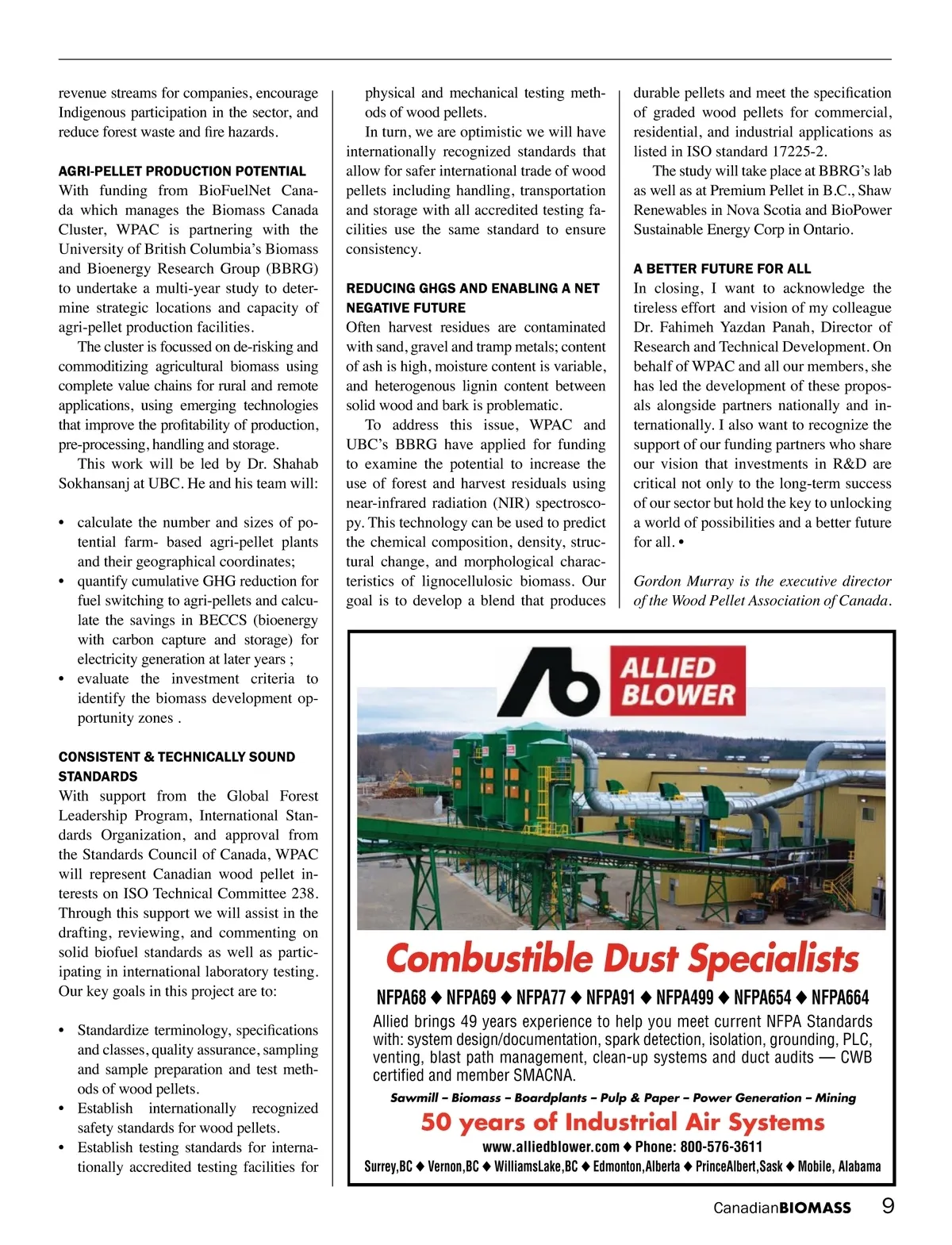
WPAC Report R&D positions Canada’s pellet sector for long-term success A By Gordon Murray t the Wood Pellet Association of Cana-da (WPAC) we are constantly seeking ways to be ahead of the curve. That’s why we expend a significant amount of our time building partnerships that leverage our collective strengths and collaborate on R&D to position our sector for long-term success. We’ve been fortunate over the years to have strategic and mutually beneficial partnerships across the country, as well as support from provincial and federal gov-ernments for our research and develop-ment activities. In 2023, we spent considerable effort to develop proposals that will enhance our reputation as a reliable and responsible supplier of wood pellets both globally and domestically. I’m proud to say that because of this work, we are advancing five major research and development projects in 2024. Pellet plants receive millions of tonnes of residuals each year; determining their exact source location is impractical. The 2024 traceability research project will investigate and test potential and practical approaches to traceability, including geolocation. Photo: Courtesy WPAC ENHANCING TRACEABILITY Increasingly, global markets and govern-ments are asking for further proof that the products they purchase come from well-managed forests. The EU’s Defor -estation Regulation will require new ap-proaches to traceability including geoloca-tion. In the Canadian context this may be impractical and therefore a market barrier for our products. As such, approaches to traceability will need to be tailored to ad-dress some of Canada’s unique attributes: vast forests, species and its public land model, and that the fibre from pellets can come many different areas and suppliers. With funding from Natural Resourc-es Canada’s Forest Innovation Program, WPAC will work with its members to in-vestigate and test potential and practical approaches to traceability including geo-location and develop tools and systems for reporting on traceability to demonstrate compliance with emerging regulations such as the European Union Deforestation Reg -ulation (EUDR). We will also work with the Sustainable Biomass Program to test the feasibility of linking our traceability approach with their data transfer systems. EXPLORING NEW BIOMASS PATHWAYS As with the rest of Canada, Ontario’s wood pellet sector has grown by using sawmill residues. In the future, there will be an increasing reliance on forest bio-mass in the form of left-over tree-tops, branches, low quality logs and fire-dam -aged timber which is often contaminated with rocks and sand which creates wear and tear on mill equipment and increases safety hazards. With funding from Ontario’s Ministry of Natural Resources and Forestry, we have partnered up with BioPower Sustain-able Energy Corp which owns and oper-ates a wood pellet plant in Atikokan, Ont. Key activities include an economic analy-sis of using a combination of an in-woods portable chipper and triple deck screen-ing plant to produce wood chips as pel-let feedstock as well as testing feedstock samples for contaminants and testing fin -ished pellets against the CAN/CSA-ISO 17225-2 pellet standards. If successful, we will be able to increase utilization of forest biofibre, create new SPRING 2024 8 Canadian BIOMASS
Canadian Biomass Spring 2024: Page 8