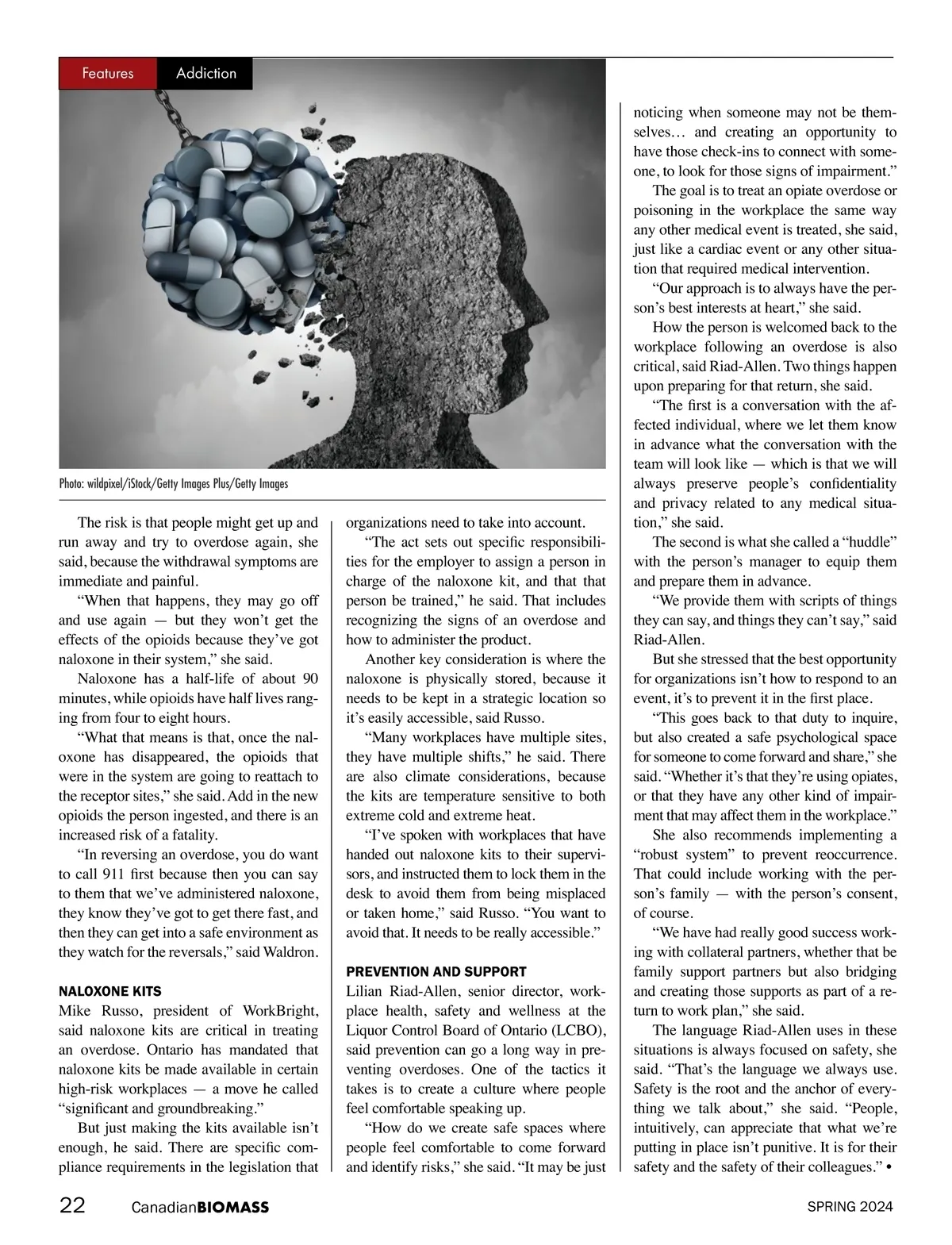
Features Addiction noticing when someone may not be them-selves… and creating an opportunity to have those check-ins to connect with some-one, to look for those signs of impairment.” The goal is to treat an opiate overdose or poisoning in the workplace the same way any other medical event is treated, she said, just like a cardiac event or any other situa-tion that required medical intervention. “Our approach is to always have the per-son’s best interests at heart,” she said. How the person is welcomed back to the workplace following an overdose is also critical, said Riad-Allen. Two things happen upon preparing for that return, she said. “The first is a conversation with the af -fected individual, where we let them know in advance what the conversation with the team will look like — which is that we will always preserve people’s confidentiality and privacy related to any medical situa-tion,” she said. The second is what she called a “huddle” with the person’s manager to equip them and prepare them in advance. “We provide them with scripts of things they can say, and things they can’t say,” said Riad-Allen. But she stressed that the best opportunity for organizations isn’t how to respond to an event, it’s to prevent it in the first place. “This goes back to that duty to inquire, but also created a safe psychological space for someone to come forward and share,” she said. “Whether it’s that they’re using opiates, or that they have any other kind of impair-ment that may affect them in the workplace.” She also recommends implementing a “robust system” to prevent reoccurrence. That could include working with the per-son’s family — with the person’s consent, of course. “We have had really good success work-ing with collateral partners, whether that be family support partners but also bridging and creating those supports as part of a re-turn to work plan,” she said. The language Riad-Allen uses in these situations is always focused on safety, she said. “That’s the language we always use. Safety is the root and the anchor of every-thing we talk about,” she said. “People, intuitively, can appreciate that what we’re putting in place isn’t punitive. It is for their safety and the safety of their colleagues.” • SPRING 2024 Photo: wildpixel/iStock/Getty Images Plus/Getty Images The risk is that people might get up and run away and try to overdose again, she said, because the withdrawal symptoms are immediate and painful. “When that happens, they may go off and use again — but they won’t get the effects of the opioids because they’ve got naloxone in their system,” she said. Naloxone has a half-life of about 90 minutes, while opioids have half lives rang-ing from four to eight hours. “What that means is that, once the nal-oxone has disappeared, the opioids that were in the system are going to reattach to the receptor sites,” she said. Add in the new opioids the person ingested, and there is an increased risk of a fatality. “In reversing an overdose, you do want to call 911 first because then you can say to them that we’ve administered naloxone, they know they’ve got to get there fast, and then they can get into a safe environment as they watch for the reversals,” said Waldron. NALOXONE KITS organizations need to take into account. “The act sets out specific responsibili -ties for the employer to assign a person in charge of the naloxone kit, and that that person be trained,” he said. That includes recognizing the signs of an overdose and how to administer the product. Another key consideration is where the naloxone is physically stored, because it needs to be kept in a strategic location so it’s easily accessible, said Russo. “Many workplaces have multiple sites, they have multiple shifts,” he said. There are also climate considerations, because the kits are temperature sensitive to both extreme cold and extreme heat. “I’ve spoken with workplaces that have handed out naloxone kits to their supervi-sors, and instructed them to lock them in the desk to avoid them from being misplaced or taken home,” said Russo. “You want to avoid that. It needs to be really accessible.” PREVENTION AND SUPPORT Mike Russo, president of WorkBright, said naloxone kits are critical in treating an overdose. Ontario has mandated that naloxone kits be made available in certain high-risk workplaces — a move he called “significant and groundbreaking.” But just making the kits available isn’t enough, he said. There are specific com -pliance requirements in the legislation that Lilian Riad-Allen, senior director, work-place health, safety and wellness at the Liquor Control Board of Ontario (LCBO), said prevention can go a long way in pre-venting overdoses. One of the tactics it takes is to create a culture where people feel comfortable speaking up. “How do we create safe spaces where people feel comfortable to come forward and identify risks,” she said. “It may be just 22 Canadian BIOMASS
Canadian Biomass Spring 2024: Page 22