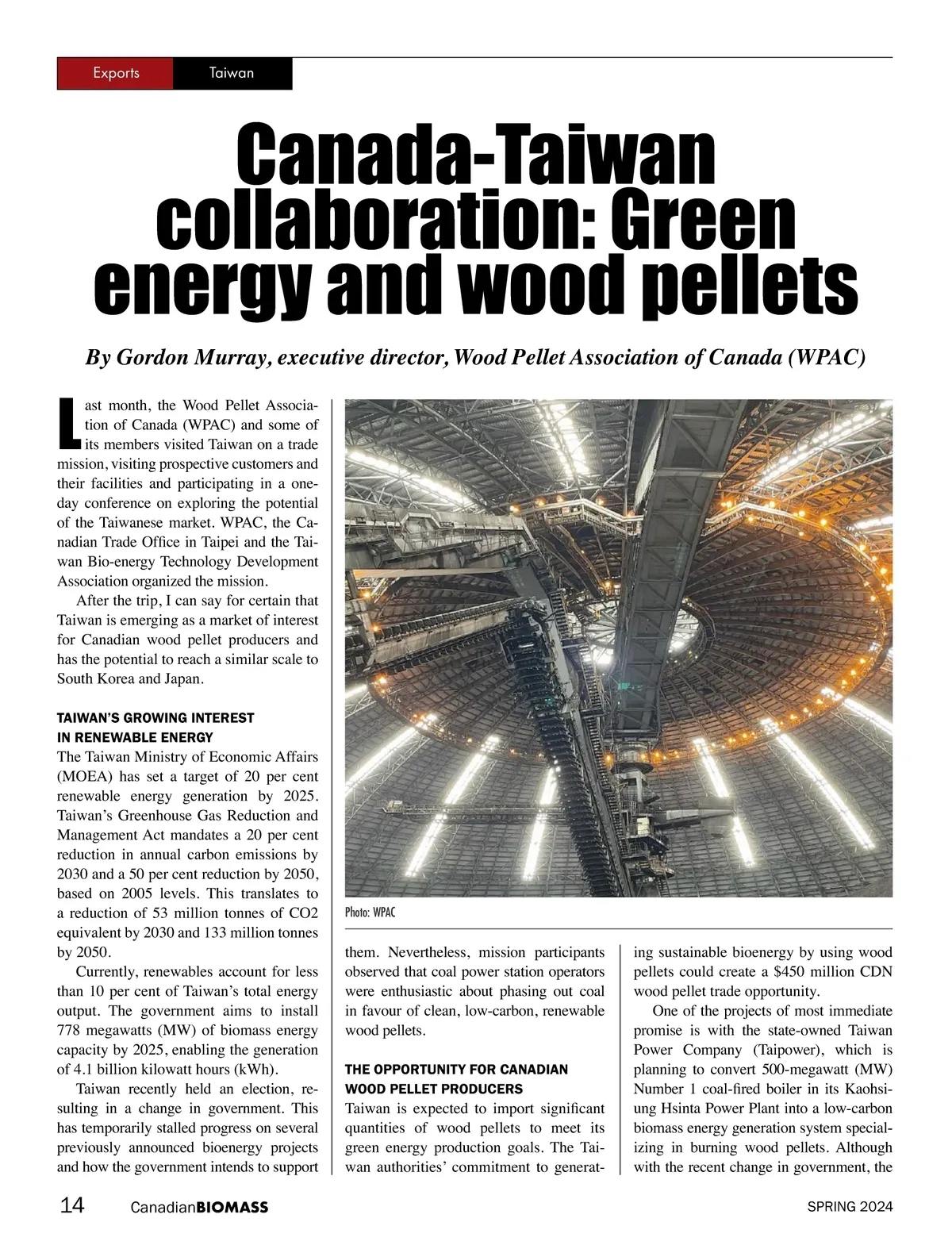
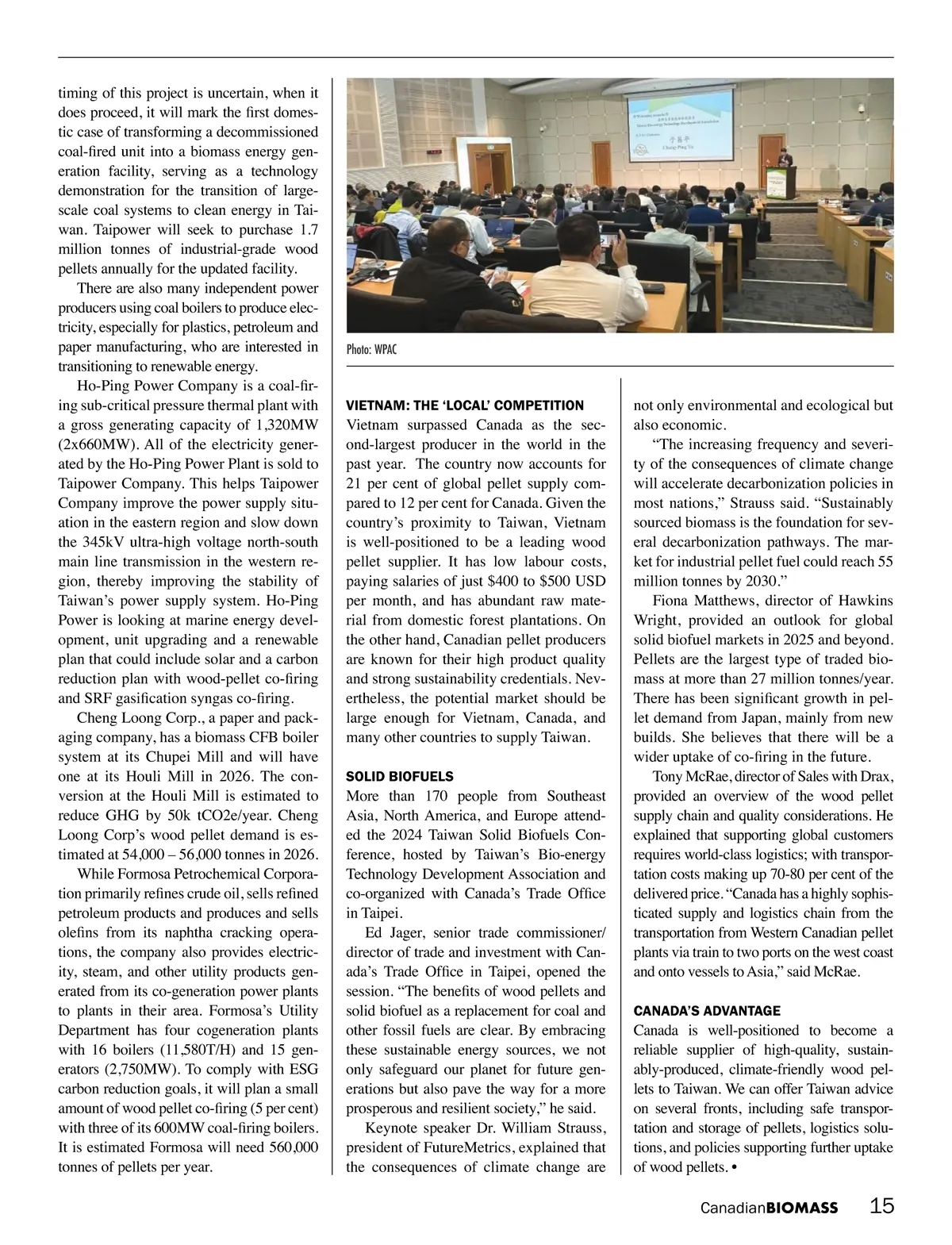
timing of this project is uncertain, when it does proceed, it will mark the first domes -tic case of transforming a decommissioned coal-fired unit into a biomass energy gen -eration facility, serving as a technology demonstration for the transition of large-scale coal systems to clean energy in Tai-wan. Taipower will seek to purchase 1.7 million tonnes of industrial-grade wood pellets annually for the updated facility. There are also many independent power producers using coal boilers to produce elec-tricity, especially for plastics, petroleum and paper manufacturing, who are interested in transitioning to renewable energy. Ho-Ping Power Company is a coal-fir -ing sub-critical pressure thermal plant with a gross generating capacity of 1,320MW (2x660MW). All of the electricity gener-ated by the Ho-Ping Power Plant is sold to Taipower Company. This helps Taipower Company improve the power supply situ-ation in the eastern region and slow down the 345kV ultra-high voltage north-south main line transmission in the western re-gion, thereby improving the stability of Taiwan’s power supply system. Ho-Ping Power is looking at marine energy devel-opment, unit upgrading and a renewable plan that could include solar and a carbon reduction plan with wood-pellet co-firing and SRF gasification syngas co-firing. Cheng Loong Corp., a paper and pack-aging company, has a biomass CFB boiler system at its Chupei Mill and will have one at its Houli Mill in 2026. The con-version at the Houli Mill is estimated to reduce GHG by 50k tCO2e/year. Cheng Loong Corp’s wood pellet demand is es-timated at 54,000 – 56,000 tonnes in 2026. While Formosa Petrochemical Corpora-tion primarily refines crude oil, sells refined petroleum products and produces and sells olefins from its naphtha cracking opera -tions, the company also provides electric-ity, steam, and other utility products gen-erated from its co-generation power plants to plants in their area. Formosa’s Utility Department has four cogeneration plants with 16 boilers (11,580T/H) and 15 gen-erators (2,750MW). To comply with ESG carbon reduction goals, it will plan a small amount of wood pellet co-firing (5 per cent) with three of its 600MW coal-firing boilers. It is estimated Formosa will need 560,000 tonnes of pellets per year. Photo: WPAC VIETNAM: THE ‘LOCAL’ COMPETITION Vietnam surpassed Canada as the sec-ond-largest producer in the world in the past year. The country now accounts for 21 per cent of global pellet supply com-pared to 12 per cent for Canada. Given the country’s proximity to Taiwan, Vietnam is well-positioned to be a leading wood pellet supplier. It has low labour costs, paying salaries of just $400 to $500 USD per month, and has abundant raw mate-rial from domestic forest plantations. On the other hand, Canadian pellet producers are known for their high product quality and strong sustainability credentials. Nev-ertheless, the potential market should be large enough for Vietnam, Canada, and many other countries to supply Taiwan. SOLID BIOFUELS More than 170 people from Southeast Asia, North America, and Europe attend-ed the 2024 Taiwan Solid Biofuels Con-ference, hosted by Taiwan’s Bio-energy Technology Development Association and co-organized with Canada’s Trade Office in Taipei. Ed Jager, senior trade commissioner/ director of trade and investment with Can-ada’s Trade Office in Taipei, opened the session. “The benefits of wood pellets and solid biofuel as a replacement for coal and other fossil fuels are clear. By embracing these sustainable energy sources, we not only safeguard our planet for future gen-erations but also pave the way for a more prosperous and resilient society,” he said. Keynote speaker Dr. William Strauss, president of FutureMetrics, explained that the consequences of climate change are not only environmental and ecological but also economic. “The increasing frequency and severi-ty of the consequences of climate change will accelerate decarbonization policies in most nations,” Strauss said. “Sustainably sourced biomass is the foundation for sev-eral decarbonization pathways. The mar-ket for industrial pellet fuel could reach 55 million tonnes by 2030.” Fiona Matthews, director of Hawkins Wright, provided an outlook for global solid biofuel markets in 2025 and beyond. Pellets are the largest type of traded bio-mass at more than 27 million tonnes/year. There has been significant growth in pel -let demand from Japan, mainly from new builds. She believes that there will be a wider uptake of co-firing in the future. Tony McRae, director of Sales with Drax, provided an overview of the wood pellet supply chain and quality considerations. He explained that supporting global customers requires world-class logistics; with transpor-tation costs making up 70-80 per cent of the delivered price. “Canada has a highly sophis-ticated supply and logistics chain from the transportation from Western Canadian pellet plants via train to two ports on the west coast and onto vessels to Asia,” said McRae. CANADA’S ADVANTAGE Canada is well-positioned to become a reliable supplier of high-quality, sustain-ably-produced, climate-friendly wood pel-lets to Taiwan. We can offer Taiwan advice on several fronts, including safe transpor-tation and storage of pellets, logistics solu-tions, and policies supporting further uptake of wood pellets. • Canadian BIOMASS 15
Canadian Biomass Spring 2024: Page 15