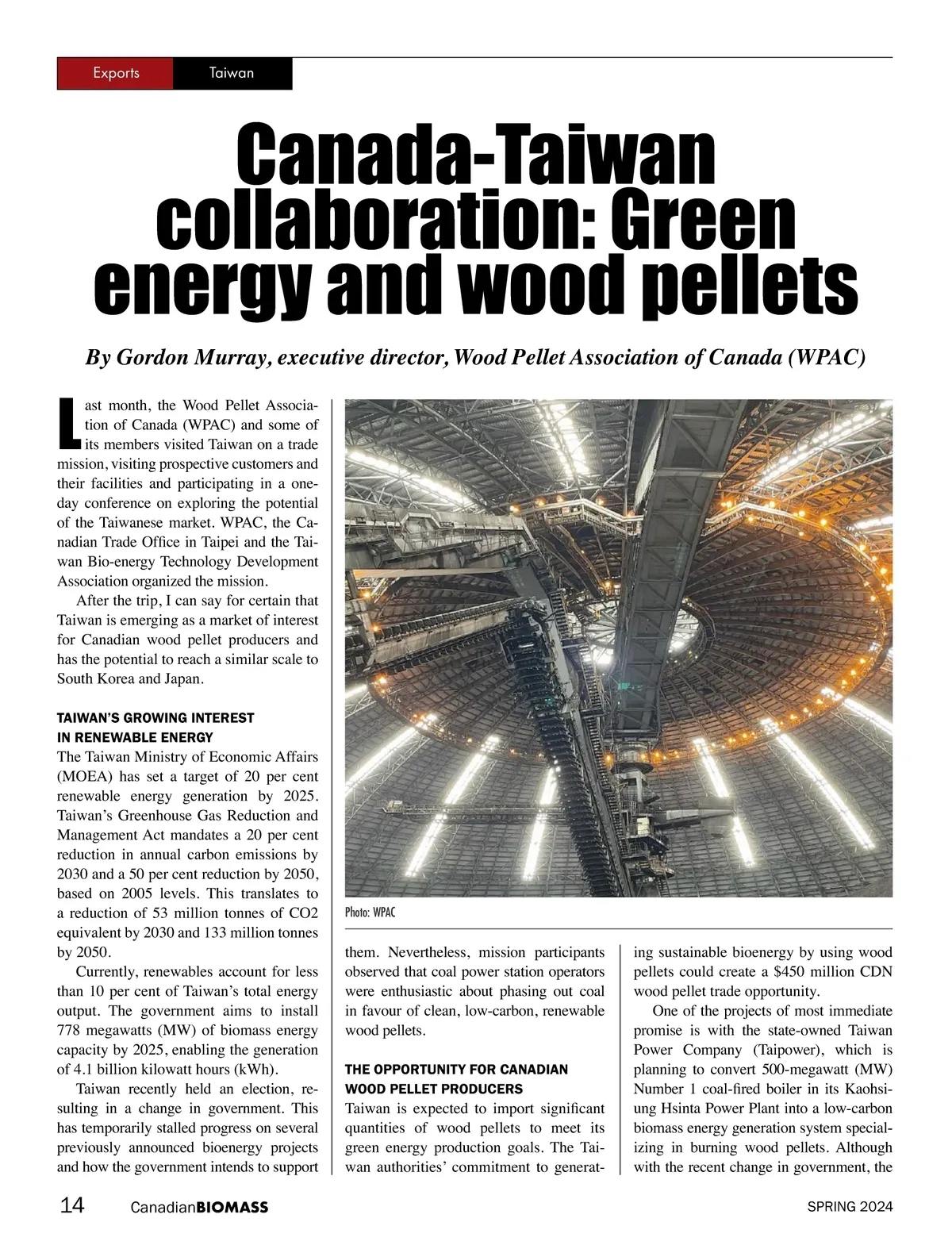
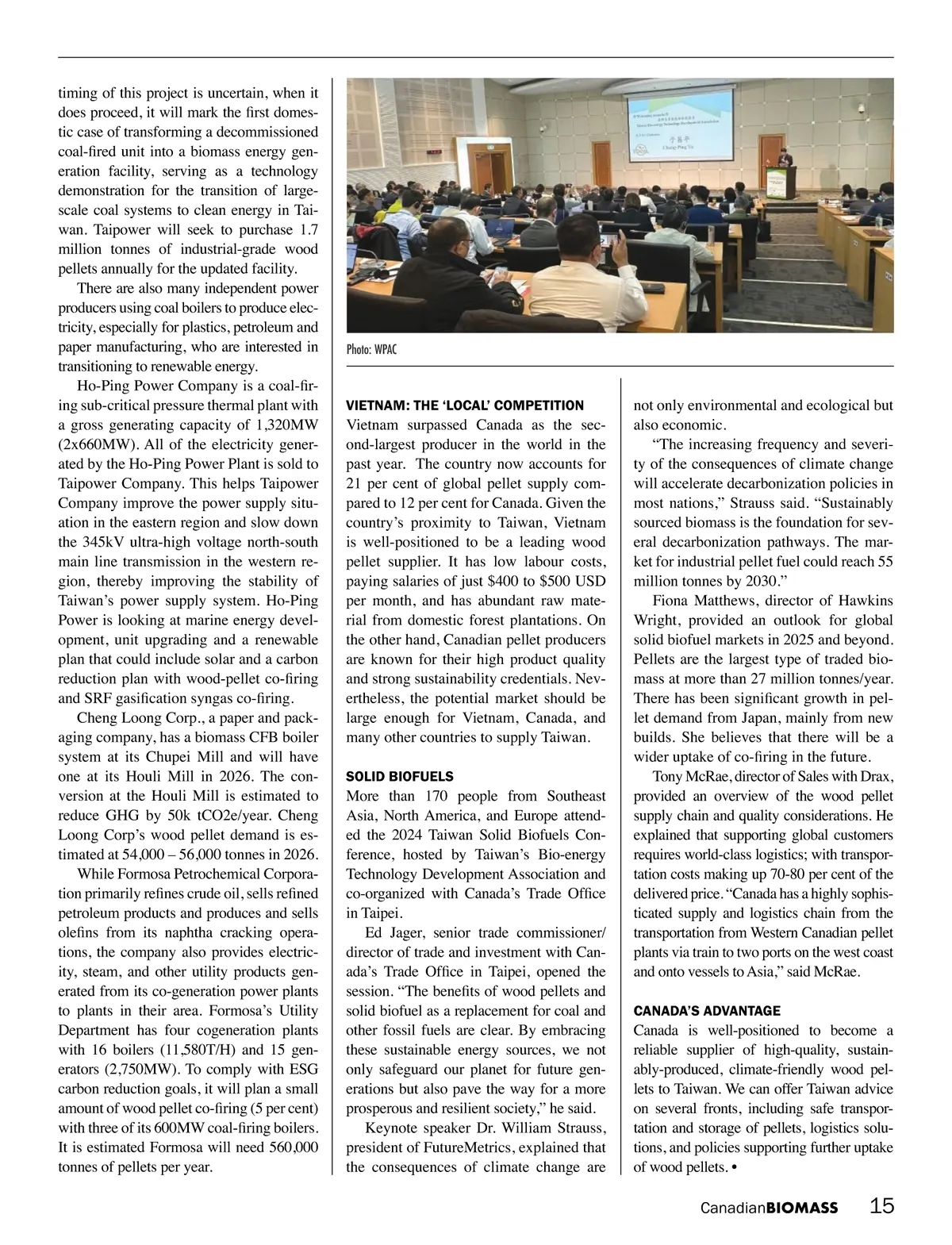
Exports Taiwan ast month, the Wood Pellet Associa-tion of Canada (WPAC) and some of its members visited Taiwan on a trade mission, visiting prospective customers and their facilities and participating in a one-day conference on exploring the potential of the Taiwanese market. WPAC, the Ca-nadian Trade Office in Taipei and the Tai -wan Bio-energy Technology Development Association organized the mission. After the trip, I can say for certain that Taiwan is emerging as a market of interest for Canadian wood pellet producers and has the potential to reach a similar scale to South Korea and Japan. TAIWAN’S GROWING INTEREST IN RENEWABLE ENERGY L By Gordon Murray, executive director, Wood Pellet Association of Canada (WPAC) Canada-Taiwan collaboration: Green energy and wood pellets The Taiwan Ministry of Economic Affairs (MOEA) has set a target of 20 per cent renewable energy generation by 2025. Taiwan’s Greenhouse Gas Reduction and Management Act mandates a 20 per cent reduction in annual carbon emissions by 2030 and a 50 per cent reduction by 2050, based on 2005 levels. This translates to a reduction of 53 million tonnes of CO2 equivalent by 2030 and 133 million tonnes by 2050. Currently, renewables account for less than 10 per cent of Taiwan’s total energy output. The government aims to install 778 megawatts (MW) of biomass energy capacity by 2025, enabling the generation of 4.1 billion kilowatt hours (kWh). Taiwan recently held an election, re-sulting in a change in government. This has temporarily stalled progress on several previously announced bioenergy projects and how the government intends to support Photo: WPAC them. Nevertheless, mission participants observed that coal power station operators were enthusiastic about phasing out coal in favour of clean, low-carbon, renewable wood pellets. THE OPPORTUNITY FOR CANADIAN WOOD PELLET PRODUCERS Taiwan is expected to import significant quantities of wood pellets to meet its green energy production goals. The Tai-wan authorities’ commitment to generat-ing sustainable bioenergy by using wood pellets could create a $450 million CDN wood pellet trade opportunity. One of the projects of most immediate promise is with the state-owned Taiwan Power Company (Taipower), which is planning to convert 500-megawatt (MW) Number 1 coal-fired boiler in its Kaohsi -ung Hsinta Power Plant into a low-carbon biomass energy generation system special-izing in burning wood pellets. Although with the recent change in government, the SPRING 2024 14 Canadian BIOMASS
Canadian Biomass Spring 2024: Page 14