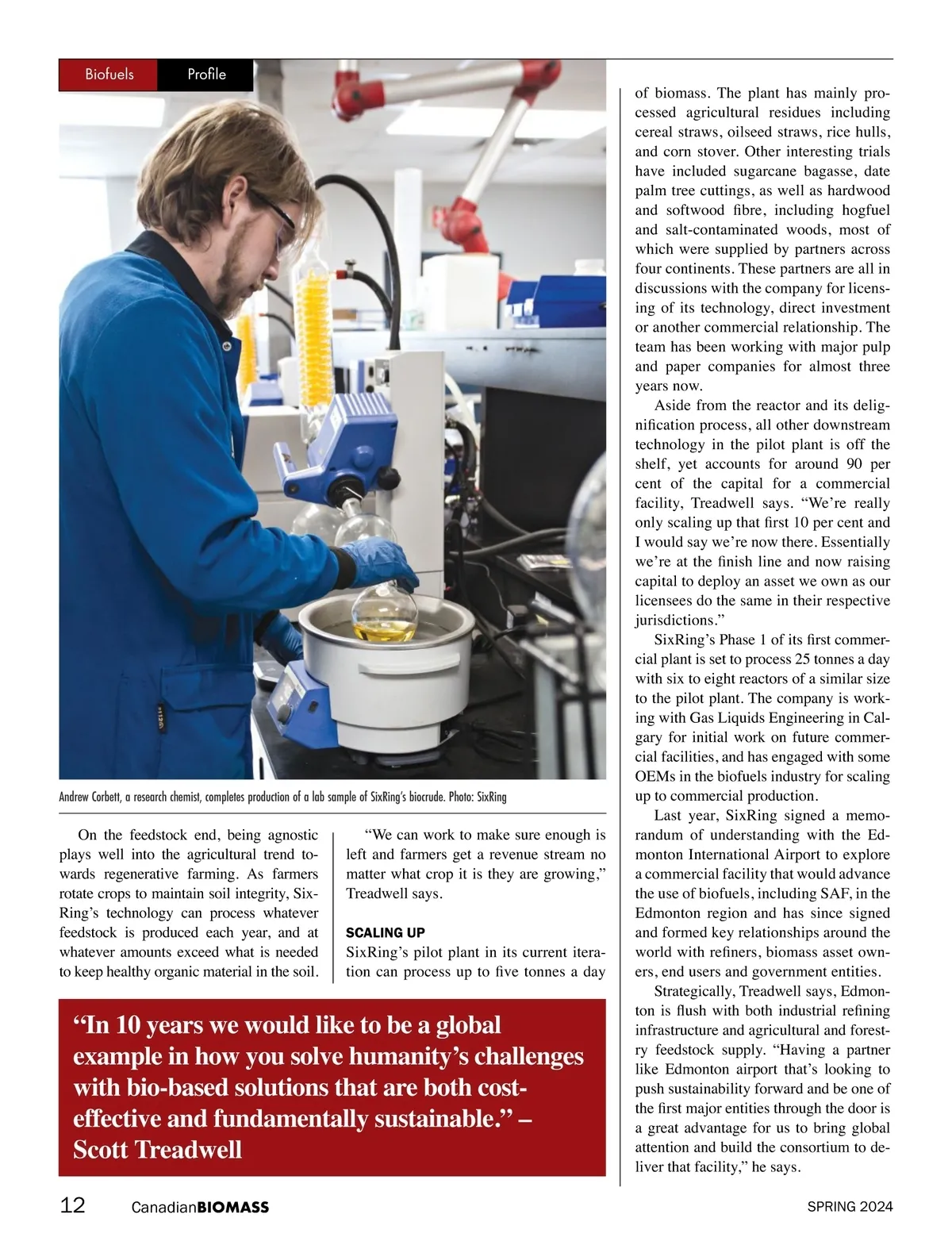
SUCCESS IN CANADA SixRing’s leadership is proud of its Canadi-an roots, but operating in Canada – a high-cost jurisdiction – comes with unique chal-lenges. Labour is one part of that challenge, as is the dwindling supply of made-in-Can-ada materials, and long hauling distances to bring in feedstocks. “Canada has done a lot to try and valo-rize biomass, not just in forestry but in ag-riculture as well,” Treadwell says. “But in a global sense, thinking of biofuels, you’re trying to chase $80 a barrel oil and $5 a gallon diesel, and if you are starting with feedstock that’s $150 a tonne, you’re on the back foot economically.” Despite these challenges, the fundamen-tal conditions to succeed in the biomass in-dustry at scale are as good in Canada as in any other jurisdiction, Treadwell says. There are some policy gaps, he acknowledges, but these policies must be balanced to ensure taxpayer money is invested sensibly. And most importantly, Treadwell says he believes the majority of Canadians are wiling to support new solutions, even those that come at a small price increase, if it’s the right thing to do, especially when they save or create new jobs. “I think Canada is a country where peo-ple are open to doing things better. If there is a slight incremental cost, people are will-ing to at least evaluate it on its benefits be -fore saying, ‘No, I don’t want to pay anoth-er nickel for my litre of gas or plane ticket.’ So I think there is an opportunity here to build markets and build end uses. There are enough people with enough good will for Canada to be a leader.” Similar to the energy industry, Tread-well says the biomass industry at times struggles to marry technical expertise with sales expertise. “Sometimes the good tech-nology and the good story aren’t the same thing. You have good technologies out there that suffer because the story is not be-ing told properly. And you have some real-ly good stories, but when you dig into them they’re not as shiny as you once thought. And that’s true in any industry,” he says. “I do think as the industry matures you will start to see a movement of talented people.” Visualizing 10 years from now, Tread-well sees success for SixRing as a multi-bil-lion-dollar company with 100 or more em-ployees that has licensed its technology C M Y CM MY CY K SixRing can process non-food biomass in almost any shape or size, including this shipment of rice hulls. Photo: SixRing globally. The company has evolved from uct development and licencing support. one that develops processes to one that is “In 10 years we would like to be a solving downstream, final-product prob -global example in how you solve human-lems. SixRing will continue to invest heav-ity’s challenges with bio-based solutions ily in R&D, he says, but that will ideally that are both cost-effective and fundamen-4.875in x 4.75in-Detroit Comb Equip-Canadian Biomass copy.pdf 1 6/16/2023 10:57:34 AM shift from 2023-06-15 tech commercialization to prod-tally sustainable,” Treadwell says. • CMY Canadian BIOMASS CB_DetroitStoker_Summer23.indd 1 13 2023-06-19 11:21 AM
Canadian Biomass Spring 2024: Page 13