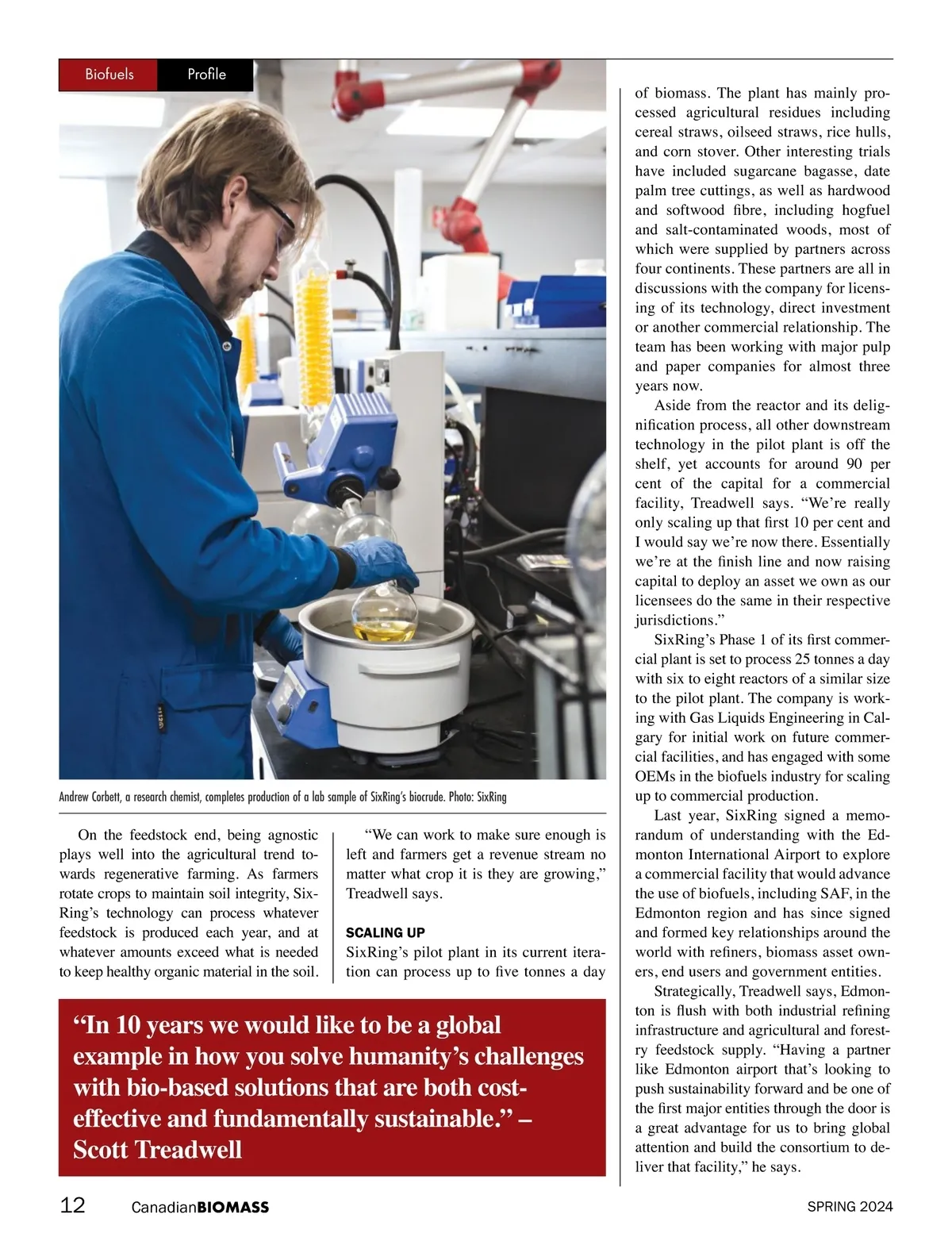
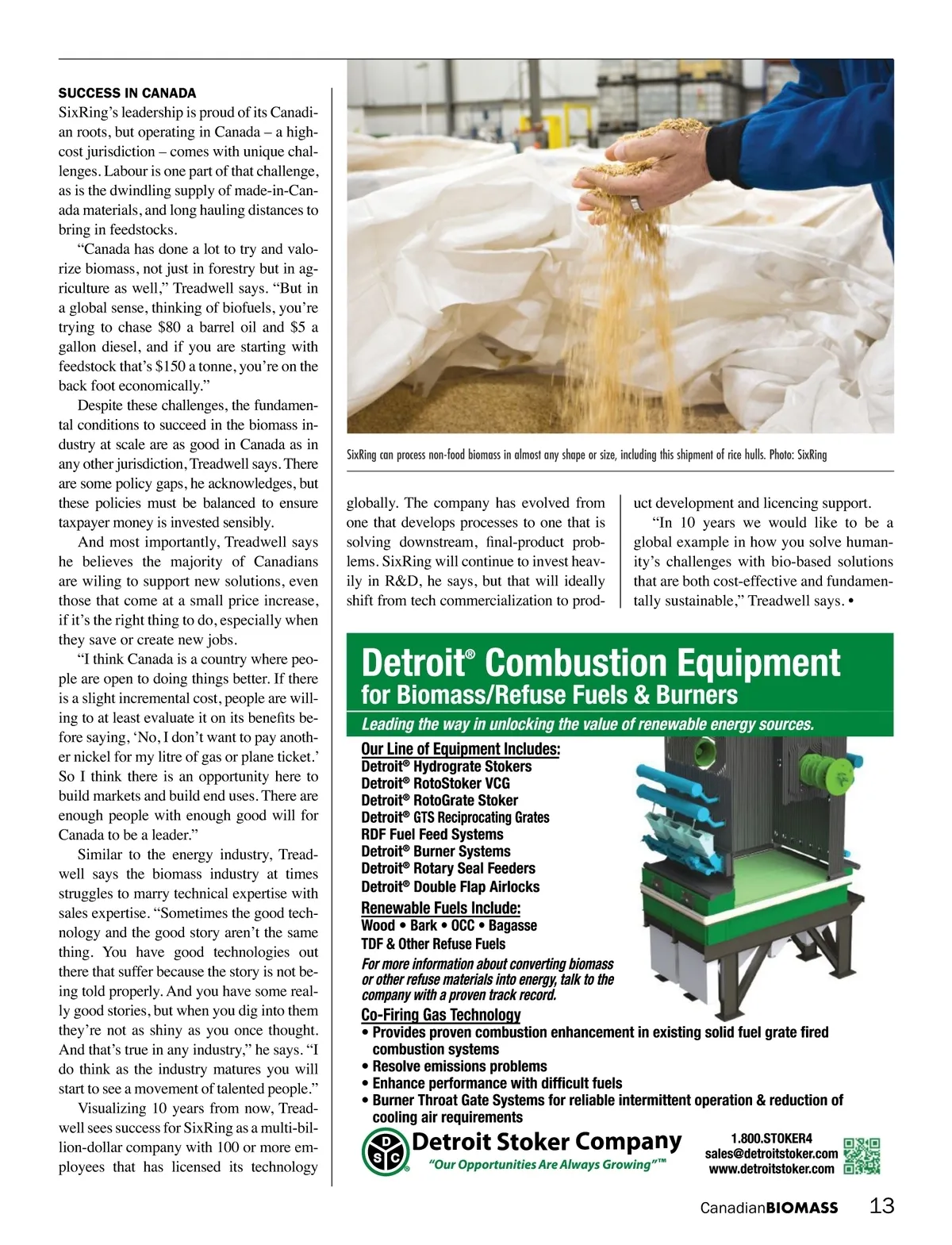
Biofuels Profile Andrew Corbett, a research chemist, completes production of a lab sample of SixRing’s biocrude. Photo: SixRing On the feedstock end, being agnostic plays well into the agricultural trend to-wards regenerative farming. As farmers rotate crops to maintain soil integrity, Six-Ring’s technology can process whatever feedstock is produced each year, and at whatever amounts exceed what is needed to keep healthy organic material in the soil. “We can work to make sure enough is left and farmers get a revenue stream no matter what crop it is they are growing,” Treadwell says. SCALING UP SixRing’s pilot plant in its current itera-tion can process up to five tonnes a day “In 10 years we would like to be a global example in how you solve humanity’s challenges with bio-based solutions that are both cost-effective and fundamentally sustainable.” – Scott Treadwell 12 Canadian BIOMASS of biomass. The plant has mainly pro-cessed agricultural residues including cereal straws, oilseed straws, rice hulls, and corn stover. Other interesting trials have included sugarcane bagasse, date palm tree cuttings, as well as hardwood and softwood fibre, including hogfuel and salt-contaminated woods, most of which were supplied by partners across four continents. These partners are all in discussions with the company for licens-ing of its technology, direct investment or another commercial relationship. The team has been working with major pulp and paper companies for almost three years now. Aside from the reactor and its delig-nification process, all other downstream technology in the pilot plant is off the shelf, yet accounts for around 90 per cent of the capital for a commercial facility, Treadwell says. “We’re really only scaling up that first 10 per cent and I would say we’re now there. Essentially we’re at the finish line and now raising capital to deploy an asset we own as our licensees do the same in their respective jurisdictions.” SixRing’s Phase 1 of its first commer -cial plant is set to process 25 tonnes a day with six to eight reactors of a similar size to the pilot plant. The company is work-ing with Gas Liquids Engineering in Cal-gary for initial work on future commer-cial facilities, and has engaged with some OEMs in the biofuels industry for scaling up to commercial production. Last year, SixRing signed a memo-randum of understanding with the Ed-monton International Airport to explore a commercial facility that would advance the use of biofuels, including SAF, in the Edmonton region and has since signed and formed key relationships around the world with refiners, biomass asset own -ers, end users and government entities. Strategically, Treadwell says, Edmon-ton is flush with both industrial refining infrastructure and agricultural and forest-ry feedstock supply. “Having a partner like Edmonton airport that’s looking to push sustainability forward and be one of the first major entities through the door is a great advantage for us to bring global attention and build the consortium to de-liver that facility,” he says. SPRING 2024
Canadian Biomass Spring 2024: Page 12