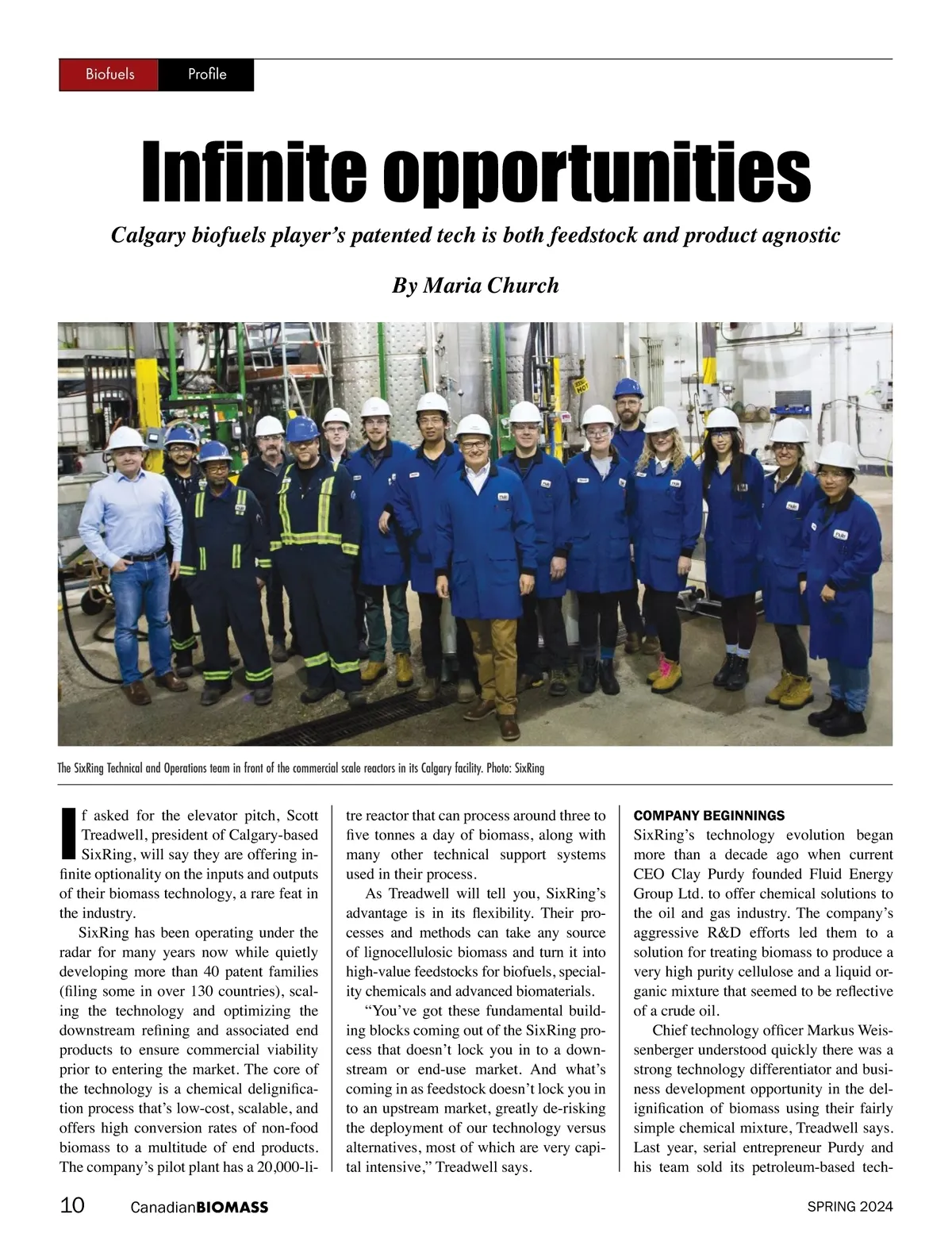
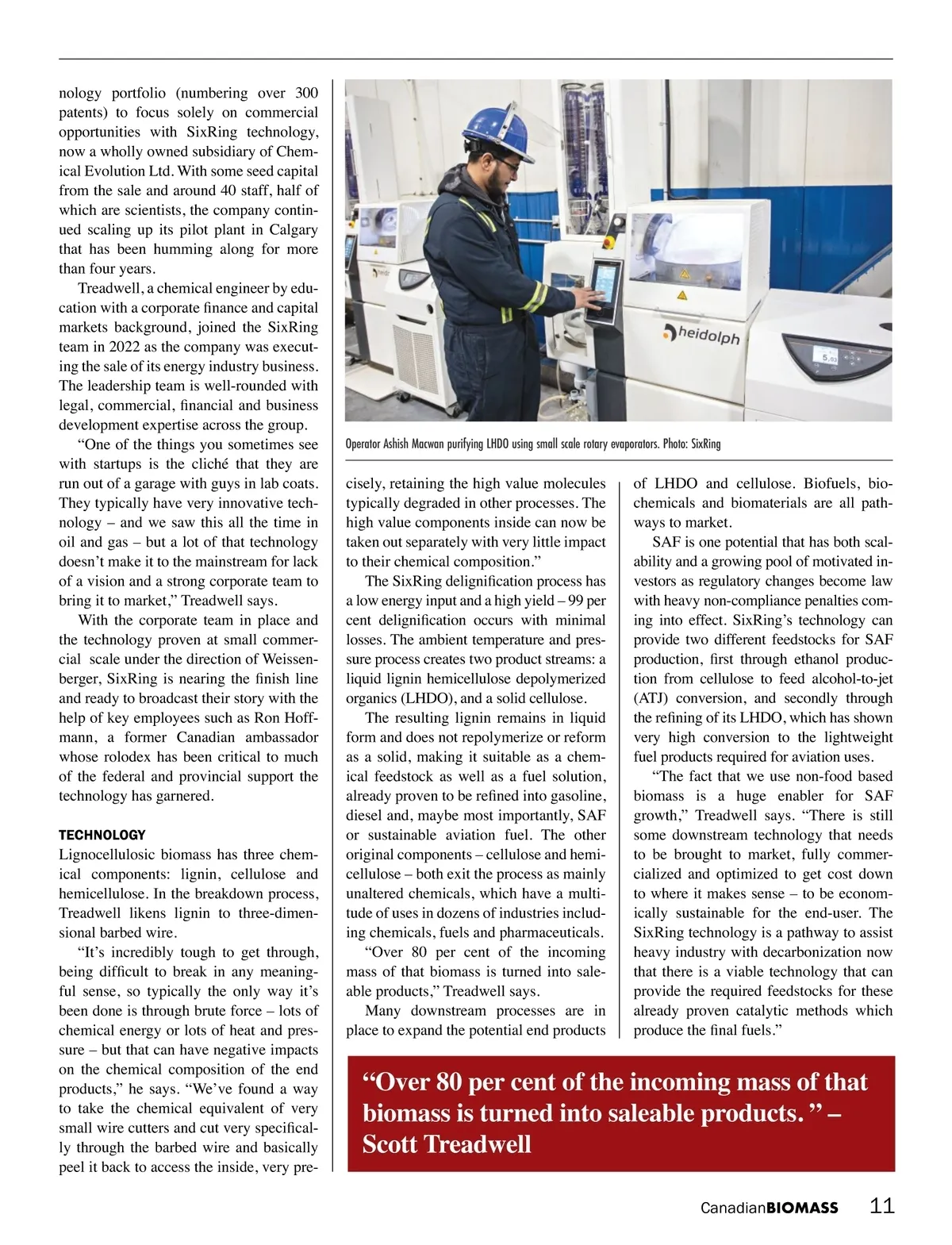
nology portfolio (numbering over 300 patents) to focus solely on commercial opportunities with SixRing technology, now a wholly owned subsidiary of Chem-ical Evolution Ltd. With some seed capital from the sale and around 40 staff, half of which are scientists, the company contin-ued scaling up its pilot plant in Calgary that has been humming along for more than four years. Treadwell, a chemical engineer by edu-cation with a corporate finance and capital markets background, joined the SixRing team in 2022 as the company was execut-ing the sale of its energy industry business. The leadership team is well-rounded with legal, commercial, financial and business development expertise across the group. “One of the things you sometimes see with startups is the cliché that they are run out of a garage with guys in lab coats. They typically have very innovative tech-nology – and we saw this all the time in oil and gas – but a lot of that technology doesn’t make it to the mainstream for lack of a vision and a strong corporate team to bring it to market,” Treadwell says. With the corporate team in place and the technology proven at small commer-cial scale under the direction of Weissen-berger, SixRing is nearing the finish line and ready to broadcast their story with the help of key employees such as Ron Hoff-mann, a former Canadian ambassador whose rolodex has been critical to much of the federal and provincial support the technology has garnered. TECHNOLOGY Operator Ashish Macwan purifying LHDO using small scale rotary evaporators. Photo: SixRing Lignocellulosic biomass has three chem-ical components: lignin, cellulose and hemicellulose. In the breakdown process, Treadwell likens lignin to three-dimen-sional barbed wire. “It’s incredibly tough to get through, being difficult to break in any meaning -ful sense, so typically the only way it’s been done is through brute force – lots of chemical energy or lots of heat and pres-sure – but that can have negative impacts on the chemical composition of the end products,” he says. “We’ve found a way to take the chemical equivalent of very small wire cutters and cut very specifical -ly through the barbed wire and basically peel it back to access the inside, very pre-cisely, retaining the high value molecules typically degraded in other processes. The high value components inside can now be taken out separately with very little impact to their chemical composition.” The SixRing delignification process has a low energy input and a high yield – 99 per cent delignification occurs with minimal losses. The ambient temperature and pres-sure process creates two product streams: a liquid lignin hemicellulose depolymerized organics (LHDO), and a solid cellulose. The resulting lignin remains in liquid form and does not repolymerize or reform as a solid, making it suitable as a chem-ical feedstock as well as a fuel solution, already proven to be refined into gasoline, diesel and, maybe most importantly, SAF or sustainable aviation fuel. The other original components – cellulose and hemi-cellulose – both exit the process as mainly unaltered chemicals, which have a multi-tude of uses in dozens of industries includ-ing chemicals, fuels and pharmaceuticals. “Over 80 per cent of the incoming mass of that biomass is turned into sale-able products,” Treadwell says. Many downstream processes are in place to expand the potential end products of LHDO and cellulose. Biofuels, bio-chemicals and biomaterials are all path-ways to market. SAF is one potential that has both scal-ability and a growing pool of motivated in-vestors as regulatory changes become law with heavy non-compliance penalties com-ing into effect. SixRing’s technology can provide two different feedstocks for SAF production, first through ethanol produc -tion from cellulose to feed alcohol-to-jet (ATJ) conversion, and secondly through the refining of its LHDO, which has shown very high conversion to the lightweight fuel products required for aviation uses. “The fact that we use non-food based biomass is a huge enabler for SAF growth,” Treadwell says. “There is still some downstream technology that needs to be brought to market, fully commer-cialized and optimized to get cost down to where it makes sense – to be econom-ically sustainable for the end-user. The SixRing technology is a pathway to assist heavy industry with decarbonization now that there is a viable technology that can provide the required feedstocks for these already proven catalytic methods which produce the final fuels.” “Over 80 per cent of the incoming mass of that biomass is turned into saleable products. ” – Scott Treadwell Canadian BIOMASS 11
Canadian Biomass Spring 2024: Page 11