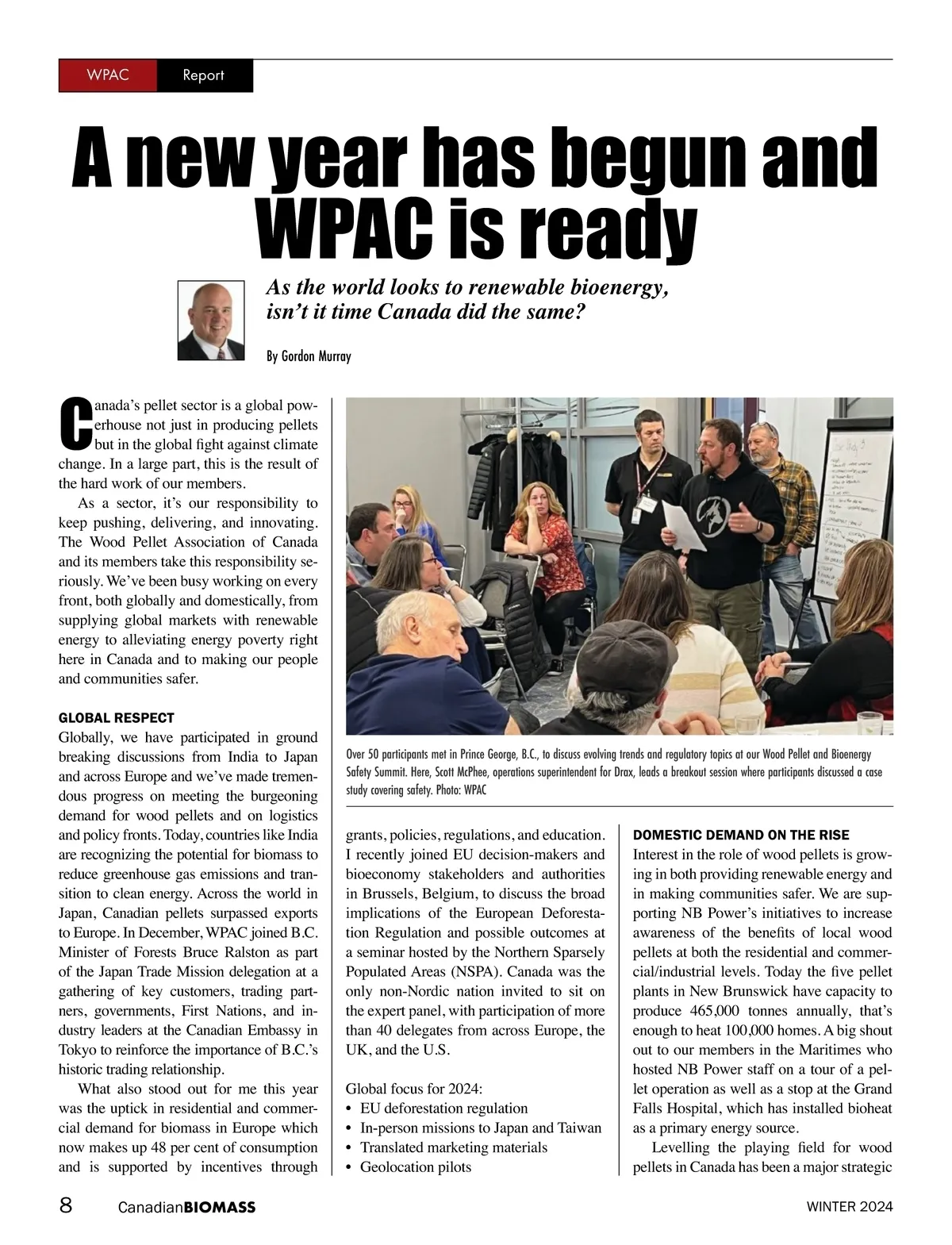
WPAC Report A new year has begun and WPAC is ready As the world looks to renewable bioenergy, isn’t it time Canada did the same? By Gordon Murray C anada’s pellet sector is a global pow-erhouse not just in producing pellets but in the global fight against climate change. In a large part, this is the result of the hard work of our members. As a sector, it’s our responsibility to keep pushing, delivering, and innovating. The Wood Pellet Association of Canada and its members take this responsibility se -riously. We’ve been busy working on every front, both globally and domestically, from supplying global markets with renewable energy to alleviating energy poverty right here in Canada and to making our people and communities safer. GLOBAL RESPECT Globally, we have participated in ground breaking discussions from India to Japan and across Europe and we’ve made tremen-dous progress on meeting the burgeoning demand for wood pellets and on logistics and policy fronts. Today, countries like India are recognizing the potential for biomass to reduce greenhouse gas emissions and tran-sition to clean energy. Across the world in Japan, Canadian pellets surpassed exports to Europe. In December, WPAC joined B.C. Minister of Forests Bruce Ralston as part of the Japan Trade Mission delegation at a gathering of key customers, trading part -ners, governments, First Nations, and in-dustry leaders at the Canadian Embassy in Tokyo to reinforce the importance of B.C.’s historic trading relationship. What also stood out for me this year was the uptick in residential and commer -cial demand for biomass in Europe which now makes up 48 per cent of consumption and is supported by incentives through Over 50 participants met in Prince George, B.C., to discuss evolving trends and regulatory topics at our Wood Pellet and Bioenergy Safety Summit. Here, Scott McPhee, operations superintendent for Drax, leads a breakout session where participants discussed a case study covering safety. Photo: WPAC grants, policies, regulations, and education. I recently joined EU decision-makers and bioeconomy stakeholders and authorities in Brussels, Belgium, to discuss the broad implications of the European Deforesta-tion Regulation and possible outcomes at a seminar hosted by the Northern Sparsely Populated Areas (NSPA). Canada was the only non-Nordic nation invited to sit on the expert panel, with participation of more than 40 delegates from across Europe, the UK, and the U.S. Global focus for 2024: • EU deforestation regulation • In-person missions to Japan and Taiwan • Translated marketing materials • Geolocation pilots DOMESTIC DEMAND ON THE RISE Interest in the role of wood pellets is grow-ing in both providing renewable energy and in making communities safer. We are sup -porting NB Power’s initiatives to increase awareness of the benefits of local wood pellets at both the residential and commer-cial/industrial levels. Today the five pellet plants in New Brunswick have capacity to produce 465,000 tonnes annually, that’s enough to heat 100,000 homes. A big shout out to our members in the Maritimes who hosted NB Power staff on a tour of a pel -let operation as well as a stop at the Grand Falls Hospital, which has installed bioheat as a primary energy source. Levelling the playing field for wood pellets in Canada has been a major strategic WINTER 2024 8 Canadian BIOMASS
Canadian Biomass Winter 2024: Page 8