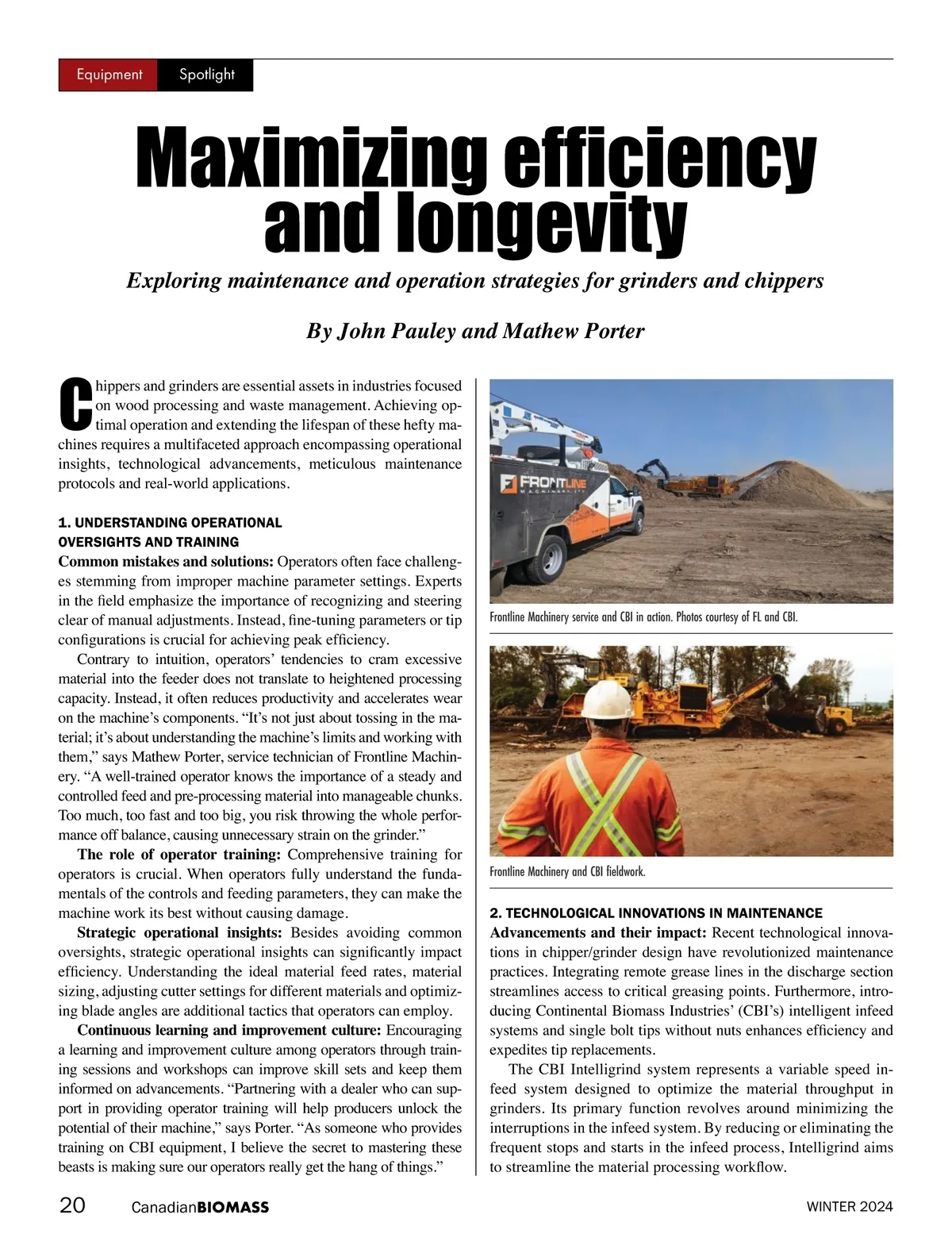
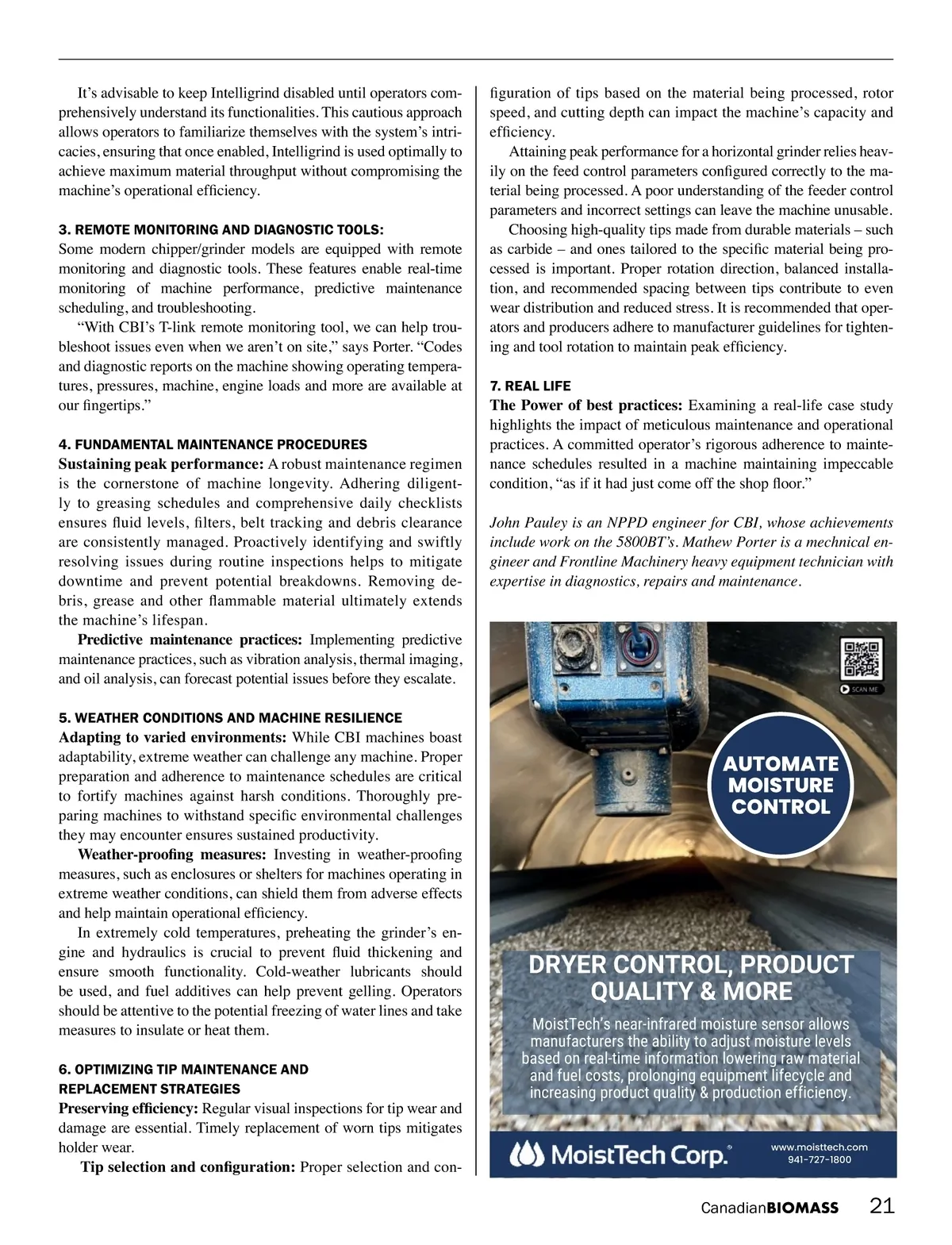
Equipment Spotlight Exploring maintenance and operation strategies for grinders and chippers By John Pauley and Mathew Porter Maximizing efficiency and longevity C hippers and grinders are essential assets in industries focused on wood processing and waste management. Achieving op-timal operation and extending the lifespan of these hefty ma-chines requires a multifaceted approach encompassing operational insights, technological advancements, meticulous maintenance protocols and real-world applications. 1. UNDERSTANDING OPERATIONAL OVERSIGHTS AND TRAINING Common mistakes and solutions: Operators often face challeng-es stemming from improper machine parameter settings. Experts in the field emphasize the importance of recognizing and steering clear of manual adjustments. Instead, fine-tuning parameters or tip configurations is crucial for achieving peak efficiency. Contrary to intuition, operators’ tendencies to cram excessive material into the feeder does not translate to heightened processing capacity. Instead, it often reduces productivity and accelerates wear on the machine’s components. “It’s not just about tossing in the ma-terial; it’s about understanding the machine’s limits and working with them,” says Mathew Porter, service technician of Frontline Machin -ery. “A well-trained operator knows the importance of a steady and controlled feed and pre-processing material into manageable chunks. Too much, too fast and too big, you risk throwing the whole perfor -mance off balance, causing unnecessary strain on the grinder.” The role of operator training: Comprehensive training for operators is crucial. When operators fully understand the funda-mentals of the controls and feeding parameters, they can make the machine work its best without causing damage. Strategic operational insights: Besides avoiding common oversights, strategic operational insights can significantly impact efficiency. Understanding the ideal material feed rates, material sizing, adjusting cutter settings for different materials and optimiz-ing blade angles are additional tactics that operators can employ. Continuous learning and improvement culture: Encouraging a learning and improvement culture among operators through train-ing sessions and workshops can improve skill sets and keep them informed on advancements. “Partnering with a dealer who can sup -port in providing operator training will help producers unlock the potential of their machine,” says Porter. “As someone who provides training on CBI equipment, I believe the secret to mastering these beasts is making sure our operators really get the hang of things.” Frontline Machinery service and CBI in action. Photos courtesy of FL and CBI. Frontline Machinery and CBI fieldwork. 2. TECHNOLOGICAL INNOVATIONS IN MAINTENANCE Advancements and their impact: Recent technological innova-tions in chipper/grinder design have revolutionized maintenance practices. Integrating remote grease lines in the discharge section streamlines access to critical greasing points. Furthermore, intro-ducing Continental Biomass Industries’ (CBI’s) intelligent infeed systems and single bolt tips without nuts enhances efficiency and expedites tip replacements. The CBI Intelligrind system represents a variable speed in-feed system designed to optimize the material throughput in grinders. Its primary function revolves around minimizing the interruptions in the infeed system. By reducing or eliminating the frequent stops and starts in the infeed process, Intelligrind aims to streamline the material processing workflow. WINTER 2024 20 Canadian BIOMASS
Canadian Biomass Winter 2024: Page 20