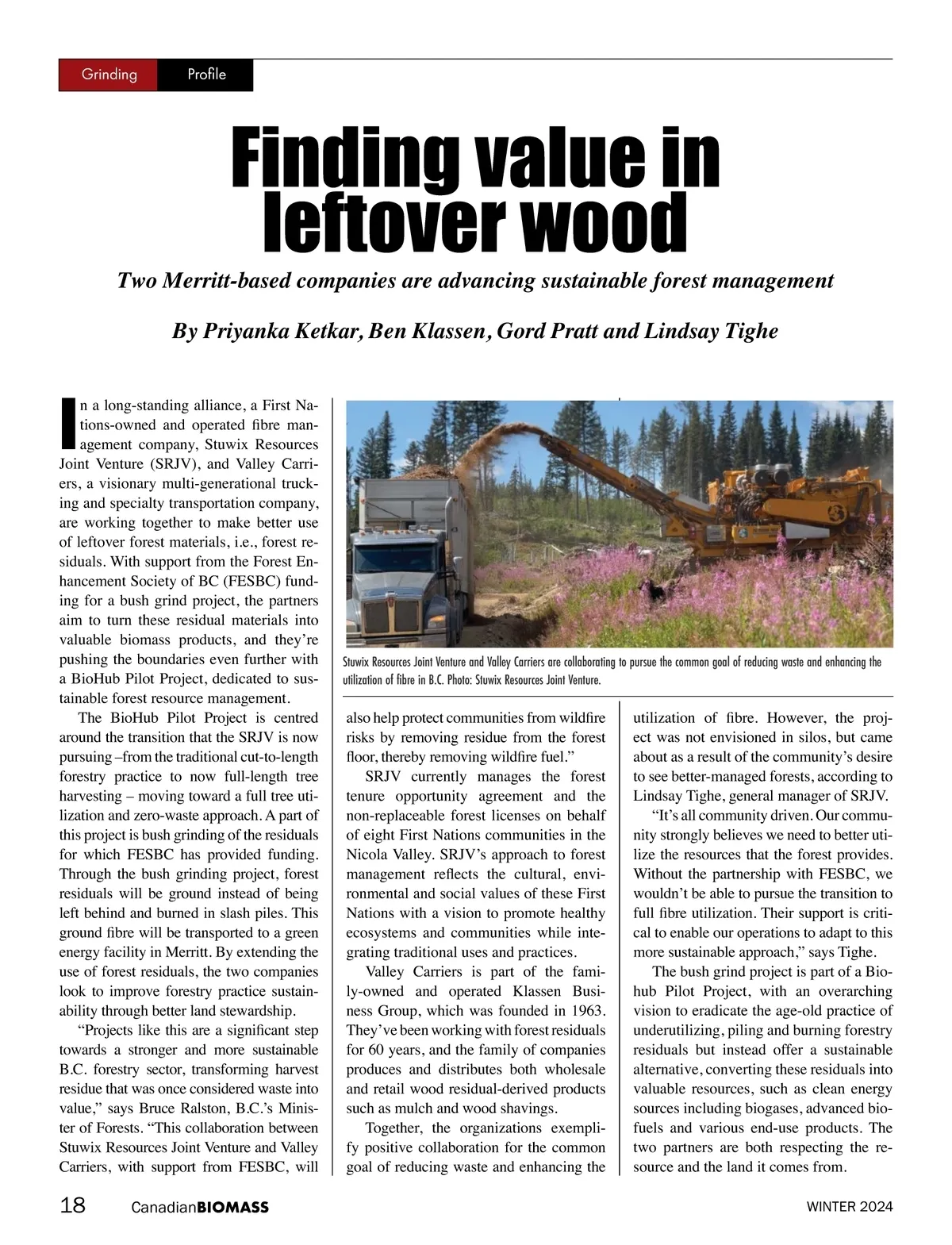
Grinding Profile Two Merritt-based companies are advancing sustainable forest management By Priyanka Ketkar, Ben Klassen, Gord Pratt and Lindsay Tighe n a long-standing alliance, a First Na-tions-owned and operated fibre man -agement company, Stuwix Resources Joint Venture (SRJV), and Valley Carri -ers, a visionary multi-generational truck -ing and specialty transportation company, are working together to make better use of leftover forest materials, i.e., forest re-siduals. With support from the Forest En-hancement Society of BC (FESBC) fund -ing for a bush grind project, the partners aim to turn these residual materials into valuable biomass products, and they’re pushing the boundaries even further with a BioHub Pilot Project, dedicated to sus -tainable forest resource management. The BioHub Pilot Project is centred around the transition that the SRJV is now pursuing –from the traditional cut-to-length forestry practice to now full-length tree harvesting – moving toward a full tree uti-lization and zero-waste approach. A part of this project is bush grinding of the residuals for which FESBC has provided funding. Through the bush grinding project, forest residuals will be ground instead of being left behind and burned in slash piles. This ground fibre will be transported to a green energy facility in Merritt. By extending the use of forest residuals, the two companies look to improve forestry practice sustain -ability through better land stewardship. “Projects like this are a significant step towards a stronger and more sustainable B.C. forestry sector, transforming harvest residue that was once considered waste into value,” says Bruce Ralston, B.C.’s Minis-ter of Forests. “This collaboration between Stuwix Resources Joint Venture and Valley Carriers, with support from FESBC, will Finding value in leftover wood I Stuwix Resources Joint Venture and Valley Carriers are collaborating to pursue the common goal of reducing waste and enhancing the utilization of fibre in B.C. Photo: Stuwix Resources Joint Venture. also help protect communities from wildfire risks by removing residue from the forest floor, thereby removing wildfire fuel.” SRJV currently manages the forest tenure opportunity agreement and the non-replaceable forest licenses on behalf of eight First Nations communities in the Nicola Valley. SRJV’s approach to forest management reflects the cultural, envi -ronmental and social values of these First Nations with a vision to promote healthy ecosystems and communities while inte-grating traditional uses and practices. Valley Carriers is part of the fami -ly-owned and operated Klassen Busi-ness Group, which was founded in 1963. They’ve been working with forest residuals for 60 years, and the family of companies produces and distributes both wholesale and retail wood residual-derived products such as mulch and wood shavings. Together, the organizations exempli-fy positive collaboration for the common goal of reducing waste and enhancing the utilization of fibre. However, the proj -ect was not envisioned in silos, but came about as a result of the community’s desire to see better-managed forests, according to Lindsay Tighe, general manager of SRJV. “It’s all community driven. Our commu-nity strongly believes we need to better uti-lize the resources that the forest provides. Without the partnership with FESBC, we wouldn’t be able to pursue the transition to full fibre utilization. Their support is criti -cal to enable our operations to adapt to this more sustainable approach,” says Tighe. The bush grind project is part of a Bio-hub Pilot Project, with an overarching vision to eradicate the age-old practice of underutilizing, piling and burning forestry residuals but instead offer a sustainable alternative, converting these residuals into valuable resources, such as clean energy sources including biogases, advanced bio-fuels and various end-use products. The two partners are both respecting the re-source and the land it comes from. WINTER 2024 18 Canadian BIOMASS
Canadian Biomass Winter 2024: Page 18