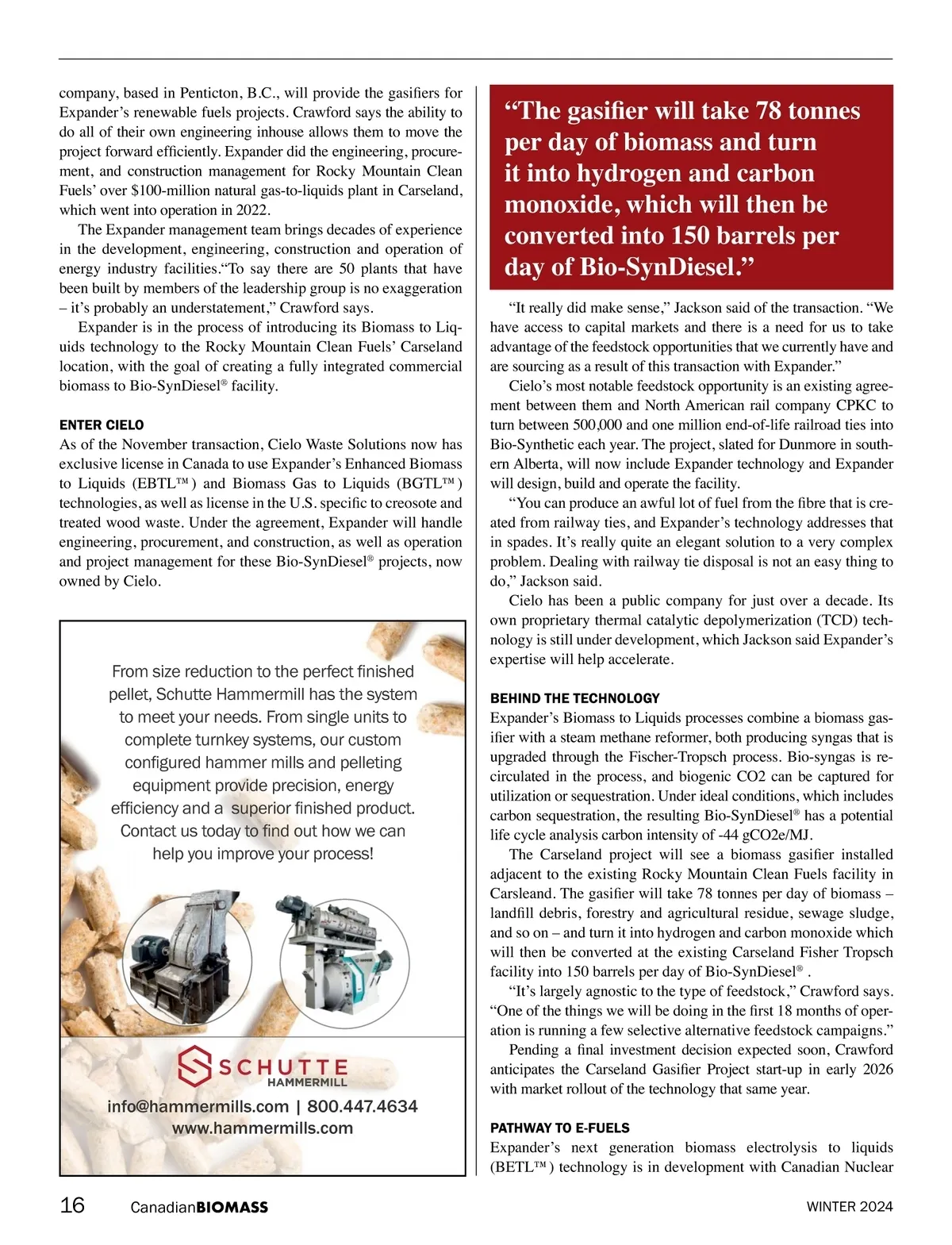
Bio-Syngas Recirculation Vent Biogenic CO 2 for Utilization or Sequestration Green Hydrogen 2:1 Syngas SMR Natural Gas (option) Fischer Tropsch “FOSSIL FREE” Net-Zero CI Renewable Fuel Bio Syngas Oxygen Biomass Gasifier Carbon Cycle Bio-CO 2 Cellulosic Biomass A figure depicting the Expander Enhanced Biomass to Liquids (EBTL™) process. Laboratories in Chalk River, Ont. The technology uses electrolysis of water in place of the steam methane reformer, pro-ducing both green hydrogen as a fuel and using hydrogen in the Fischer-Tropsch process along with bio-syngas to produce Bio-Synthetic fuel. “There’s a lot of interest from the nu-clear industry,” Crawford says. “Nuclear can produce grid-level, proven, baseload electricity. But how does that support the heavy transport liquid fuels market? Bat -tery power for small vehicles will contin-ue to roll out, but the concept of batteries for jet aircraft, heavy industrial equipment and things along those lines are far more challenging and further out.” GROWING NEED In 2023, the Canadian Council for Sus -tainable Aviation Fuels (C-SAF) put out a strategy and roadmap for building a feed-stocks-to-fuels SAF supply chain in Canada. The council has set an ambitious target of one billion litres of SAF production in Can -ada by 2030 in order to achieve a 10 per cent share of the projected Canadian jet fuel use. The roadmap further identifies that, long term, up to 90 per cent of feedstocks should be cellulosic biomass from forestry and agricultural residues, municipal solid waste, and ethanol. Expander, Crawford says, is among the Canadian firms offering a practical pro -duction pathway from those feedstocks. “We have a number of process configura -tions that allows us to get to 30 gCO2e/ MJ or lower, which is equivalent or better than the HDRD [hydrogenation-derived renewable diesel] fuels on the market, us -ing our technology,” he says. Once Carseland and Dunmore – Proj -ects 1 and 2 – are up and running over the next couple years, Cielo and Expander can build duplicate facilities anywhere the market brings them, Crawford says. Slave Lake, Alta., is a strong contender for Project 3. The companies are working with Slave Lake-based Vanderwell Con -tractors to create a large scale EBTL facil -ity alongside their sawmill. The plant will consume 300 tonnes per day of mill resid -ual fibre to produce 600 barrels per day of Bio-SynDiesel ® , Bio-SynJet ® , renewable naptha and renewable Bio-Wax. Crawford says Canada’s Clean Fuels Standard, once in place and enforced, will be a boon – but, despite the Canadian regulations, he says, market forces will dictate de -mand, which is currently dominated by California in the U.S., and countries in Europe. Canada currently has almost no SAF production, and minimal advanced biofuel production, but plenty of potential. “Canada can lead in this area,” Craw-ford says. “Alberta has traditionally had pipelines going south, east and west, pro-ducing liquid fossil fuels. What is going to fill those pipelines and supply clean en -ergy as the world becomes decarbonized? There is an opportunity for Alberta and Canada to continue to provide the world with clean, responsible energy.” • Canadian BIOMASS Untitled-2 1 17 2023-03-27 8:50 AM
Canadian Biomass Winter 2024: Page 17