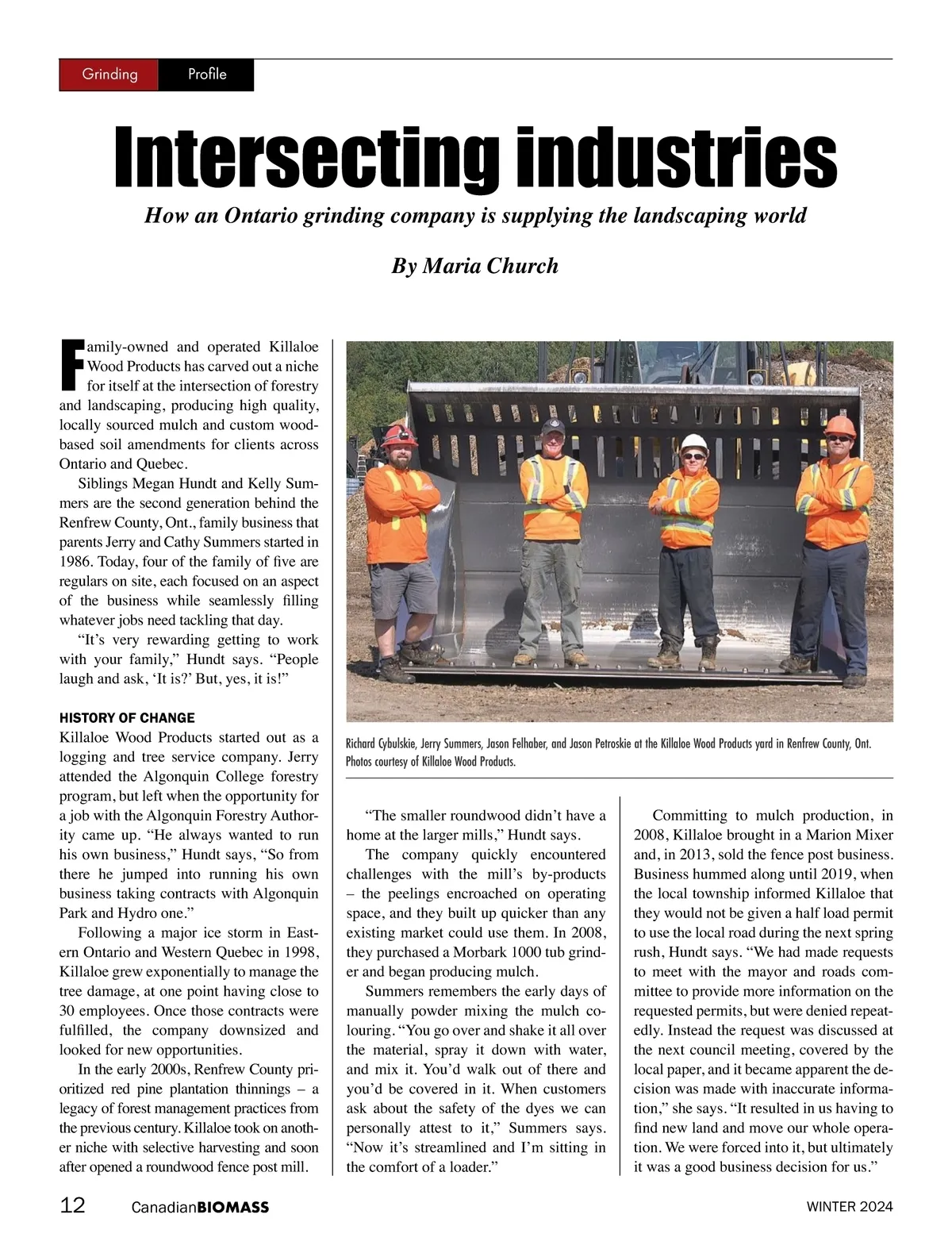
Grinding Profile Intersecting industries How an Ontario grinding company is supplying the landscaping world By Maria Church amily-owned and operated Killaloe Wood Products has carved out a niche for itself at the intersection of forestry and landscaping, producing high quality, locally sourced mulch and custom wood-based soil amendments for clients across Ontario and Quebec. Siblings Megan Hundt and Kelly Sum -mers are the second generation behind the Renfrew County, Ont., family business that parents Jerry and Cathy Summers started in 1986. Today, four of the family of five are regulars on site, each focused on an aspect of the business while seamlessly filling whatever jobs need tackling that day. “It’s very rewarding getting to work with your family,” Hundt says. “People laugh and ask, ‘It is?’ But, yes, it is!” HISTORY OF CHANGE F Killaloe Wood Products started out as a logging and tree service company. Jerry attended the Algonquin College forestry program, but left when the opportunity for a job with the Algonquin Forestry Author -ity came up. “He always wanted to run his own business,” Hundt says, “So from there he jumped into running his own business taking contracts with Algonquin Park and Hydro one.” Following a major ice storm in East-ern Ontario and Western Quebec in 1998, Killaloe grew exponentially to manage the tree damage, at one point having close to 30 employees. Once those contracts were fulfilled, the company downsized and looked for new opportunities. In the early 2000s, Renfrew County pri-oritized red pine plantation thinnings – a legacy of forest management practices from the previous century. Killaloe took on anoth -er niche with selective harvesting and soon after opened a roundwood fence post mill. Richard Cybulskie, Jerry Summers, Jason Felhaber, and Jason Petroskie at the Killaloe Wood Products yard in Renfrew County, Ont. Photos courtesy of Killaloe Wood Products. “The smaller roundwood didn’t have a home at the larger mills,” Hundt says. The company quickly encountered challenges with the mill’s by-products – the peelings encroached on operating space, and they built up quicker than any existing market could use them. In 2008, they purchased a Morbark 1000 tub grind -er and began producing mulch. Summers remembers the early days of manually powder mixing the mulch co-louring. “You go over and shake it all over the material, spray it down with water, and mix it. You’d walk out of there and you’d be covered in it. When customers ask about the safety of the dyes we can personally attest to it,” Summers says. “Now it’s streamlined and I’m sitting in the comfort of a loader.” Committing to mulch production, in 2008, Killaloe brought in a Marion Mixer and, in 2013, sold the fence post business. Business hummed along until 2019, when the local township informed Killaloe that they would not be given a half load permit to use the local road during the next spring rush, Hundt says. “We had made requests to meet with the mayor and roads com-mittee to provide more information on the requested permits, but were denied repeat -edly. Instead the request was discussed at the next council meeting, covered by the local paper, and it became apparent the de-cision was made with inaccurate informa-tion,” she says. “It resulted in us having to find new land and move our whole opera -tion. We were forced into it, but ultimately it was a good business decision for us.” WINTER 2024 12 Canadian BIOMASS
Canadian Biomass Winter 2024: Page 12