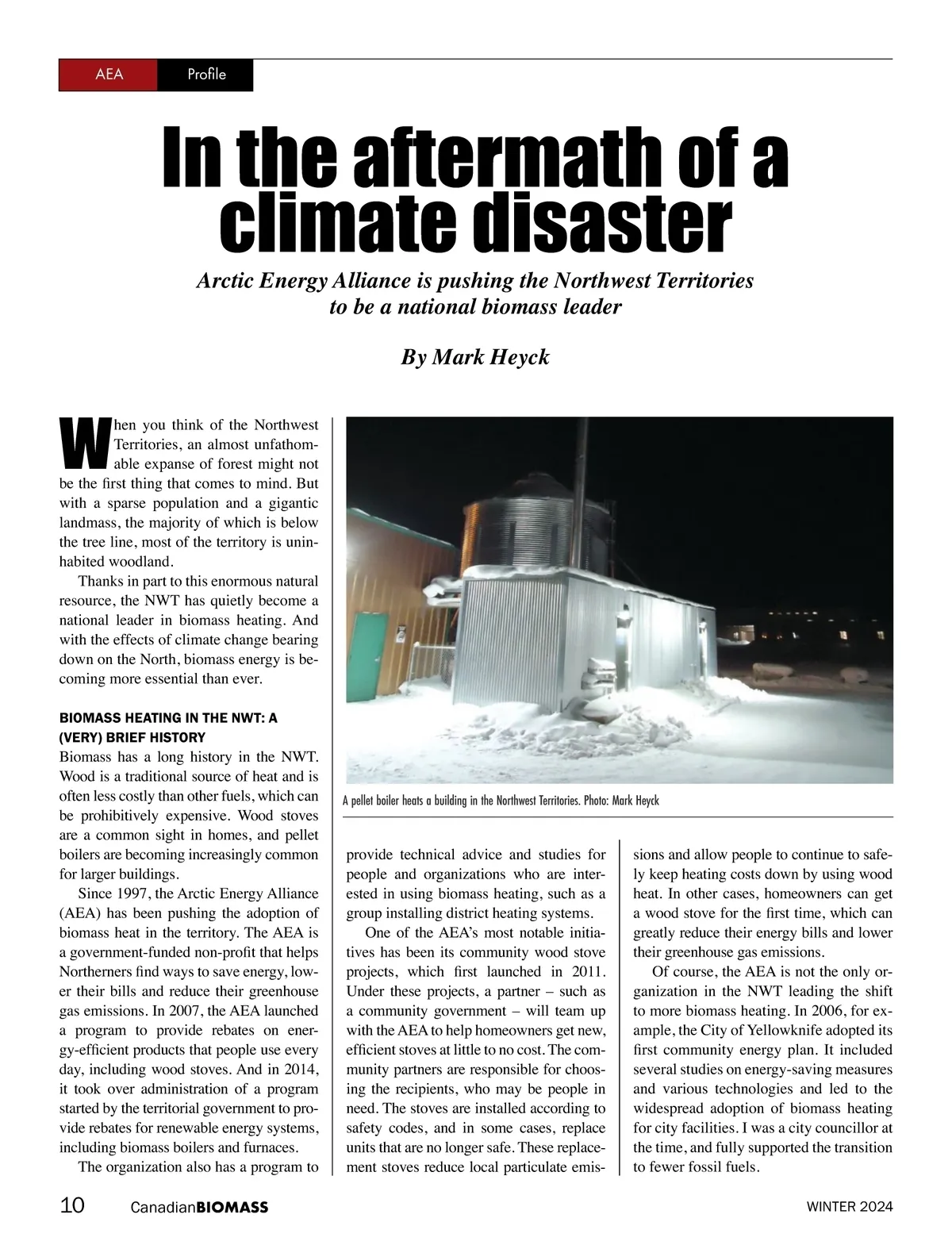
WHEN CLIMATE CHANGE HITS HOME This past summer, Canada saw its worst wildfire season on record. Proportional -ly, the NWT may have been hit harder than any other province or territory. Ap-proximately 4.1 million hectares were affected, which is 23 per cent of the to -tal area that burned across the country and equivalent to more than half of New Brunswick. Almost 70 per cent of the ter -ritory’s residents were forced to evacuate their homes and communities. And the fires released more than 110 megatonnes of carbon – more than a quarter of the emissions from all the wildfires across Canada combined. The fires were an obvious challenge for everyone in the NWT, and the AEA was no exception. The evacuations put some of the organization’s work on hold and meant it had to change the schedule for its com-munity wood stove projects for the year. The disaster brought to the fore the fact that both adaptation and mitigation are necessary when dealing with climate change. We need to prepare for extreme weather events and climate-related natural disasters. At the same time, it’s important to do all that we can to keep them from getting worse. When it comes to climate change, the AEA’s work is focused on miti -gation, and that’s where biomass comes in. WHAT CAN WE DO? The NWT’s population may be small, but with the North so affected by climate change, the territory can be a model for elsewhere. Ironically, the devastating wildfires highlight the case for biomass as one way to reduce our dependence on fos-sil fuels: when used sustainably, biofuels can be considered carbon neutral. The Government of the Northwest Territories, in its 2030 Energy Strategy , laid out a goal of reducing greenhouse gas emissions in the territory by 517 kilo -tonnes over 2016 levels. One of the major objectives to meet this goal is to increase the share of renewable energy used for space heating to 40 per cent. Biomass is one of the main ways to achieve this objective, and the AEA is helping to lead the charge. In addition to regular programs and projects, it has re-cently been promoting biomass heating through an annual Northwest Territories Biomass Week conference (the week of Jan. 29, 2024), held in conjunction with the Wood Pellet Association of Canada. It has also started what it calls biomass “fast-track” projects, where the AEA gives out rebates for installing biomass boilers. Other organizations are also working to en -courage the adoption of biomass heating, and the effort is paying off: the territory is seeing new biomass heating systems in-stalled every year. Of course, it’s not all roses. There are still gaps in the labour force and supply chains can be an issue in communities without year-round road access. More work needs to be done, and collaboration and co-operation are necessary for suc-cessful projects. But with forests aplenty and climate change looming large, the NWT is on track to continue being at the forefront of biomass heating in Canada. • Mark Heyck is the executive director of the Arctic Energy Alliance in Yellowknife, and previously served two terms as mayor. CB_Concept Air_Winter24_CSA.indd 1 Canadian BIOMASS 2024-01-18 2:14 PM 11
Canadian Biomass Winter 2024: Page 11