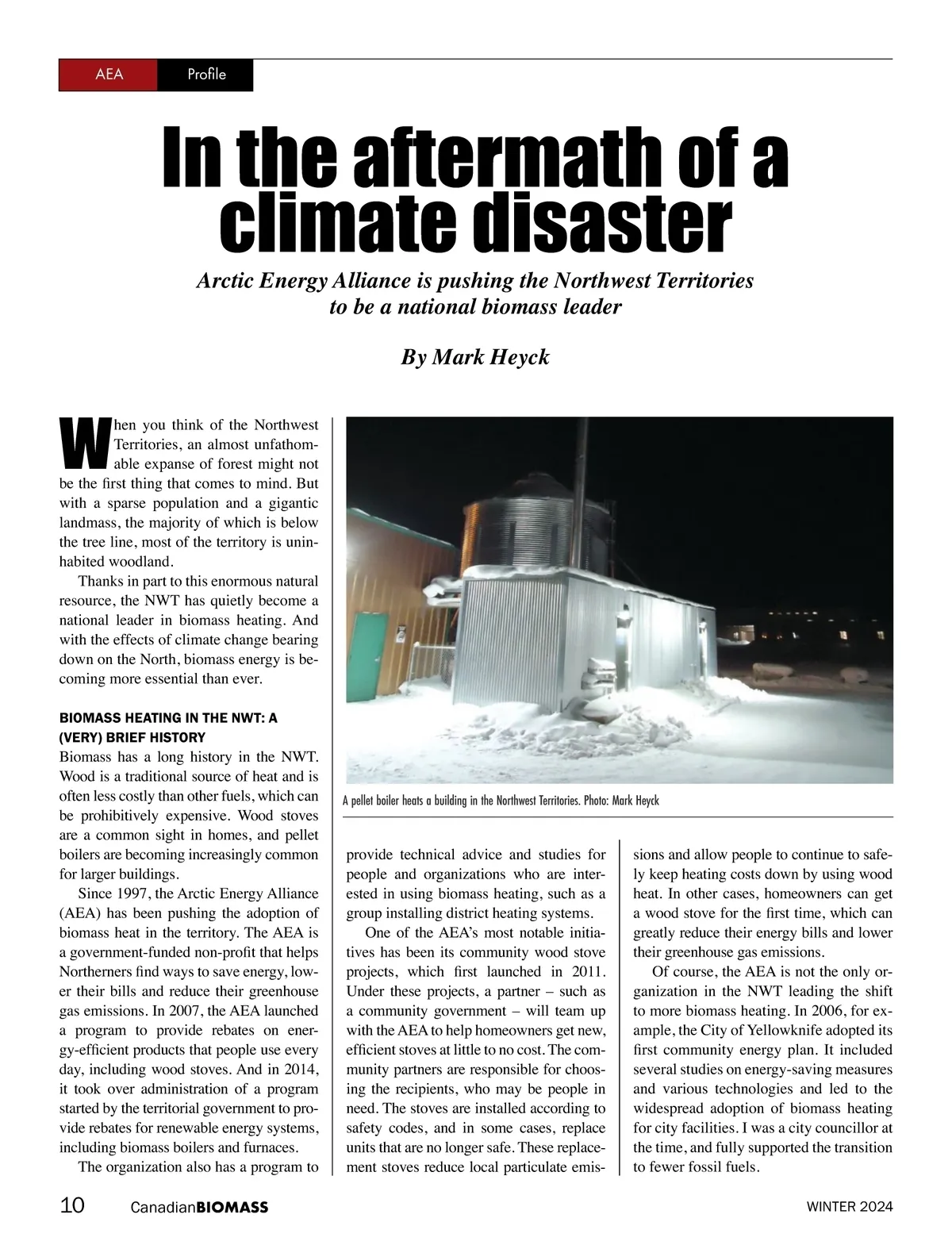
AEA Profile In the aftermath of a climate disaster Arctic Energy Alliance is pushing the Northwest Territories to be a national biomass leader By Mark Heyck W hen you think of the Northwest Territories, an almost unfathom-able expanse of forest might not be the first thing that comes to mind. But with a sparse population and a gigantic landmass, the majority of which is below the tree line, most of the territory is unin-habited woodland. Thanks in part to this enormous natural resource, the NWT has quietly become a national leader in biomass heating. And with the effects of climate change bearing down on the North, biomass energy is be-coming more essential than ever. BIOMASS HEATING IN THE NWT: A (VERY) BRIEF HISTORY Biomass has a long history in the NWT. Wood is a traditional source of heat and is often less costly than other fuels, which can be prohibitively expensive. Wood stoves are a common sight in homes, and pellet boilers are becoming increasingly common for larger buildings. Since 1997, the Arctic Energy Alliance (AEA) has been pushing the adoption of biomass heat in the territory. The AEA is a government-funded non-profit that helps Northerners find ways to save energy, low -er their bills and reduce their greenhouse gas emissions. In 2007, the AEA launched a program to provide rebates on ener-gy-efficient products that people use every day, including wood stoves. And in 2014, it took over administration of a program started by the territorial government to pro-vide rebates for renewable energy systems, including biomass boilers and furnaces. The organization also has a program to A pellet boiler heats a building in the Northwest Territories. Photo: Mark Heyck provide technical advice and studies for people and organizations who are inter-ested in using biomass heating, such as a group installing district heating systems. One of the AEA’s most notable initia-tives has been its community wood stove projects, which first launched in 2011. Under these projects, a partner – such as a community government – will team up with the AEA to help homeowners get new, efficient stoves at little to no cost. The com -munity partners are responsible for choos-ing the recipients, who may be people in need. The stoves are installed according to safety codes, and in some cases, replace units that are no longer safe. These replace-ment stoves reduce local particulate emis-sions and allow people to continue to safe-ly keep heating costs down by using wood heat. In other cases, homeowners can get a wood stove for the first time, which can greatly reduce their energy bills and lower their greenhouse gas emissions. Of course, the AEA is not the only or-ganization in the NWT leading the shift to more biomass heating. In 2006, for ex-ample, the City of Yellowknife adopted its first community energy plan. It included several studies on energy-saving measures and various technologies and led to the widespread adoption of biomass heating for city facilities. I was a city councillor at the time, and fully supported the transition to fewer fossil fuels. WINTER 2024 10 Canadian BIOMASS
Canadian Biomass Winter 2024: Page 10