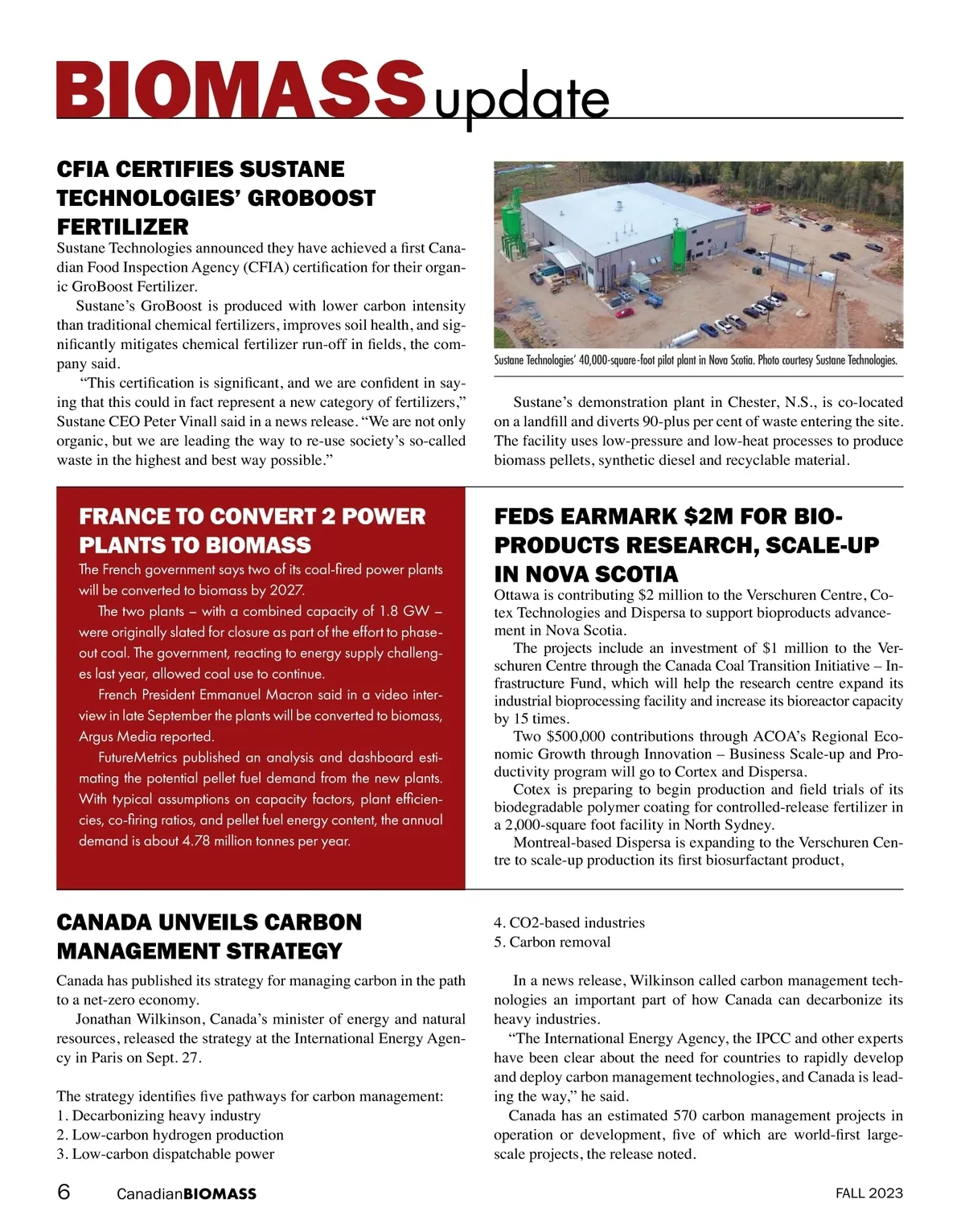
CFIA CERTIFIES SUSTANE TECHNOLOGIES’ GROBOOST FERTILIZER Sustane Technologies announced they have achieved a first Cana -dian Food Inspection Agency (CFIA) certification for their organ -ic GroBoost Fertilizer. Sustane’s GroBoost is produced with lower carbon intensity than traditional chemical fertilizers, improves soil health, and sig -nificantly mitigates chemical fertilizer run-off in fields, the com -pany said. “This certification is significant, and we are confident in say -ing that this could in fact represent a new category of fertilizers,” Sustane CEO Peter Vinall said in a news release. “We are not only organic, but we are leading the way to re-use society’s so-called waste in the highest and best way possible.” Sustane Technologies’ 40,000-square-foot pilot plant in Nova Scotia. Photo courtesy Sustane Technologies. Sustane’s demonstration plant in Chester, N.S., is co-located on a landfill and diverts 90-plus per cent of waste entering the site. The facility uses low-pressure and low-heat processes to produce biomass pellets, synthetic diesel and recyclable material. FRANCE TO CONVERT 2 POWER PLANTS TO BIOMASS The French government says two of its coal-fired power plants will be converted to biomass by 2027. The two plants – with a combined capacity of 1.8 GW – were originally slated for closure as part of the effort to phase-out coal. The government, reacting to energy supply challeng-es last year, allowed coal use to continue. French President Emmanuel Macron said in a video inter-view in late September the plants will be converted to biomass, Argus Media reported. FutureMetrics published an analysis and dashboard esti-mating the potential pellet fuel demand from the new plants. With typical assumptions on capacity factors, plant efficien-cies, co-firing ratios, and pellet fuel energy content, the annual demand is about 4.78 million tonnes per year. FEDS EARMARK $2M FOR BIO-PRODUCTS RESEARCH, SCALE-UP IN NOVA SCOTIA Ottawa is contributing $2 million to the Verschuren Centre, Co-tex Technologies and Dispersa to support bioproducts advance-ment in Nova Scotia. The projects include an investment of $1 million to the Ver-schuren Centre through the Canada Coal Transition Initiative – In-frastructure Fund, which will help the research centre expand its industrial bioprocessing facility and increase its bioreactor capacity by 15 times. Two $500,000 contributions through ACOA’s Regional Eco-nomic Growth through Innovation – Business Scale-up and Pro-ductivity program will go to Cortex and Dispersa. Cotex is preparing to begin production and field trials of its biodegradable polymer coating for controlled-release fertilizer in a 2,000-square foot facility in North Sydney. Montreal-based Dispersa is expanding to the Verschuren Cen-tre to scale-up production its first biosurfactant product, 4. CO2-based industries 5. Carbon removal In a news release, Wilkinson called carbon management tech-nologies an important part of how Canada can decarbonize its heavy industries. “The International Energy Agency, the IPCC and other experts have been clear about the need for countries to rapidly develop and deploy carbon management technologies, and Canada is lead-ing the way,” he said. Canada has an estimated 570 carbon management projects in operation or development, five of which are world-first large-scale projects, the release noted. FALL 2023 CANADA UNVEILS CARBON MANAGEMENT STRATEGY Canada has published its strategy for managing carbon in the path to a net-zero economy. Jonathan Wilkinson, Canada’s minister of energy and natural resources, released the strategy at the International Energy Agen-cy in Paris on Sept. 27. The strategy identifies five pathways for carbon management: 1. Decarbonizing heavy industry 2. Low-carbon hydrogen production 3. Low-carbon dispatchable power 6 Canadian BIOMASS
Canadian Biomass Fall 2023: Page 6