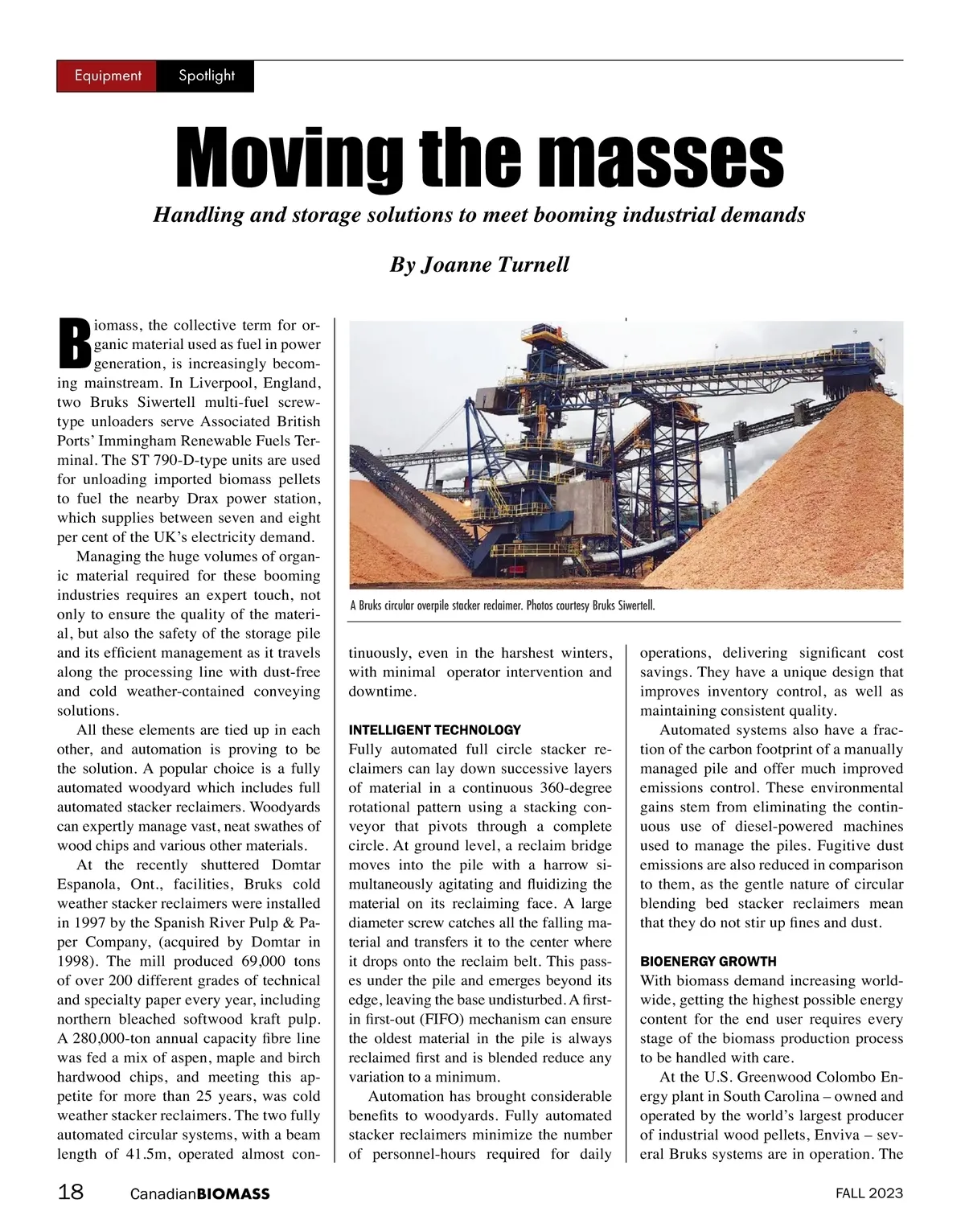
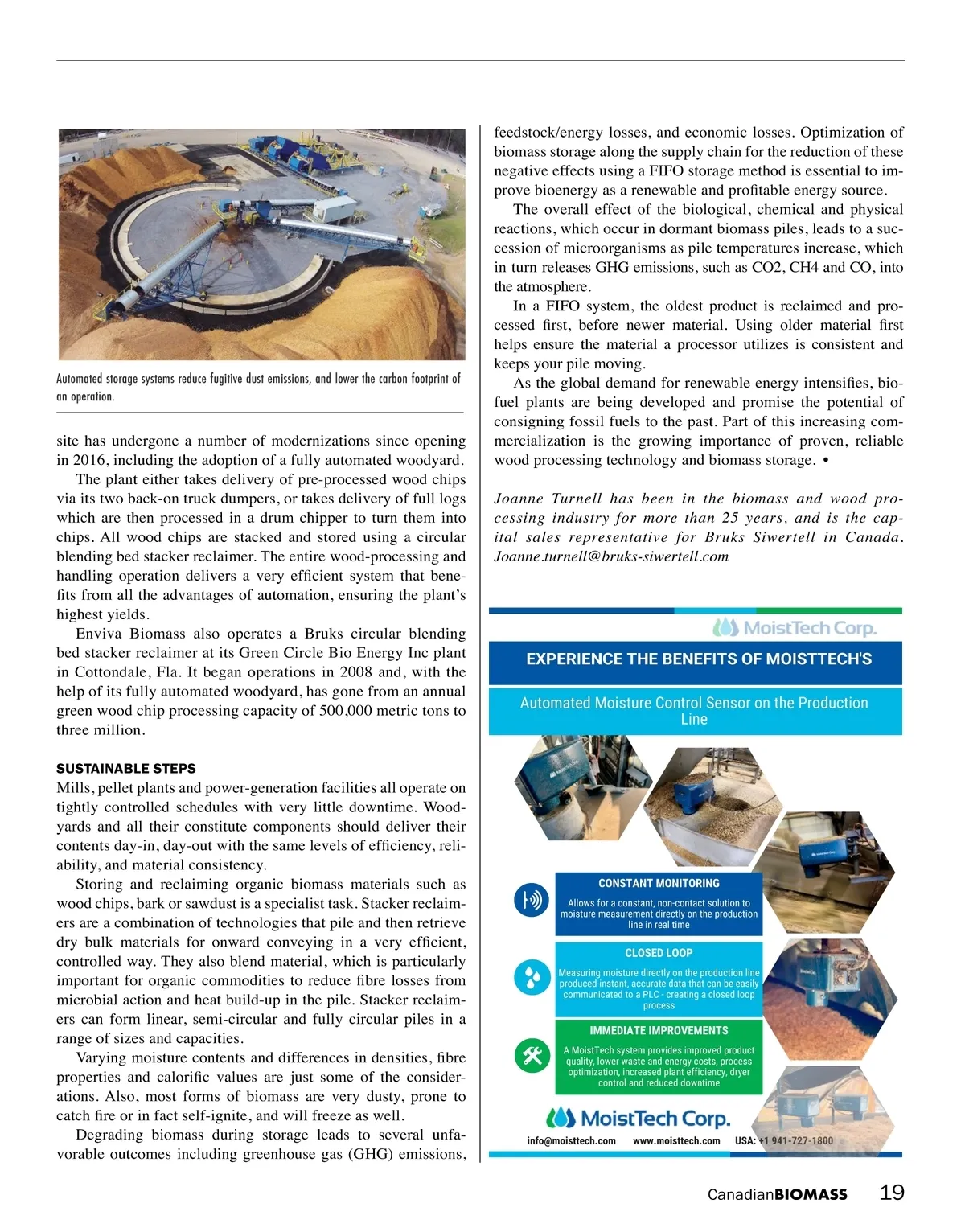
Equipment Spotlight Handling and storage solutions to meet booming industrial demands By Joanne Turnell Moving the masses B iomass, the collective term for or-ganic material used as fuel in power generation, is increasingly becom-ing mainstream. In Liverpool, England, two Bruks Siwertell multi-fuel screw-type unloaders serve Associated British Ports’ Immingham Renewable Fuels Ter-minal. The ST 790-D-type units are used for unloading imported biomass pellets to fuel the nearby Drax power station, which supplies between seven and eight per cent of the UK’s electricity demand. Managing the huge volumes of organ-ic material required for these booming industries requires an expert touch, not only to ensure the quality of the materi-al, but also the safety of the storage pile and its efficient management as it travels along the processing line with dust-free and cold weather-contained conveying solutions. All these elements are tied up in each other, and automation is proving to be the solution. A popular choice is a fully automated woodyard which includes full automated stacker reclaimers. Woodyards can expertly manage vast, neat swathes of wood chips and various other materials. At the recently shuttered Domtar Espanola, Ont., facilities, Bruks cold weather stacker reclaimers were installed in 1997 by the Spanish River Pulp & Pa -per Company, (acquired by Domtar in 1998). The mill produced 69,000 tons of over 200 different grades of technical and specialty paper every year, including northern bleached softwood kraft pulp. A 280,000-ton annual capacity fibre line was fed a mix of aspen, maple and birch hardwood chips, and meeting this ap-petite for more than 25 years, was cold weather stacker reclaimers. The two fully automated circular systems, with a beam length of 41.5m, operated almost con-A Bruks circular overpile stacker reclaimer. Photos courtesy Bruks Siwertell. tinuously, even in the harshest winters, with minimal operator intervention and downtime. INTELLIGENT TECHNOLOGY Fully automated full circle stacker re-claimers can lay down successive layers of material in a continuous 360-degree rotational pattern using a stacking con-veyor that pivots through a complete circle. At ground level, a reclaim bridge moves into the pile with a harrow si-multaneously agitating and fluidizing the material on its reclaiming face. A large diameter screw catches all the falling ma-terial and transfers it to the center where it drops onto the reclaim belt. This pass-es under the pile and emerges beyond its edge, leaving the base undisturbed. A first-in first-out (FIFO) mechanism can ensure the oldest material in the pile is always reclaimed first and is blended reduce any variation to a minimum. Automation has brought considerable benefits to woodyards. Fully automated stacker reclaimers minimize the number of personnel-hours required for daily operations, delivering significant cost savings. They have a unique design that improves inventory control, as well as maintaining consistent quality. Automated systems also have a frac-tion of the carbon footprint of a manually managed pile and offer much improved emissions control. These environmental gains stem from eliminating the contin-uous use of diesel-powered machines used to manage the piles. Fugitive dust emissions are also reduced in comparison to them, as the gentle nature of circular blending bed stacker reclaimers mean that they do not stir up fines and dust. BIOENERGY GROWTH With biomass demand increasing world-wide, getting the highest possible energy content for the end user requires every stage of the biomass production process to be handled with care. At the U.S. Greenwood Colombo En-ergy plant in South Carolina – owned and operated by the world’s largest producer of industrial wood pellets, Enviva – sev-eral Bruks systems are in operation. The FALL 2023 18 Canadian BIOMASS
Canadian Biomass Fall 2023: Page 18