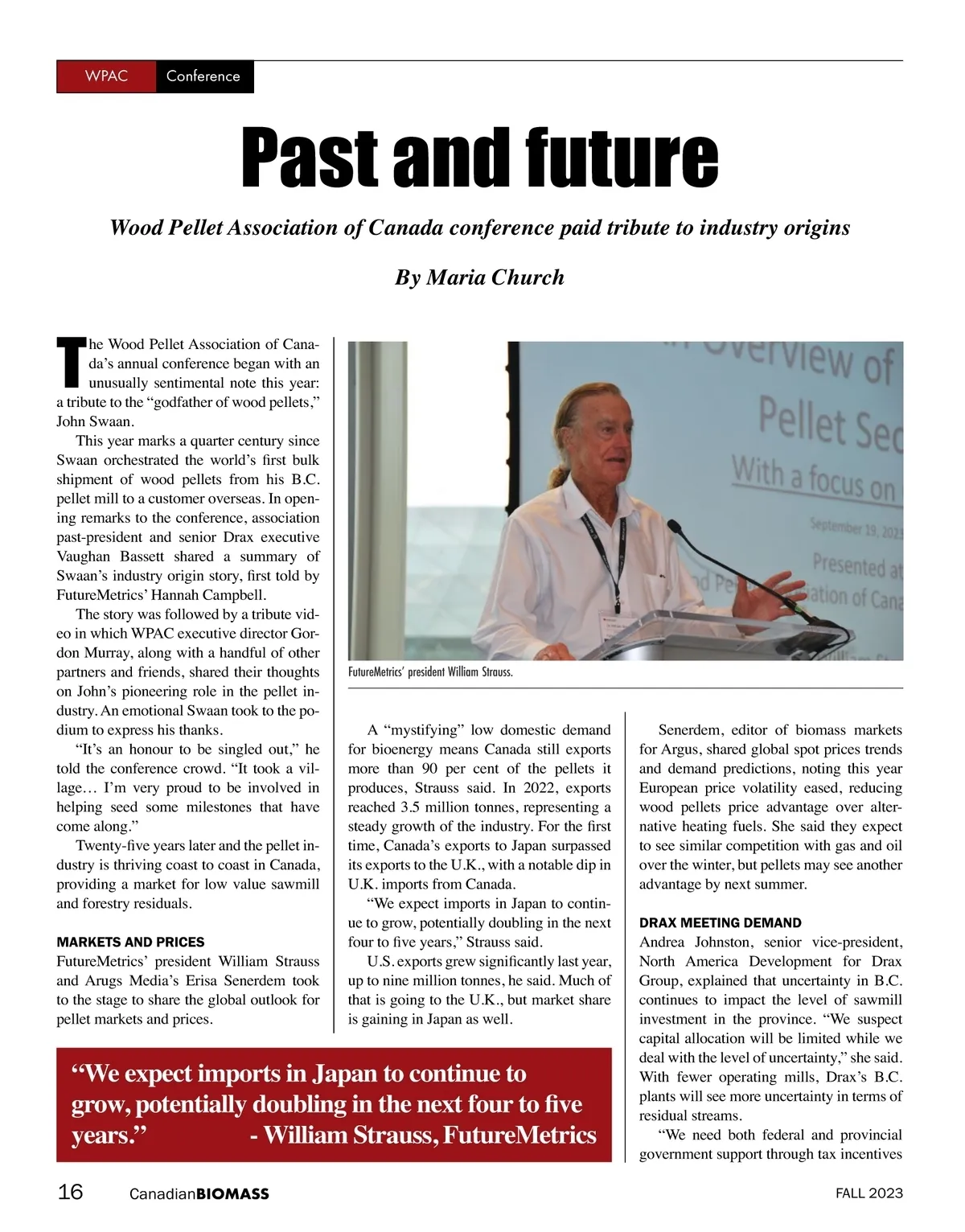
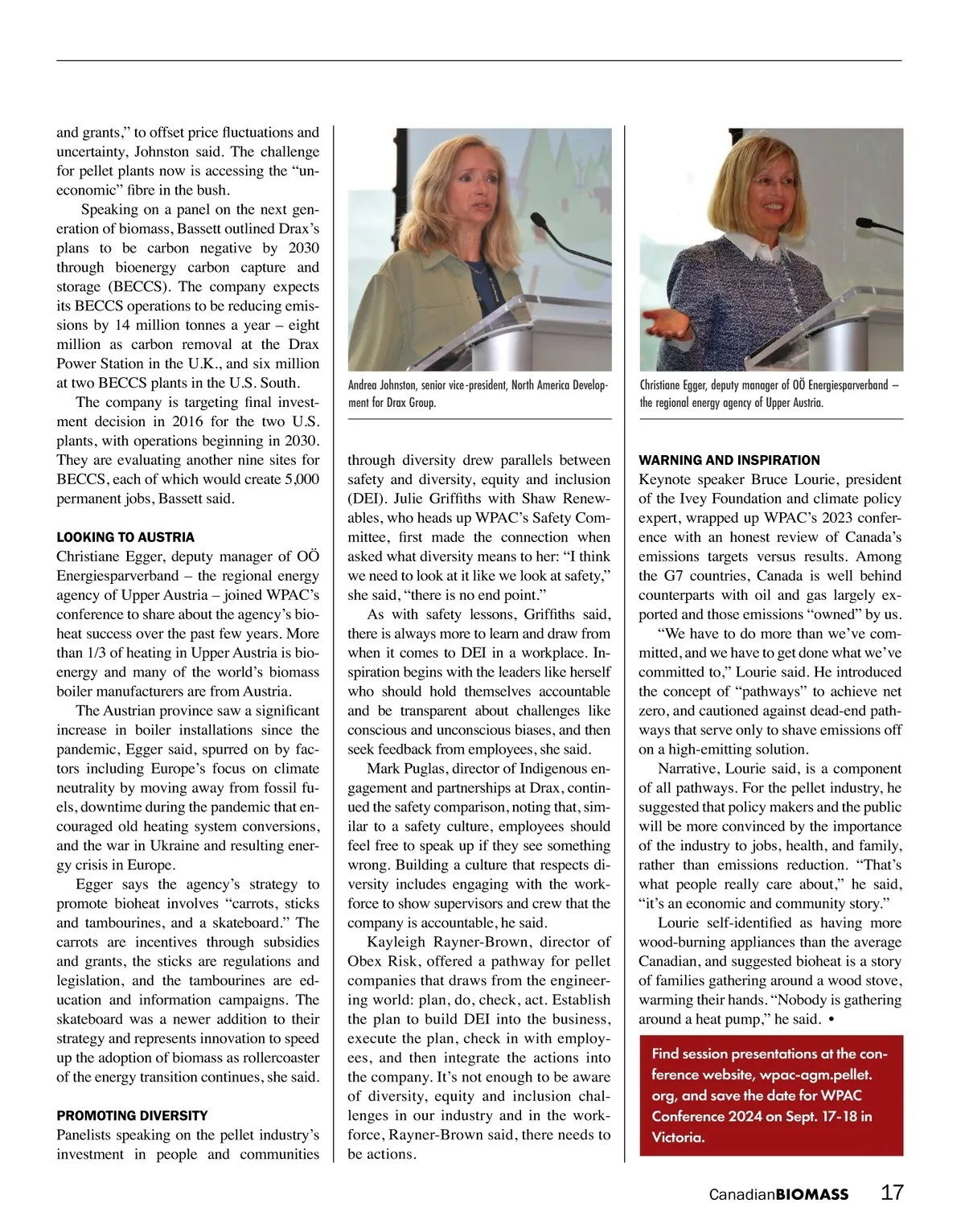
and grants,” to offset price fluctuations and uncertainty, Johnston said. The challenge for pellet plants now is accessing the “un-economic” fibre in the bush. Speaking on a panel on the next gen-eration of biomass, Bassett outlined Drax’s plans to be carbon negative by 2030 through bioenergy carbon capture and storage (BECCS). The company expects its BECCS operations to be reducing emis-sions by 14 million tonnes a year – eight million as carbon removal at the Drax Power Station in the U.K., and six million at two BECCS plants in the U.S. South. The company is targeting final invest -ment decision in 2016 for the two U.S. plants, with operations beginning in 2030. They are evaluating another nine sites for BECCS, each of which would create 5,000 permanent jobs, Bassett said. LOOKING TO AUSTRIA Andrea Johnston, senior vice-president, North America Develop-ment for Drax Group. Christiane Egger, deputy manager of OÖ Energiesparverband – the regional energy agency of Upper Austria. Christiane Egger, deputy manager of OÖ Energiesparverband – the regional energy agency of Upper Austria – joined WPAC’s conference to share about the agency’s bio-heat success over the past few years. More than 1/3 of heating in Upper Austria is bio-energy and many of the world’s biomass boiler manufacturers are from Austria. The Austrian province saw a significant increase in boiler installations since the pandemic, Egger said, spurred on by fac-tors including Europe’s focus on climate neutrality by moving away from fossil fu-els, downtime during the pandemic that en-couraged old heating system conversions, and the war in Ukraine and resulting ener-gy crisis in Europe. Egger says the agency’s strategy to promote bioheat involves “carrots, sticks and tambourines, and a skateboard.” The carrots are incentives through subsidies and grants, the sticks are regulations and legislation, and the tambourines are ed-ucation and information campaigns. The skateboard was a newer addition to their strategy and represents innovation to speed up the adoption of biomass as rollercoaster of the energy transition continues, she said. PROMOTING DIVERSITY Panelists speaking on the pellet industry’s investment in people and communities through diversity drew parallels between safety and diversity, equity and inclusion (DEI). Julie Griffiths with Shaw Renew -ables, who heads up WPAC’s Safety Com-mittee, first made the connection when asked what diversity means to her: “I think we need to look at it like we look at safety,” she said, “there is no end point.” As with safety lessons, Griffiths said, there is always more to learn and draw from when it comes to DEI in a workplace. In-spiration begins with the leaders like herself who should hold themselves accountable and be transparent about challenges like conscious and unconscious biases, and then seek feedback from employees, she said. Mark Puglas, director of Indigenous en-gagement and partnerships at Drax, contin-ued the safety comparison, noting that, sim-ilar to a safety culture, employees should feel free to speak up if they see something wrong. Building a culture that respects di-versity includes engaging with the work-force to show supervisors and crew that the company is accountable, he said. Kayleigh Rayner-Brown, director of Obex Risk, offered a pathway for pellet companies that draws from the engineer-ing world: plan, do, check, act. Establish the plan to build DEI into the business, execute the plan, check in with employ-ees, and then integrate the actions into the company. It’s not enough to be aware of diversity, equity and inclusion chal-lenges in our industry and in the work-force, Rayner-Brown said, there needs to be actions. WARNING AND INSPIRATION Keynote speaker Bruce Lourie, president of the Ivey Foundation and climate policy expert, wrapped up WPAC’s 2023 confer-ence with an honest review of Canada’s emissions targets versus results. Among the G7 countries, Canada is well behind counterparts with oil and gas largely ex-ported and those emissions “owned” by us. “We have to do more than we’ve com-mitted, and we have to get done what we’ve committed to,” Lourie said. He introduced the concept of “pathways” to achieve net zero, and cautioned against dead-end path -ways that serve only to shave emissions off on a high-emitting solution. Narrative, Lourie said, is a component of all pathways. For the pellet industry, he suggested that policy makers and the public will be more convinced by the importance of the industry to jobs, health, and family, rather than emissions reduction. “That’s what people really care about,” he said, “it’s an economic and community story.” Lourie self-identified as having more wood-burning appliances than the average Canadian, and suggested bioheat is a story of families gathering around a wood stove, warming their hands. “Nobody is gathering around a heat pump,” he said. • Find session presentations at the con-ference website, wpac-agm.pellet. org, and save the date for WPAC Conference 2024 on Sept. 17-18 in Victoria. Canadian BIOMASS 17
Canadian Biomass Fall 2023: Page 17