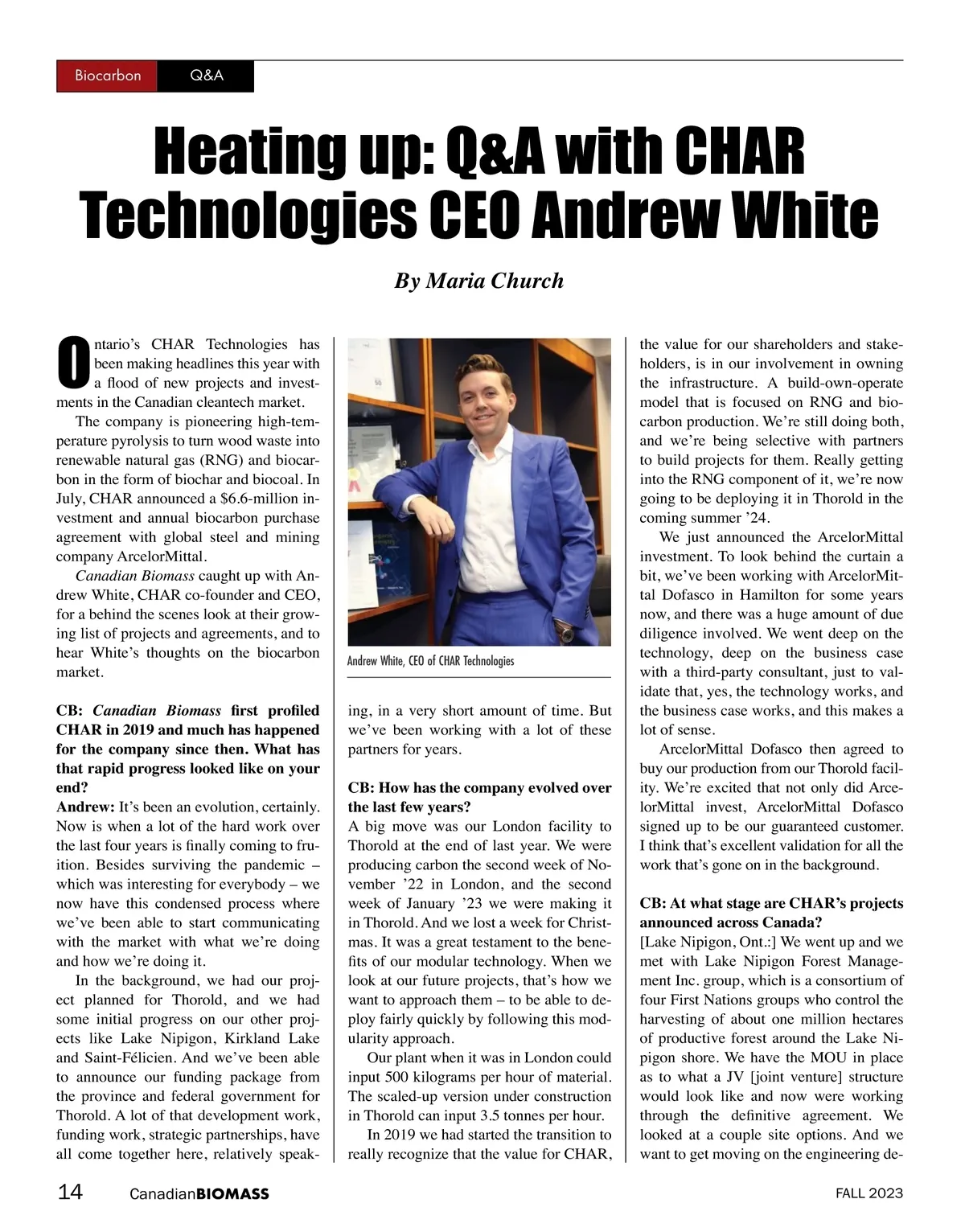
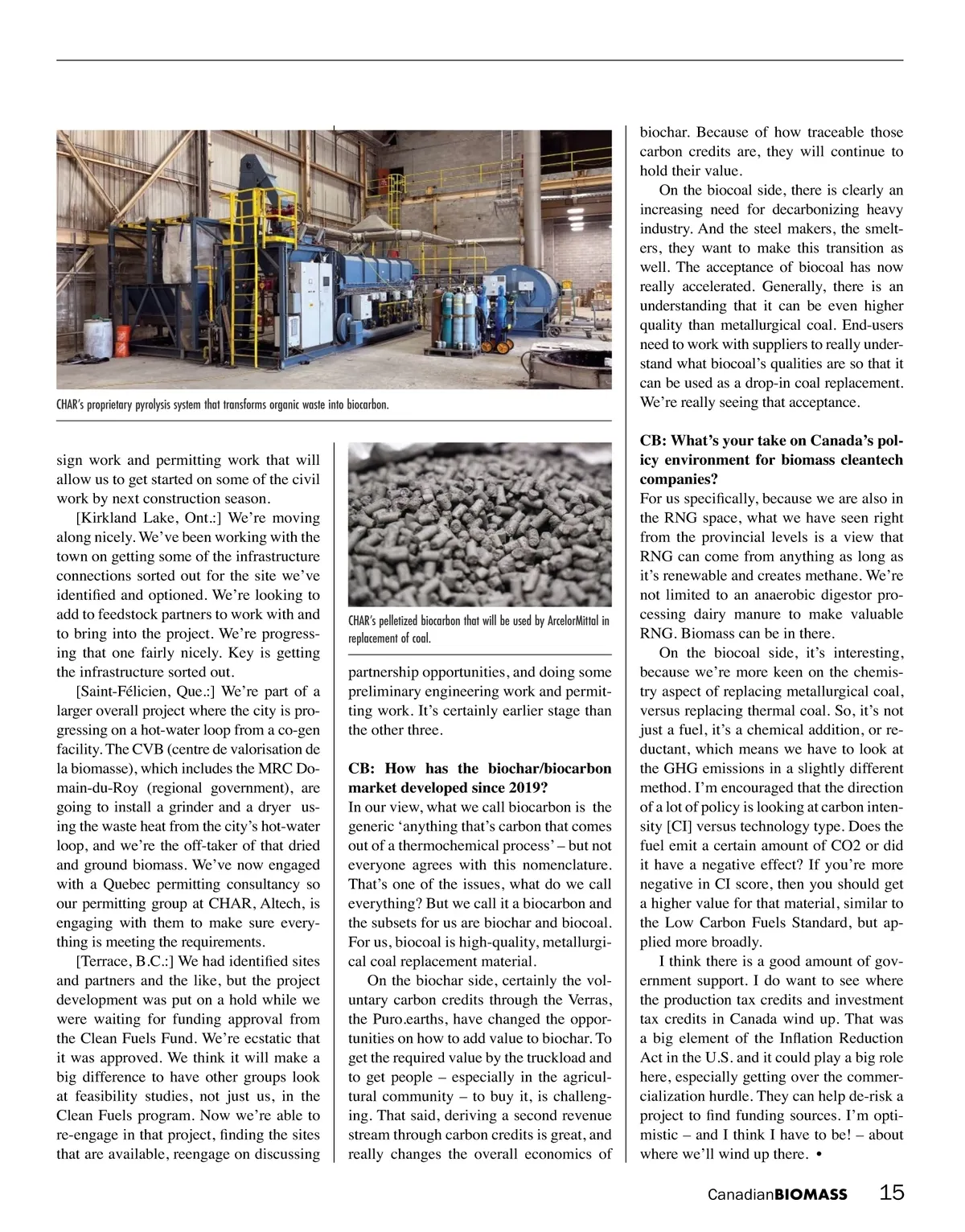
CHAR’s proprietary pyrolysis system that transforms organic waste into biocarbon. biochar. Because of how traceable those carbon credits are, they will continue to hold their value. On the biocoal side, there is clearly an increasing need for decarbonizing heavy industry. And the steel makers, the smelt-ers, they want to make this transition as well. The acceptance of biocoal has now really accelerated. Generally, there is an understanding that it can be even higher quality than metallurgical coal. End-users need to work with suppliers to really under-stand what biocoal’s qualities are so that it can be used as a drop-in coal replacement. We’re really seeing that acceptance. CB: What’s your take on Canada’s pol-icy environment for biomass cleantech companies? For us specifically, because we are also in the RNG space, what we have seen right from the provincial levels is a view that RNG can come from anything as long as it’s renewable and creates methane. We’re not limited to an anaerobic digestor pro-cessing dairy manure to make valuable RNG. Biomass can be in there. On the biocoal side, it’s interesting, because we’re more keen on the chemis-try aspect of replacing metallurgical coal, versus replacing thermal coal. So, it’s not just a fuel, it’s a chemical addition, or re-ductant, which means we have to look at the GHG emissions in a slightly different method. I’m encouraged that the direction of a lot of policy is looking at carbon inten-sity [CI] versus technology type. Does the fuel emit a certain amount of CO2 or did it have a negative effect? If you’re more negative in CI score, then you should get a higher value for that material, similar to the Low Carbon Fuels Standard, but ap-plied more broadly. I think there is a good amount of gov-ernment support. I do want to see where the production tax credits and investment tax credits in Canada wind up. That was a big element of the Inflation Reduction Act in the U.S. and it could play a big role here, especially getting over the commer-cialization hurdle. They can help de-risk a project to find funding sources. I’m opti -mistic – and I think I have to be! – about where we’ll wind up there. • sign work and permitting work that will allow us to get started on some of the civil work by next construction season. [Kirkland Lake, Ont.:] We’re moving along nicely. We’ve been working with the town on getting some of the infrastructure connections sorted out for the site we’ve identified and optioned. We’re looking to add to feedstock partners to work with and to bring into the project. We’re progress-ing that one fairly nicely. Key is getting the infrastructure sorted out. [Saint-Félicien, Que.:] We’re part of a larger overall project where the city is pro-gressing on a hot-water loop from a co-gen facility. The CVB (centre de valorisation de la biomasse), which includes the MRC Do-main-du-Roy (regional government), are going to install a grinder and a dryer us-ing the waste heat from the city’s hot-water loop, and we’re the off-taker of that dried and ground biomass. We’ve now engaged with a Quebec permitting consultancy so our permitting group at CHAR, Altech, is engaging with them to make sure every-thing is meeting the requirements. [Terrace, B.C.:] We had identified sites and partners and the like, but the project development was put on a hold while we were waiting for funding approval from the Clean Fuels Fund. We’re ecstatic that it was approved. We think it will make a big difference to have other groups look at feasibility studies, not just us, in the Clean Fuels program. Now we’re able to re-engage in that project, finding the sites that are available, reengage on discussing CHAR’s pelletized biocarbon that will be used by ArcelorMittal in replacement of coal. partnership opportunities, and doing some preliminary engineering work and permit-ting work. It’s certainly earlier stage than the other three. CB: How has the biochar/biocarbon market developed since 2019? In our view, what we call biocarbon is the generic ‘anything that’s carbon that comes out of a thermochemical process’ – but not everyone agrees with this nomenclature. That’s one of the issues, what do we call everything? But we call it a biocarbon and the subsets for us are biochar and biocoal. For us, biocoal is high-quality, metallurgi-cal coal replacement material. On the biochar side, certainly the vol-untary carbon credits through the Verras, the Puro.earths, have changed the oppor-tunities on how to add value to biochar. To get the required value by the truckload and to get people – especially in the agricul-tural community – to buy it, is challeng-ing. That said, deriving a second revenue stream through carbon credits is great, and really changes the overall economics of Canadian BIOMASS 15
Canadian Biomass Fall 2023: Page 15