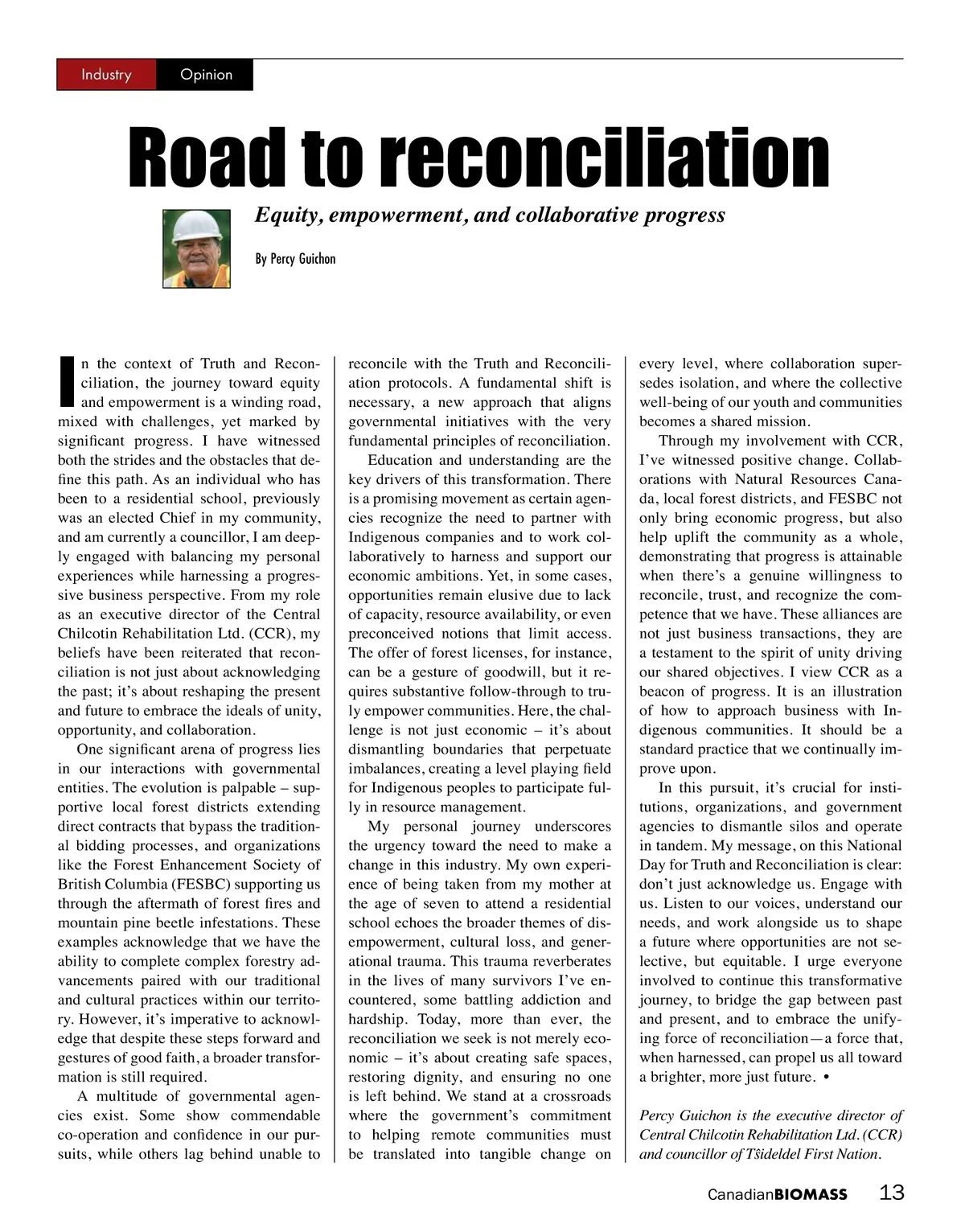
Industry Opinion Road to reconciliation Equity, empowerment, and collaborative progress By Percy Guichon I n the context of Truth and Recon-ciliation, the journey toward equity and empowerment is a winding road, mixed with challenges, yet marked by significant progress. I have witnessed both the strides and the obstacles that de-fine this path. As an individual who has been to a residential school, previously was an elected Chief in my community, and am currently a councillor, I am deep-ly engaged with balancing my personal experiences while harnessing a progres-sive business perspective. From my role as an executive director of the Central Chilcotin Rehabilitation Ltd. (CCR), my beliefs have been reiterated that recon-ciliation is not just about acknowledging the past; it’s about reshaping the present and future to embrace the ideals of unity, opportunity, and collaboration. One significant arena of progress lies in our interactions with governmental entities. The evolution is palpable – sup-portive local forest districts extending direct contracts that bypass the tradition-al bidding processes, and organizations like the Forest Enhancement Society of British Columbia (FESBC) supporting us through the aftermath of forest fires and mountain pine beetle infestations. These examples acknowledge that we have the ability to complete complex forestry ad-vancements paired with our traditional and cultural practices within our territo-ry. However, it’s imperative to acknowl-edge that despite these steps forward and gestures of good faith, a broader transfor-mation is still required. A multitude of governmental agen-cies exist. Some show commendable co-operation and confidence in our pur -suits, while others lag behind unable to reconcile with the Truth and Reconcili-ation protocols. A fundamental shift is necessary, a new approach that aligns governmental initiatives with the very fundamental principles of reconciliation. Education and understanding are the key drivers of this transformation. There is a promising movement as certain agen-cies recognize the need to partner with Indigenous companies and to work col-laboratively to harness and support our economic ambitions. Yet, in some cases, opportunities remain elusive due to lack of capacity, resource availability, or even preconceived notions that limit access. The offer of forest licenses, for instance, can be a gesture of goodwill, but it re-quires substantive follow-through to tru-ly empower communities. Here, the chal-lenge is not just economic – it’s about dismantling boundaries that perpetuate imbalances, creating a level playing field for Indigenous peoples to participate ful-ly in resource management. My personal journey underscores the urgency toward the need to make a change in this industry. My own experi-ence of being taken from my mother at the age of seven to attend a residential school echoes the broader themes of dis-empowerment, cultural loss, and gener-ational trauma. This trauma reverberates in the lives of many survivors I’ve en-countered, some battling addiction and hardship. Today, more than ever, the reconciliation we seek is not merely eco-nomic – it’s about creating safe spaces, restoring dignity, and ensuring no one is left behind. We stand at a crossroads where the government’s commitment to helping remote communities must be translated into tangible change on every level, where collaboration super-sedes isolation, and where the collective well-being of our youth and communities becomes a shared mission. Through my involvement with CCR, I’ve witnessed positive change. Collab-orations with Natural Resources Cana-da, local forest districts, and FESBC not only bring economic progress, but also help uplift the community as a whole, demonstrating that progress is attainable when there’s a genuine willingness to reconcile, trust, and recognize the com -petence that we have. These alliances are not just business transactions, they are a testament to the spirit of unity driving our shared objectives. I view CCR as a beacon of progress. It is an illustration of how to approach business with In-digenous communities. It should be a standard practice that we continually im-prove upon. In this pursuit, it’s crucial for insti-tutions, organizations, and government agencies to dismantle silos and operate in tandem. My message, on this National Day for Truth and Reconciliation is clear: don’t just acknowledge us. Engage with us. Listen to our voices, understand our needs, and work alongside us to shape a future where opportunities are not se-lective, but equitable. I urge everyone involved to continue this transformative journey, to bridge the gap between past and present, and to embrace the unify-ing force of reconciliation—a force that, when harnessed, can propel us all toward a brighter, more just future. • Percy Guichon is the executive director of Central Chilcotin Rehabilitation Ltd. (CCR) and councillor of Tŝideldel First Nation. Canadian BIOMASS 13
Canadian Biomass Fall 2023: Page 13