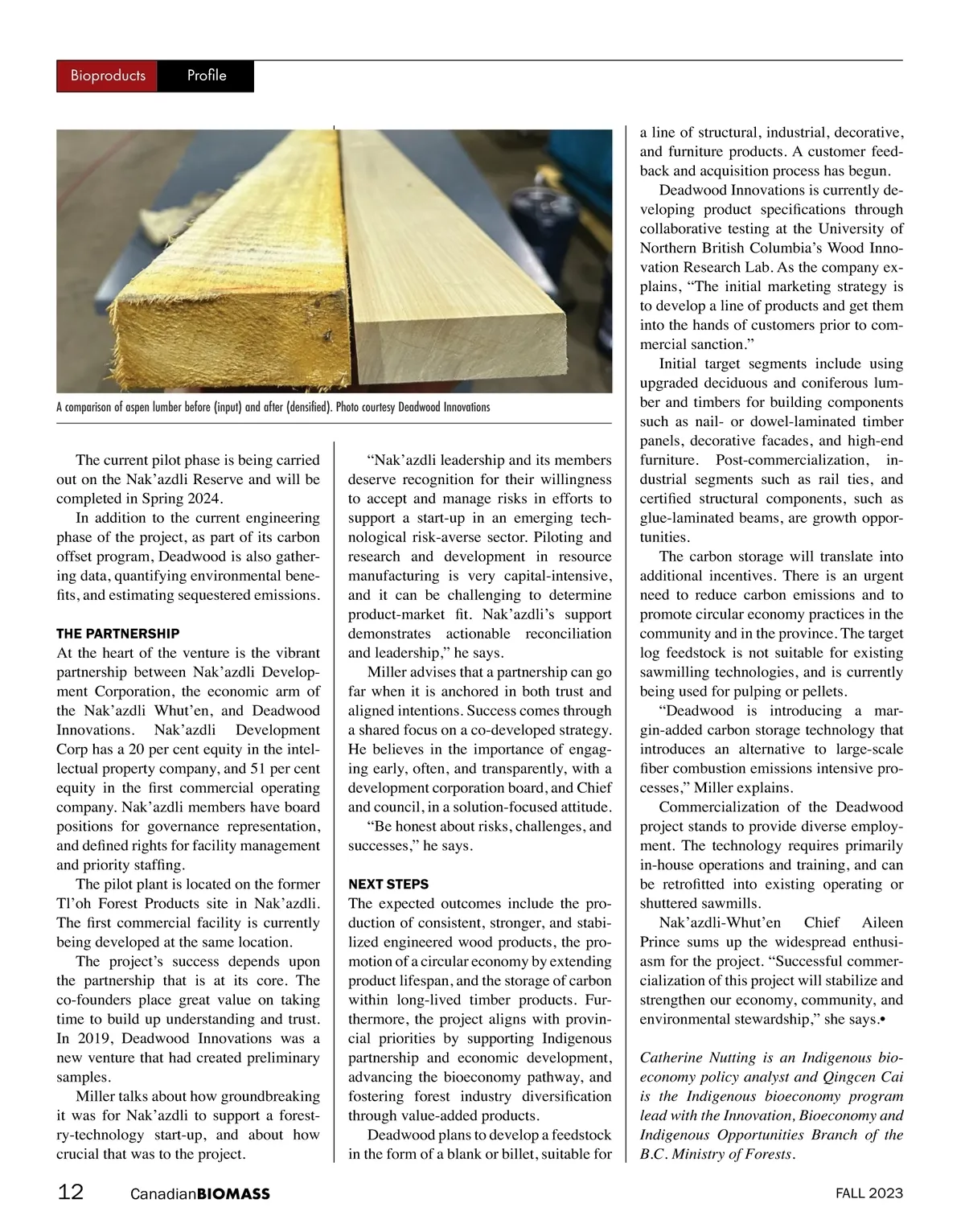
Bioproducts Profile a line of structural, industrial, decorative, and furniture products. A customer feed-back and acquisition process has begun. Deadwood Innovations is currently de-veloping product specifications through collaborative testing at the University of Northern British Columbia’s Wood Inno-vation Research Lab. As the company ex-plains, “The initial marketing strategy is to develop a line of products and get them into the hands of customers prior to com-mercial sanction.” Initial target segments include using upgraded deciduous and coniferous lum-ber and timbers for building components such as nail-or dowel-laminated timber panels, decorative facades, and high-end furniture. Post-commercialization, in -dustrial segments such as rail ties, and certified structural components, such as glue-laminated beams, are growth oppor-tunities. The carbon storage will translate into additional incentives. There is an urgent need to reduce carbon emissions and to promote circular economy practices in the community and in the province. The target log feedstock is not suitable for existing sawmilling technologies, and is currently being used for pulping or pellets. “Deadwood is introducing a mar-gin-added carbon storage technology that introduces an alternative to large-scale fiber combustion emissions intensive pro -cesses,” Miller explains. Commercialization of the Deadwood project stands to provide diverse employ-ment. The technology requires primarily in-house operations and training, and can be retrofitted into existing operating or shuttered sawmills. Nak’azdli-Whut’en Chief Aileen Prince sums up the widespread enthusi-asm for the project. “Successful commer-cialization of this project will stabilize and strengthen our economy, community, and environmental stewardship,” she says.• Catherine Nutting is an Indigenous bio-economy policy analyst and Qingcen Cai is the Indigenous bioeconomy program lead with the Innovation, Bioeconomy and Indigenous Opportunities Branch of the B.C. Ministry of Forests. FALL 2023 A comparison of aspen lumber before (input) and after (densified). Photo courtesy Deadwood Innovations The current pilot phase is being carried out on the Nak’azdli Reserve and will be completed in Spring 2024. In addition to the current engineering phase of the project, as part of its carbon offset program, Deadwood is also gather-ing data, quantifying environmental bene-fits, and estimating sequestered emissions. THE PARTNERSHIP At the heart of the venture is the vibrant partnership between Nak’azdli Develop -ment Corporation, the economic arm of the Nak’azdli Whut’en, and Deadwood Innovations. Nak’azdli Development Corp has a 20 per cent equity in the intel-lectual property company, and 51 per cent equity in the first commercial operating company. Nak’azdli members have board positions for governance representation, and defined rights for facility management and priority staffing. The pilot plant is located on the former Tl’oh Forest Products site in Nak’azdli. The first commercial facility is currently being developed at the same location. The project’s success depends upon the partnership that is at its core. The co-founders place great value on taking time to build up understanding and trust. In 2019, Deadwood Innovations was a new venture that had created preliminary samples. Miller talks about how groundbreaking it was for Nak’azdli to support a forest -ry-technology start-up, and about how crucial that was to the project. “Nak’azdli leadership and its members deserve recognition for their willingness to accept and manage risks in efforts to support a start-up in an emerging tech-nological risk-averse sector. Piloting and research and development in resource manufacturing is very capital-intensive, and it can be challenging to determine product-market fit. Nak’azdli’s support demonstrates actionable reconciliation and leadership,” he says. Miller advises that a partnership can go far when it is anchored in both trust and aligned intentions. Success comes through a shared focus on a co-developed strategy. He believes in the importance of engag-ing early, often, and transparently, with a development corporation board, and Chief and council, in a solution-focused attitude. “Be honest about risks, challenges, and successes,” he says. NEXT STEPS The expected outcomes include the pro-duction of consistent, stronger, and stabi-lized engineered wood products, the pro -motion of a circular economy by extending product lifespan, and the storage of carbon within long-lived timber products. Fur-thermore, the project aligns with provin-cial priorities by supporting Indigenous partnership and economic development, advancing the bioeconomy pathway, and fostering forest industry diversification through value-added products. Deadwood plans to develop a feedstock in the form of a blank or billet, suitable for 12 Canadian BIOMASS
Canadian Biomass Fall 2023: Page 12