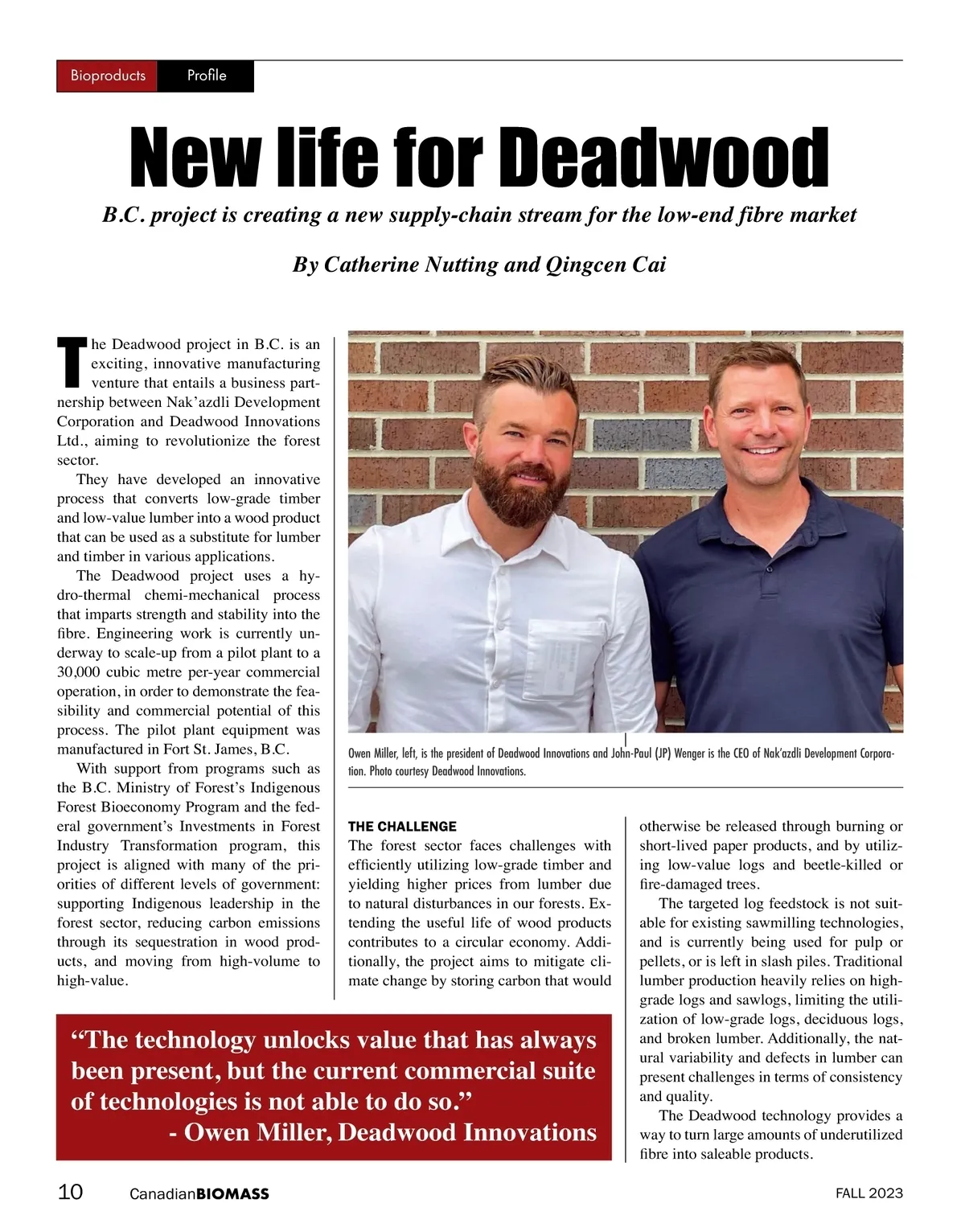
Densified aspen cant end view and densified aspen lumber. Photo courtesy Deadwood Innovations. “The technology presents an additional supply-chain stream for the current low-end off-spec fibre market,” says Owen Miller, president of Deadwood Innova-tions. THE PROCESS infestation, as well as underutilized decid -uous species. The process starts with dead timber that has dried in the field, or de -ciduous stands that are not economical for conventional lumber production at current standards due to pocket rot in the tree. Logs are scanned and sorted by spe-cies, moisture content, and condition, and are then transferred to infeed. After debarking, the logs are densified and sta -bilized in a unique process that leverages and combines engineering principles from various manufacturing processes. The lumber upgrading process is similar but does not require debarking. The resulting manufactured wood can range in density from that of a softwood to that of a hardwood simply through the press-ing mechanism and lignocellulose reactions, not through the addition of resins. As the Deadwood partners explain, “A wide variety of dimensions and densities are attainable using our unique pressing process.” The upgrading process that transforms low-quality fibre into a novel wood prod -uct has evolved through research and de-velopment and has been optimized for ac -celerated commercialization. Patents are pending for the inventions of the system. The province supported Nak’azdli Whut’en First Nation’s priorities in the natural resource sector through a multi-phased bioeconomy project. This en-tailed supporting a partnership between Nak’azdli Development Corporation and Deadwood Innovations Ltd. to commer-cialize this novel forest bioproduct. Deadwood’s proprietary technology converts low-grade timber into densified engineered cants, and low-value lumber into densified engineered lumber that substitutes for traditional lumber. The en-gineered wood products have properties comparable to hardwoods. The advantag-es of their product include the ability to use various feedstock sources, producing consistently stable, strong products, pro-moting circular economy practices, and storing carbon. “The technology unlocks value that has always been present, but the current com-mercial suite of technologies is not able to do so,” Miller says. The system manufactures engineered ood products using a feedstock of conifer-ous timber, damaged by wildfire or beetle Combustible Dust Specialists NFPA68 NFPA69 NFPA77 NFPA91 NFPA499 NFPA654 NFPA664 Allied brings 49 years experience to help you meet current NFPA Standards with: system design/documentation, spark detection, isolation, grounding, PLC, venting, blast path management, clean-up systems and duct audits — CWB certified and member SMACNA. Sawmill – Biomass – Boardplants – Pulp & Paper – Power Generation – Mining 49 years of Industrial Air Systems www.alliedblower.com Phone: 800-576-3611 Surrey,BC Vernon,BC WilliamsLake,BC Edmonton,Alberta PrinceAlbert,Sask Mobile, Alabama Canadian BIOMASS CFI_AlliedBlower_MarApr23_CSA.indd 1 2023-03-22 8:57 AM 11
Canadian Biomass Fall 2023: Page 11