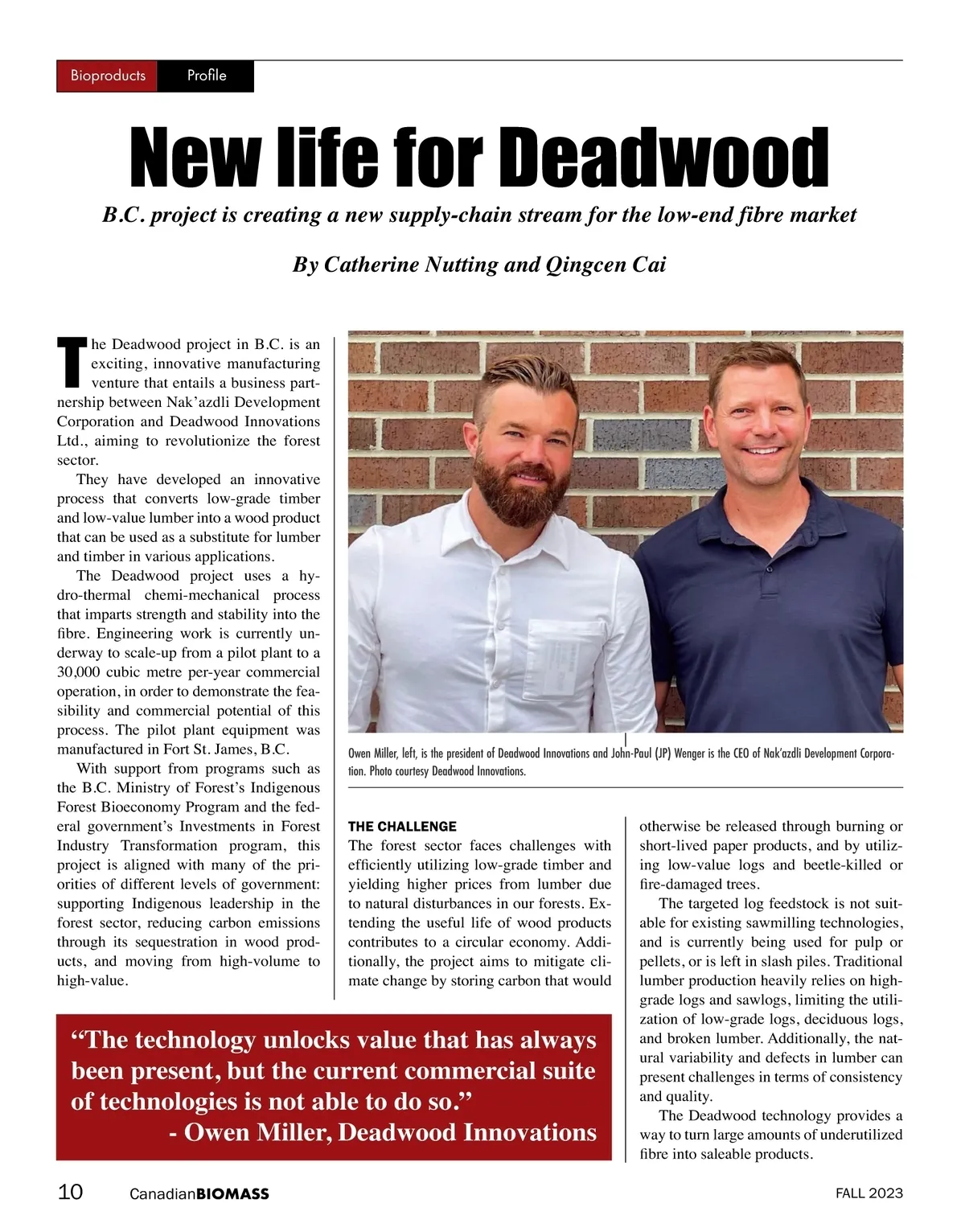
Bioproducts Profile B.C. project is creating a new supply-chain stream for the low-end fibre market By Catherine Nutting and Qingcen Cai he Deadwood project in B.C. is an exciting, innovative manufacturing venture that entails a business part-nership between Nak’azdli Development Corporation and Deadwood Innovations Ltd., aiming to revolutionize the forest sector. They have developed an innovative process that converts low-grade timber and low-value lumber into a wood product that can be used as a substitute for lumber and timber in various applications. The Deadwood project uses a hy-dro-thermal chemi-mechanical process that imparts strength and stability into the fibre. Engineering work is currently un -derway to scale-up from a pilot plant to a 30,000 cubic metre per-year commercial operation, in order to demonstrate the fea-sibility and commercial potential of this process. The pilot plant equipment was manufactured in Fort St. James, B.C. With support from programs such as the B.C. Ministry of Forest’s Indigenous Forest Bioeconomy Program and the fed-eral government’s Investments in Forest Industry Transformation program, this project is aligned with many of the pri-orities of different levels of government: supporting Indigenous leadership in the forest sector, reducing carbon emissions through its sequestration in wood prod-ucts, and moving from high-volume to high-value. New life for Deadwood T Owen Miller, left, is the president of Deadwood Innovations and John-Paul (JP) Wenger is the CEO of Nak’azdli Development Corpora-tion. Photo courtesy Deadwood Innovations. THE CHALLENGE The forest sector faces challenges with efficiently utilizing low-grade timber and yielding higher prices from lumber due to natural disturbances in our forests. Ex-tending the useful life of wood products contributes to a circular economy. Addi-tionally, the project aims to mitigate cli-mate change by storing carbon that would “The technology unlocks value that has always been present, but the current commercial suite of technologies is not able to do so.” -Owen Miller, Deadwood Innovations 10 Canadian BIOMASS otherwise be released through burning or short-lived paper products, and by utiliz -ing low-value logs and beetle-killed or fire-damaged trees. The targeted log feedstock is not suit-able for existing sawmilling technologies, and is currently being used for pulp or pellets, or is left in slash piles. Traditional lumber production heavily relies on high-grade logs and sawlogs, limiting the utili-zation of low-grade logs, deciduous logs, and broken lumber. Additionally, the nat-ural variability and defects in lumber can present challenges in terms of consistency and quality. The Deadwood technology provides a way to turn large amounts of underutilized fibre into saleable products. FALL 2023
Canadian Biomass Fall 2023: Page 10