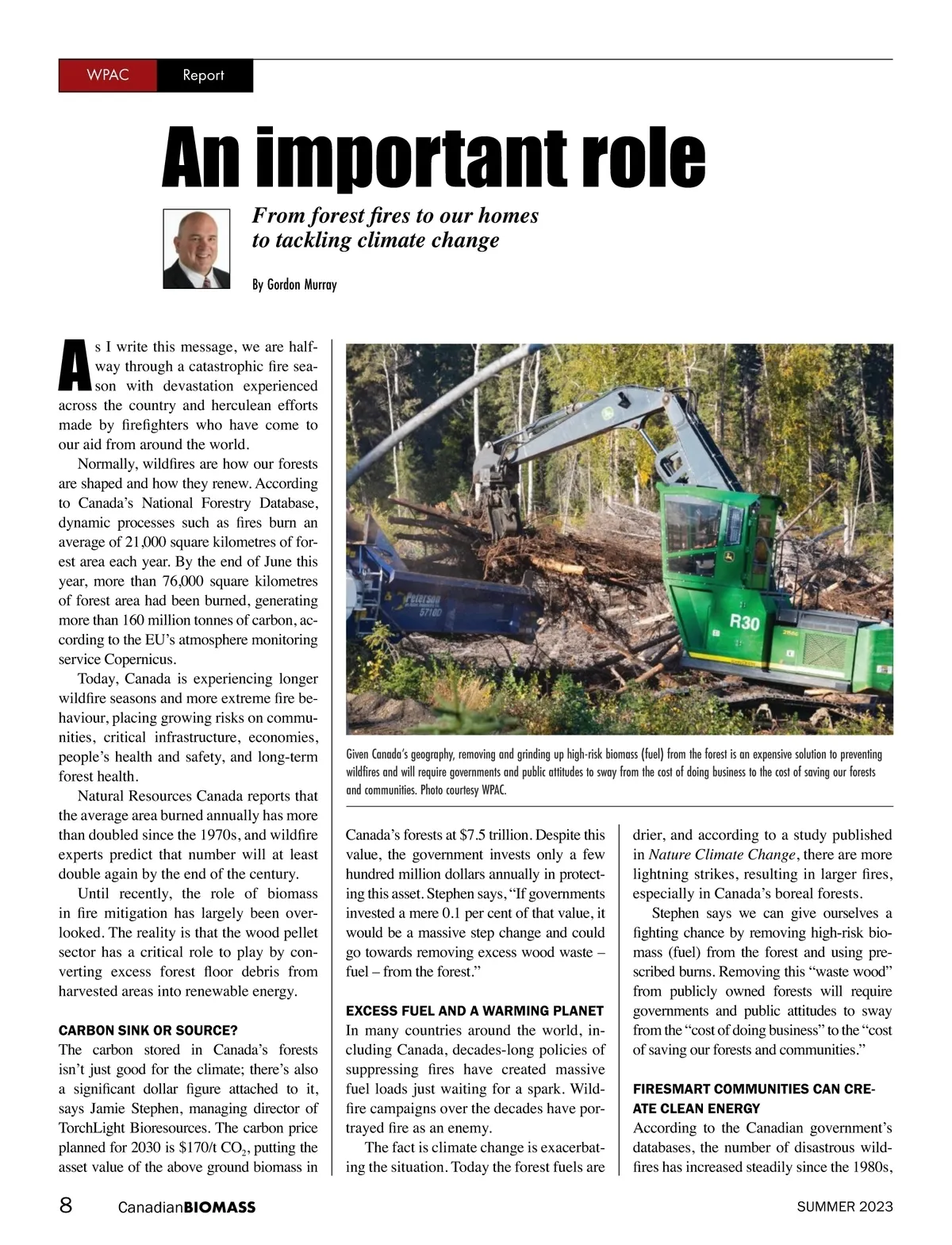
WPAC Report An important role From forest fires to our homes to tackling climate change By Gordon Murray A s I write this message, we are half-way through a catastrophic fire sea -son with devastation experienced across the country and herculean efforts made by firefighters who have come to our aid from around the world. Normally, wildfires are how our forests are shaped and how they renew. According to Canada’s National Forestry Database, dynamic processes such as fires burn an average of 21,000 square kilometres of for-est area each year. By the end of June this year, more than 76,000 square kilometres of forest area had been burned, generating more than 160 million tonnes of carbon, ac-cording to the EU’s atmosphere monitoring service Copernicus. Today, Canada is experiencing longer wildfire seasons and more extreme fire be -haviour, placing growing risks on commu-nities, critical infrastructure, economies, people’s health and safety, and long-term forest health. Natural Resources Canada reports that the average area burned annually has more than doubled since the 1970s, and wildfire experts predict that number will at least double again by the end of the century. Until recently, the role of biomass in fire mitigation has largely been over -looked. The reality is that the wood pellet sector has a critical role to play by con-verting excess forest floor debris from harvested areas into renewable energy. Given Canada’s geography, removing and grinding up high-risk biomass (fuel) from the forest is an expensive solution to preventing wildfires and will require governments and public attitudes to sway from the cost of doing business to the cost of saving our forests and communities. Photo courtesy WPAC. Canada’s forests at $7.5 trillion. Despite this value, the government invests only a few hundred million dollars annually in protect-ing this asset. Stephen says, “If governments invested a mere 0.1 per cent of that value, it would be a massive step change and could go towards removing excess wood waste – fuel – from the forest.” EXCESS FUEL AND A WARMING PLANET CARBON SINK OR SOURCE? The carbon stored in Canada’s forests isn’t just good for the climate; there’s also a significant dollar figure attached to it, says Jamie Stephen, managing director of TorchLight Bioresources. The carbon price planned for 2030 is $170/t CO 2 , putting the asset value of the above ground biomass in In many countries around the world, in-cluding Canada, decades-long policies of suppressing fires have created massive fuel loads just waiting for a spark. Wild -fire campaigns over the decades have por -trayed fire as an enemy. The fact is climate change is exacerbat-ing the situation. Today the forest fuels are drier, and according to a study published in Nature Climate Change , there are more lightning strikes, resulting in larger fires, especially in Canada’s boreal forests. Stephen says we can give ourselves a fighting chance by removing high-risk bio -mass (fuel) from the forest and using pre-scribed burns. Removing this “waste wood” from publicly owned forests will require governments and public attitudes to sway from the “cost of doing business” to the “cost of saving our forests and communities.” FIRESMART COMMUNITIES CAN CRE-ATE CLEAN ENERGY According to the Canadian government’s databases, the number of disastrous wild-fires has increased steadily since the 1980s, SUMMER 2023 8 Canadian BIOMASS
Canadian Biomass Summer 2023: Page 8