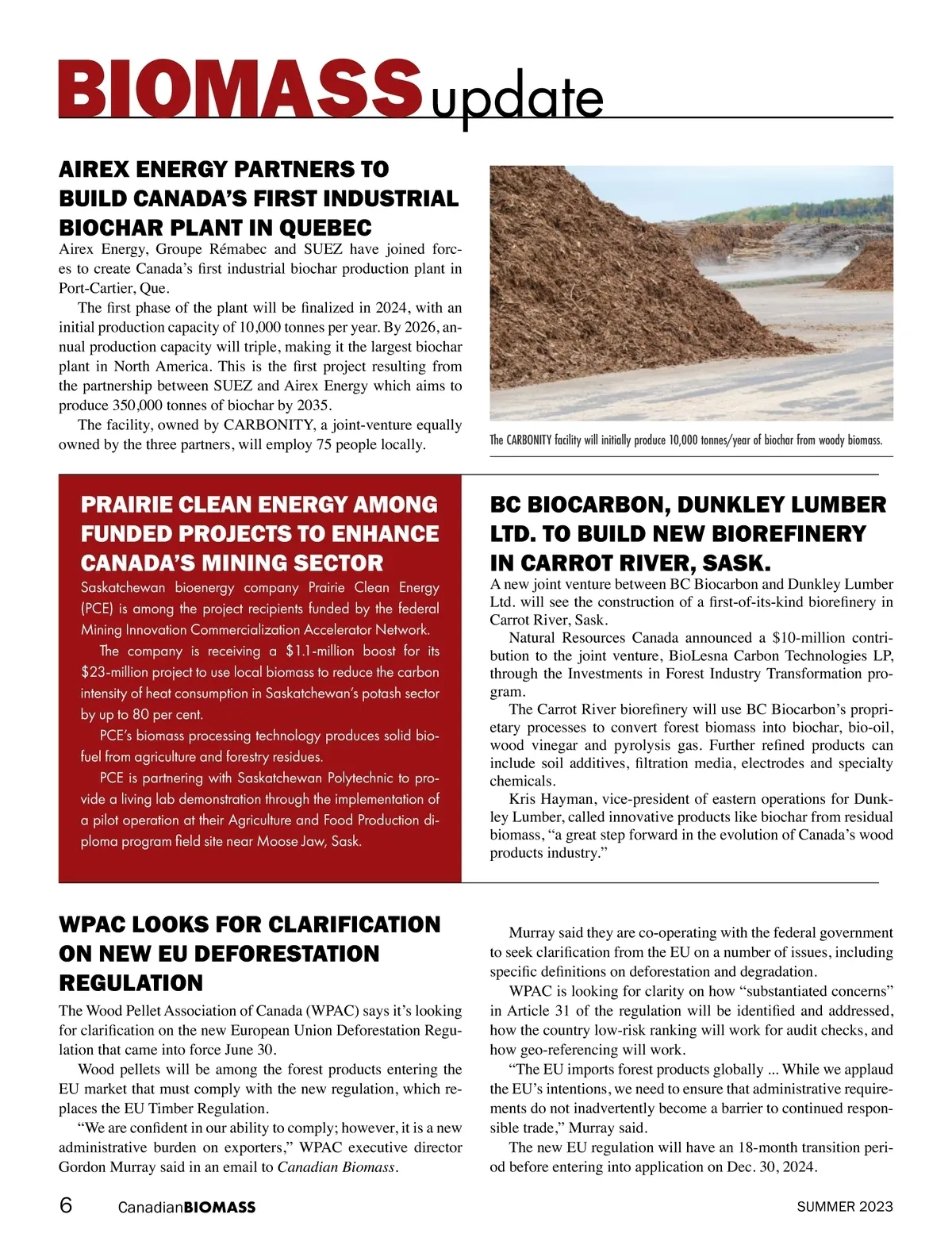
AIREX ENERGY PARTNERS TO BUILD CANADA’S FIRST INDUSTRIAL BIOCHAR PLANT IN QUEBEC Airex Energy, Groupe Rémabec and SUEZ have joined forc-es to create Canada’s first industrial biochar production plant in Port-Cartier, Que. The first phase of the plant will be finalized in 2024, with an initial production capacity of 10,000 tonnes per year. By 2026, an -nual production capacity will triple, making it the largest biochar plant in North America. This is the first project resulting from the partnership between SUEZ and Airex Energy which aims to produce 350,000 tonnes of biochar by 2035. The facility, owned by CARBONITY, a joint-venture equally owned by the three partners, will employ 75 people locally. The CARBONITY facility will initially produce 10,000 tonnes/year of biochar from woody biomass. PRAIRIE CLEAN ENERGY AMONG FUNDED PROJECTS TO ENHANCE CANADA’S MINING SECTOR Saskatchewan bioenergy company Prairie Clean Energy (PCE) is among the project recipients funded by the federal Mining Innovation Commercialization Accelerator Network. The company is receiving a $1.1-million boost for its $23-million project to use local biomass to reduce the carbon intensity of heat consumption in Saskatchewan’s potash sector by up to 80 per cent. PCE’s biomass processing technology produces solid bio-fuel from agriculture and forestry residues. PCE is partnering with Saskatchewan Polytechnic to pro-vide a living lab demonstration through the implementation of a pilot operation at their Agriculture and Food Production di-ploma program field site near Moose Jaw, Sask. BC BIOCARBON, DUNKLEY LUMBER LTD. TO BUILD NEW BIOREFINERY IN CARROT RIVER, SASK. A new joint venture between BC Biocarbon and Dunkley Lumber Ltd. will see the construction of a first-of-its-kind biorefinery in Carrot River, Sask. Natural Resources Canada announced a $10-million contri-bution to the joint venture, BioLesna Carbon Technologies LP, through the Investments in Forest Industry Transformation pro-gram. The Carrot River biorefinery will use BC Biocarbon’s propri -etary processes to convert forest biomass into biochar, bio-oil, wood vinegar and pyrolysis gas. Further refined products can include soil additives, filtration media, electrodes and specialty chemicals. Kris Hayman, vice-president of eastern operations for Dunk-ley Lumber, called innovative products like biochar from residual biomass, “a great step forward in the evolution of Canada’s wood products industry.” WPAC LOOKS FOR CLARIFICATION ON NEW EU DEFORESTATION REGULATION The Wood Pellet Association of Canada (WPAC) says it’s looking for clarification on the new European Union Deforestation Regu -lation that came into force June 30. Wood pellets will be among the forest products entering the EU market that must comply with the new regulation, which re-places the EU Timber Regulation. “We are confident in our ability to comply; however, it is a new administrative burden on exporters,” WPAC executive director Gordon Murray said in an email to Canadian Biomass . Murray said they are co-operating with the federal government to seek clarification from the EU on a number of issues, including specific definitions on deforestation and degradation. WPAC is looking for clarity on how “substantiated concerns” in Article 31 of the regulation will be identified and addressed, how the country low-risk ranking will work for audit checks, and how geo-referencing will work. “The EU imports forest products globally ... While we applaud the EU’s intentions, we need to ensure that administrative require -ments do not inadvertently become a barrier to continued respon-sible trade,” Murray said. The new EU regulation will have an 18-month transition peri-od before entering into application on Dec. 30, 2024. SUMMER 2023 6 Canadian BIOMASS
Canadian Biomass Summer 2023: Page 6