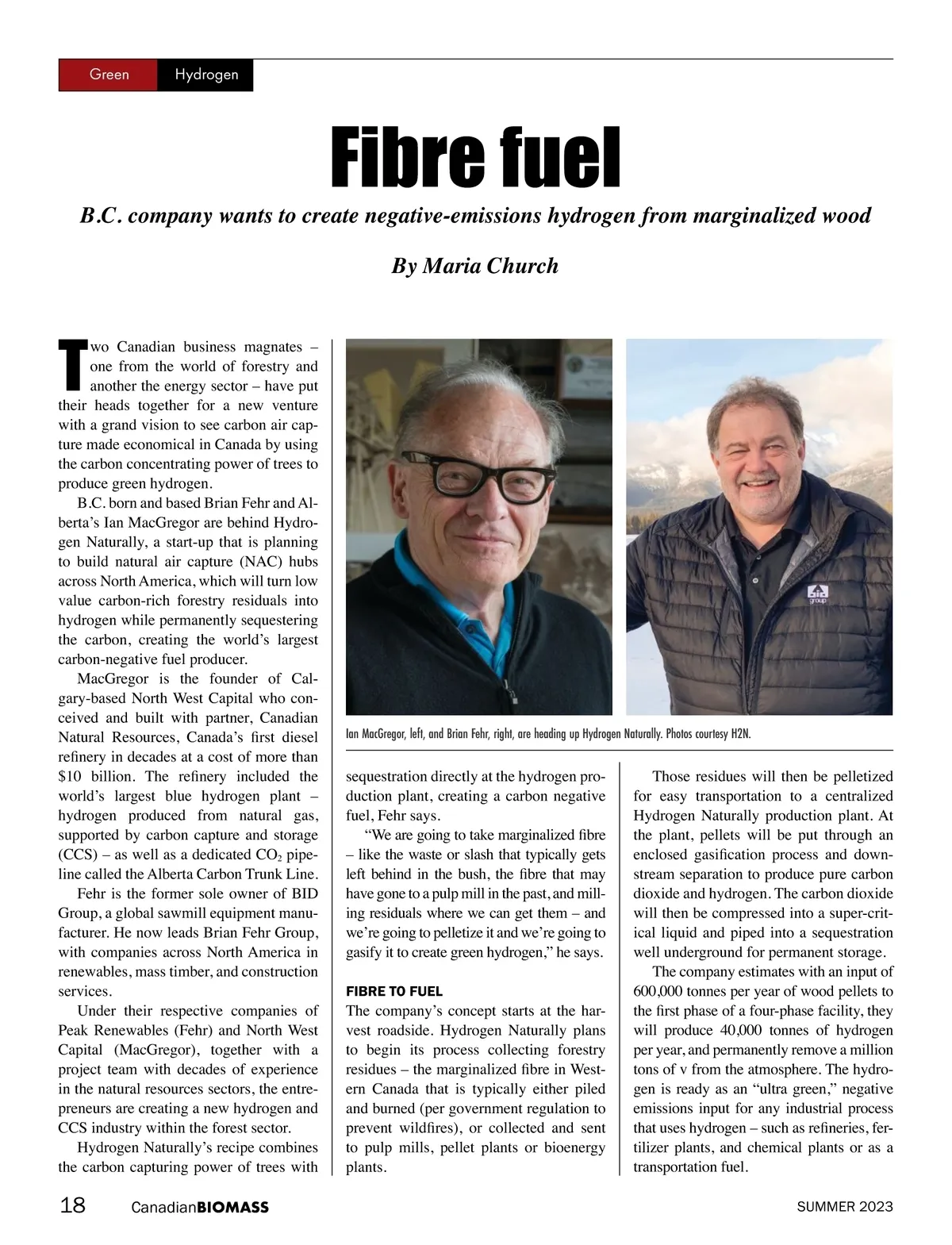
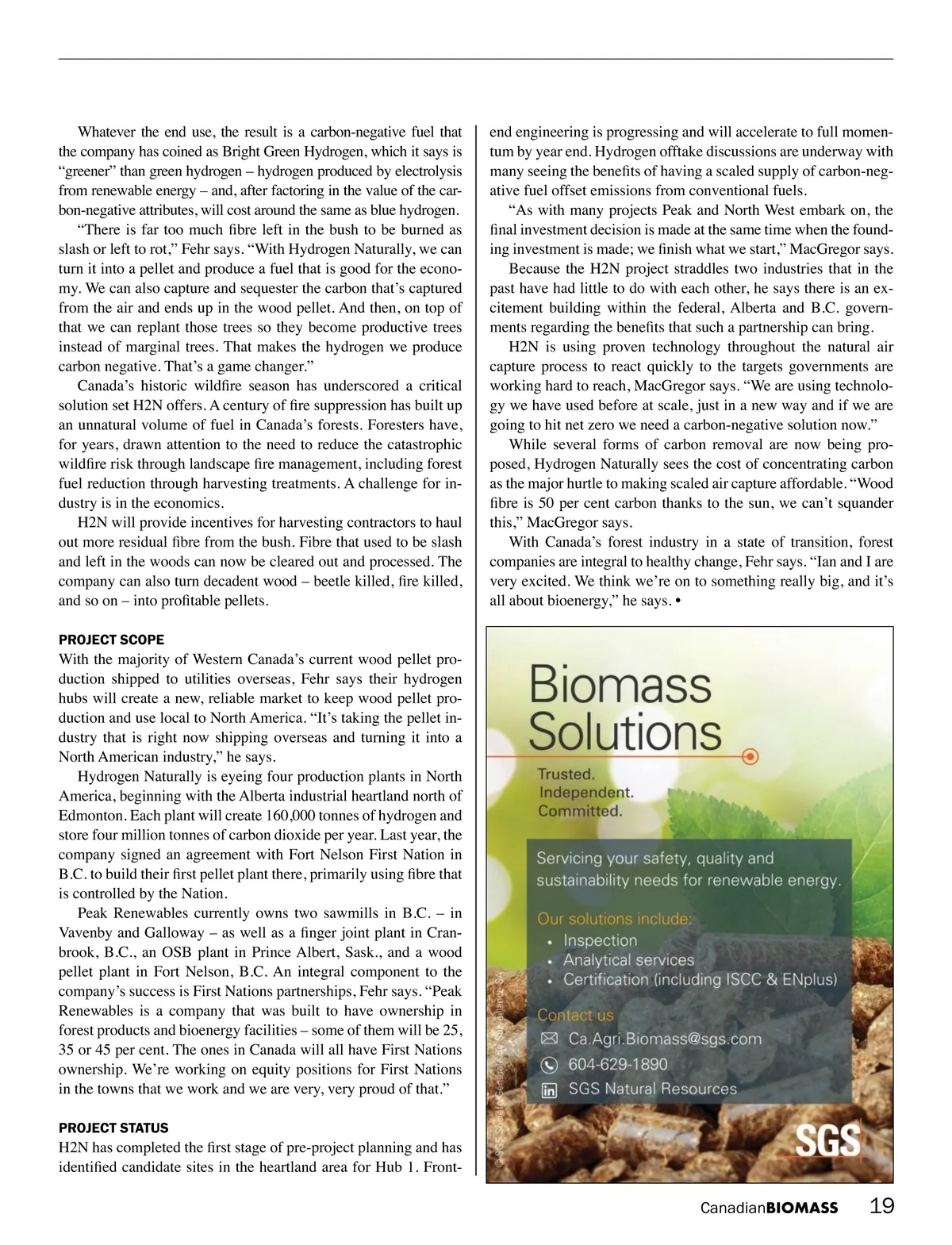
Green Hydrogen B.C. company wants to create negative-emissions hydrogen from marginalized wood By Maria Church wo Canadian business magnates – one from the world of forestry and another the energy sector – have put their heads together for a new venture with a grand vision to see carbon air cap-ture made economical in Canada by using the carbon concentrating power of trees to produce green hydrogen. B.C. born and based Brian Fehr and Al -berta’s Ian MacGregor are behind Hydro -gen Naturally, a start-up that is planning to build natural air capture (NAC) hubs across North America, which will turn low value carbon-rich forestry residuals into hydrogen while permanently sequestering the carbon, creating the world’s largest carbon-negative fuel producer. MacGregor is the founder of Cal-gary-based North West Capital who con-ceived and built with partner, Canadian Natural Resources, Canada’s first diesel refinery in decades at a cost of more than $10 billion. The refinery included the world’s largest blue hydrogen plant – hydrogen produced from natural gas, supported by carbon capture and storage (CCS) – as well as a dedicated CO 2 pipe-line called the Alberta Carbon Trunk Line. Fehr is the former sole owner of BID Group, a global sawmill equipment manu-facturer. He now leads Brian Fehr Group, with companies across North America in renewables, mass timber, and construction services. Under their respective companies of Peak Renewables (Fehr) and North West Capital (MacGregor), together with a project team with decades of experience in the natural resources sectors, the entre-preneurs are creating a new hydrogen and CCS industry within the forest sector. Hydrogen Naturally’s recipe combines the carbon capturing power of trees with Fibre fuel T Ian MacGregor, left, and Brian Fehr, right, are heading up Hydrogen Naturally. Photos courtesy H2N. sequestration directly at the hydrogen pro-duction plant, creating a carbon negative fuel, Fehr says. “We are going to take marginalized fibre – like the waste or slash that typically gets left behind in the bush, the fibre that may have gone to a pulp mill in the past, and mill-ing residuals where we can get them – and we’re going to pelletize it and we’re going to gasify it to create green hydrogen,” he says. FIBRE TO FUEL The company’s concept starts at the har -vest roadside. Hydrogen Naturally plans to begin its process collecting forestry residues – the marginalized fibre in West -ern Canada that is typically either piled and burned (per government regulation to prevent wildfires), or collected and sent to pulp mills, pellet plants or bioenergy plants. Those residues will then be pelletized for easy transportation to a centralized Hydrogen Naturally production plant. At the plant, pellets will be put through an enclosed gasification process and down -stream separation to produce pure carbon dioxide and hydrogen. The carbon dioxide will then be compressed into a super-crit-ical liquid and piped into a sequestration well underground for permanent storage. The company estimates with an input of 600,000 tonnes per year of wood pellets to the first phase of a four-phase facility, they will produce 40,000 tonnes of hydrogen per year, and permanently remove a million tons of v from the atmosphere. The hydro -gen is ready as an “ultra green,” negative emissions input for any industrial process that uses hydrogen – such as refineries, fer -tilizer plants, and chemical plants or as a transportation fuel. SUMMER 2023 18 Canadian BIOMASS
Canadian Biomass Summer 2023: Page 18