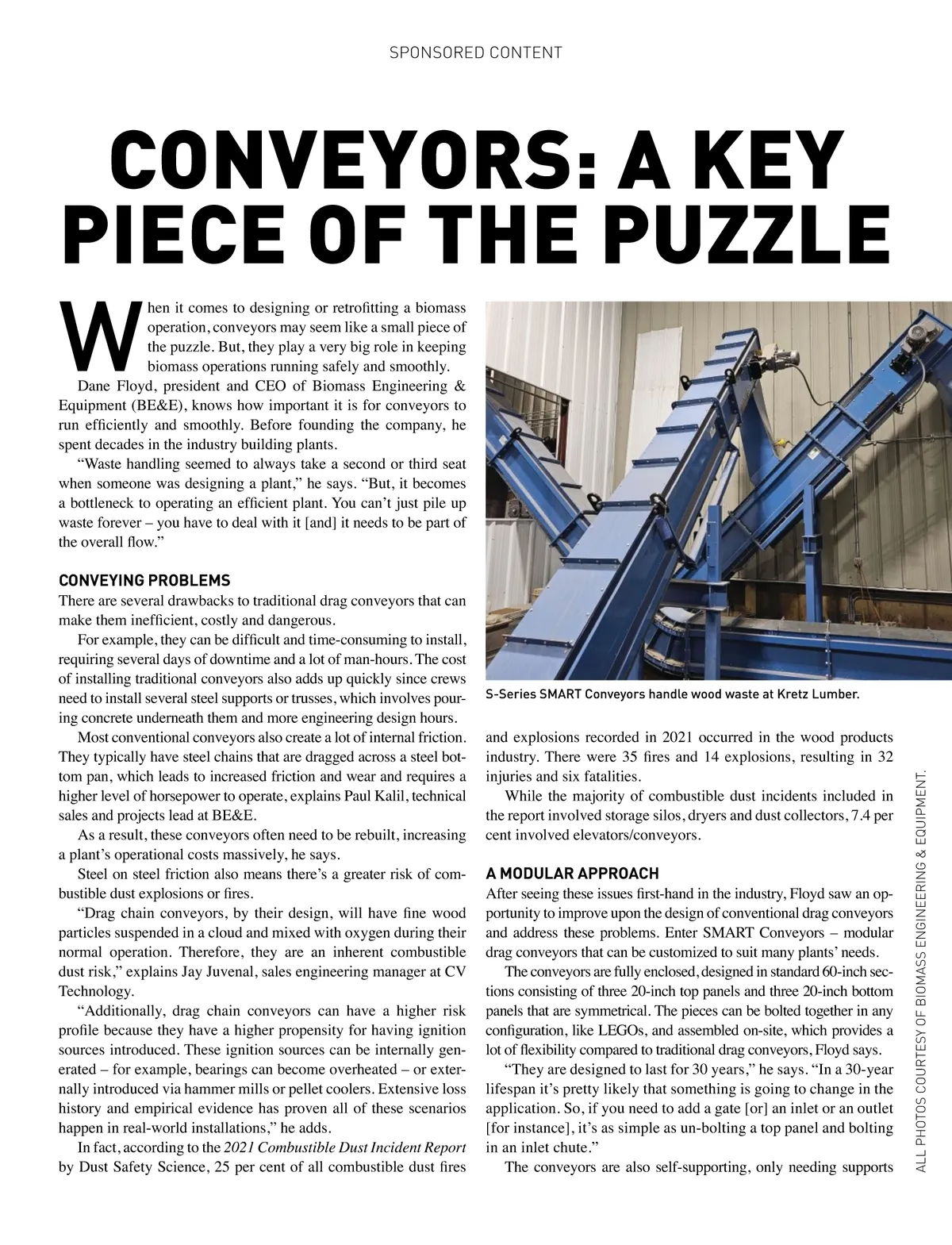
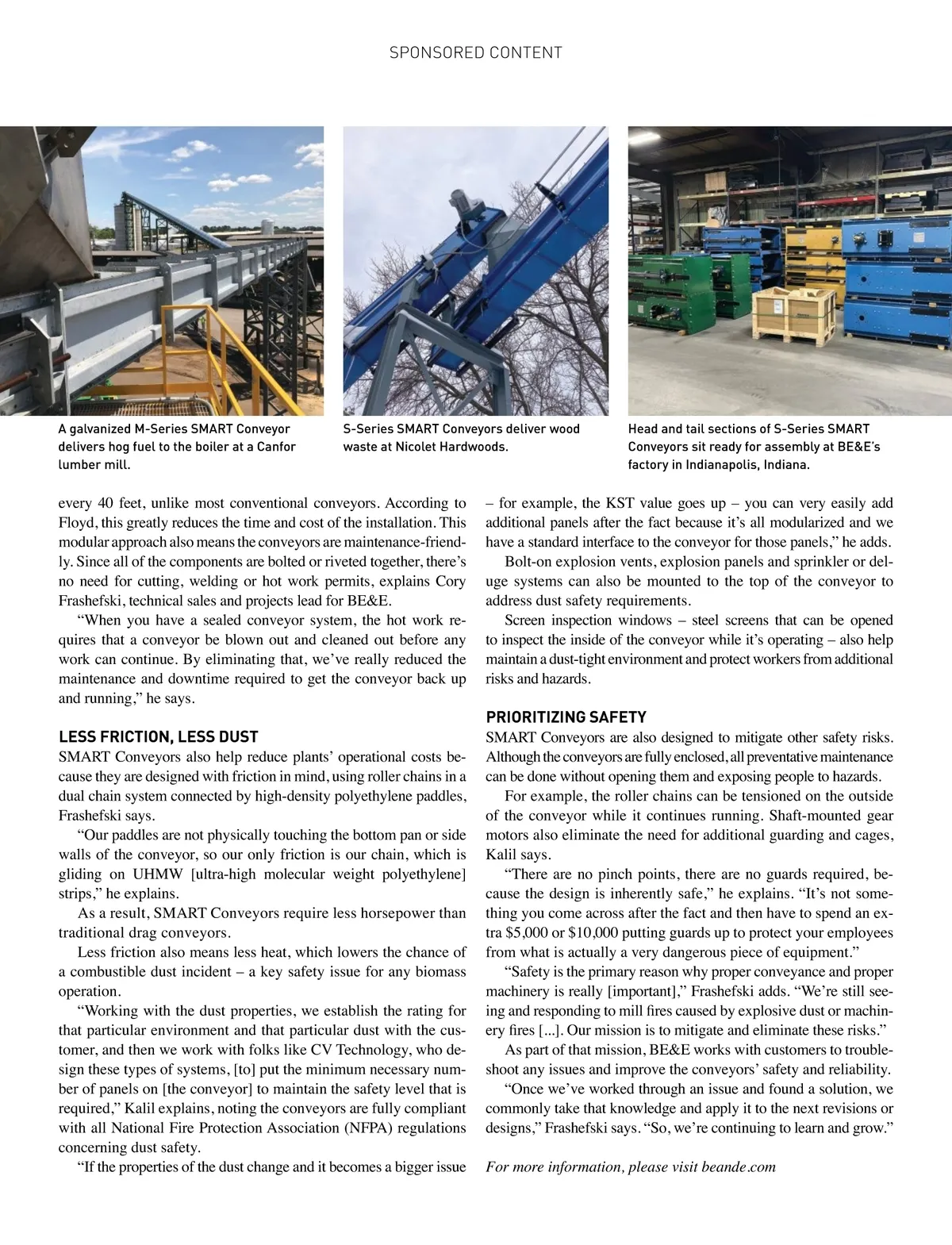
SPONSORED CONTENT hen it comes to designing or retrofitting a biomass operation, conveyors may seem like a small piece of the puzzle. But, they play a very big role in keeping biomass operations running safely and smoothly. Dane Floyd, president and CEO of Biomass Engineering & Equipment (BE&E), knows how important it is for conveyors to run efficiently and smoothly. Before founding the company, he spent decades in the industry building plants. “Waste handling seemed to always take a second or third seat when someone was designing a plant,” he says. “But, it becomes a bottleneck to operating an efficient plant. You can’t just pile up waste forever – you have to deal with it [and] it needs to be part of the overall flow.” There are several drawbacks to traditional drag conveyors that can make them inefficient, costly and dangerous. For example, they can be difficult and time-consuming to install, requiring several days of downtime and a lot of man-hours. The cost of installing traditional conveyors also adds up quickly since crews need to install several steel supports or trusses, which involves pour-ing concrete underneath them and more engineering design hours. Most conventional conveyors also create a lot of internal friction. They typically have steel chains that are dragged across a steel bot-tom pan, which leads to increased friction and wear and requires a higher level of horsepower to operate, explains Paul Kalil, technical sales and projects lead at BE&E. As a result, these conveyors often need to be rebuilt, increasing a plant’s operational costs massively, he says. Steel on steel friction also means there’s a greater risk of com -bustible dust explosions or fires. “Drag chain conveyors, by their design, will have fine wood particles suspended in a cloud and mixed with oxygen during their normal operation. Therefore, they are an inherent combustible dust risk,” explains Jay Juvenal, sales engineering manager at CV Technology. “Additionally, drag chain conveyors can have a higher risk profile because they have a higher propensity for having ignition sources introduced. These ignition sources can be internally gen -erated – for example, bearings can become overheated – or exter -nally introduced via hammer mills or pellet coolers. Extensive loss history and empirical evidence has proven all of these scenarios happen in real-world installations,” he adds. In fact, according to the 2021 Combustible Dust Incident Report by Dust Safety Science, 25 per cent of all combustible dust fires W CONVEYORS: A KEY PIECE OF THE PUZZLE CONVEYING PROBLEMS S-Series SMART Conveyors handle wood waste at Kretz Lumber. After seeing these issues first-hand in the industry, Floyd saw an op -portunity to improve upon the design of conventional drag conveyors and address these problems. Enter SMART Conveyors – modular drag conveyors that can be customized to suit many plants’ needs. The conveyors are fully enclosed, designed in standard 60-inch sec-tions consisting of three 20-inch top panels and three 20-inch bottom panels that are symmetrical. The pieces can be bolted together in any configuration, like LEGOs, and assembled on-site, which provides a lot of flexibility compared to traditional drag conveyors, Floyd says. “They are designed to last for 30 years,” he says. “In a 30-year lifespan it’s pretty likely that something is going to change in the application. So, if you need to add a gate [or] an inlet or an outlet [for instance], it’s as simple as un-bolting a top panel and bolting in an inlet chute.” The conveyors are also self-supporting, only needing supports A MODULAR APPROACH ALL PHOTOS COURTESY OF BIOMASS ENGINEERING & EQUIPMENT. and explosions recorded in 2021 occurred in the wood products industry. There were 35 fires and 14 explosions, resulting in 32 injuries and six fatalities. While the majority of combustible dust incidents included in the report involved storage silos, dryers and dust collectors, 7.4 per cent involved elevators/conveyors.
Canadian Biomass Summer 2023: Page 16