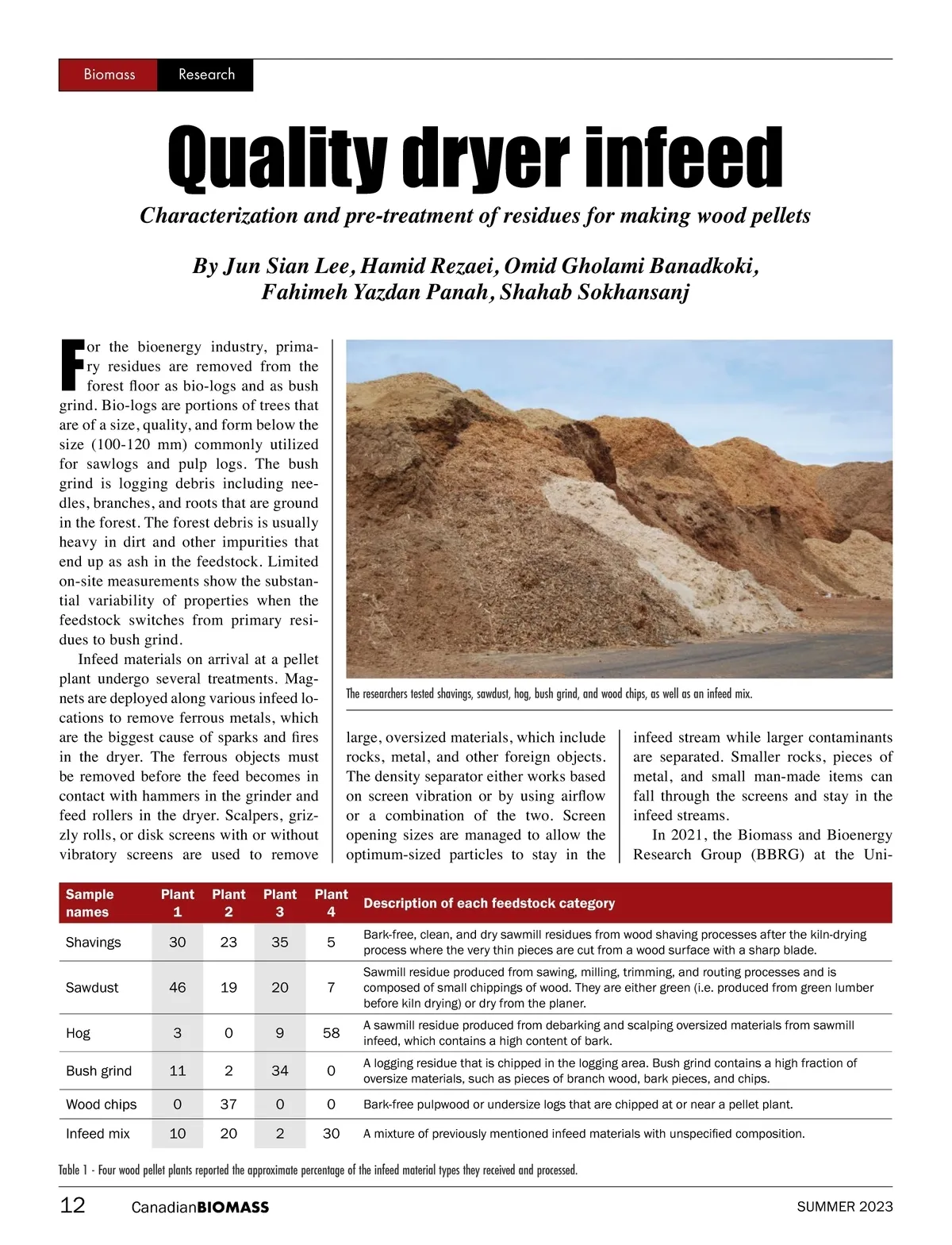
Biomass Research Characterization and pre-treatment of residues for making wood pellets By Jun Sian Lee, Hamid Rezaei, Omid Gholami Banadkoki, Fahimeh Yazdan Panah, Shahab Sokhansanj or the bioenergy industry, prima-ry residues are removed from the forest floor as bio-logs and as bush grind. Bio-logs are portions of trees that are of a size, quality, and form below the size (100-120 mm) commonly utilized for sawlogs and pulp logs. The bush grind is logging debris including nee-dles, branches, and roots that are ground in the forest. The forest debris is usually heavy in dirt and other impurities that end up as ash in the feedstock. Limited on-site measurements show the substan-tial variability of properties when the feedstock switches from primary resi-dues to bush grind. Infeed materials on arrival at a pellet plant undergo several treatments. Mag -nets are deployed along various infeed lo-cations to remove ferrous metals, which are the biggest cause of sparks and fires in the dryer. The ferrous objects must be removed before the feed becomes in contact with hammers in the grinder and feed rollers in the dryer. Scalpers, griz -zly rolls, or disk screens with or without vibratory screens are used to remove Sample names Shavings Sawdust Hog Bush grind Wood chips Infeed mix Plant 1 30 46 3 11 0 10 Plant 2 23 19 0 2 37 20 Plant 3 35 20 9 34 0 2 Quality dryer infeed F The researchers tested shavings, sawdust, hog, bush grind, and wood chips, as well as an infeed mix. large, oversized materials, which include rocks, metal, and other foreign objects. The density separator either works based on screen vibration or by using airflow or a combination of the two. Screen opening sizes are managed to allow the optimum-sized particles to stay in the Description of each feedstock category infeed stream while larger contaminants are separated. Smaller rocks, pieces of metal, and small man-made items can fall through the screens and stay in the infeed streams. In 2021, the Biomass and Bioenergy Research Group (BBRG) at the Uni-Plant 4 5 7 58 0 0 30 Bark-free, clean, and dry sawmill residues from wood shaving processes after the kiln-drying process where the very thin pieces are cut from a wood surface with a sharp blade. Sawmill residue produced from sawing, milling, trimming, and routing processes and is composed of small chippings of wood. They are either green (i.e. produced from green lumber before kiln drying) or dry from the planer. A sawmill residue produced from debarking and scalping oversized materials from sawmill infeed, which contains a high content of bark. A logging residue that is chipped in the logging area. Bush grind contains a high fraction of oversize materials, such as pieces of branch wood, bark pieces, and chips. Bark-free pulpwood or undersize logs that are chipped at or near a pellet plant. A mixture of previously mentioned infeed materials with unspecified composition. Table 1 -Four wood pellet plants reported the approximate percentage of the infeed material types they received and processed. 12 Canadian BIOMASS SUMMER 2023
Canadian Biomass Summer 2023: Page 12