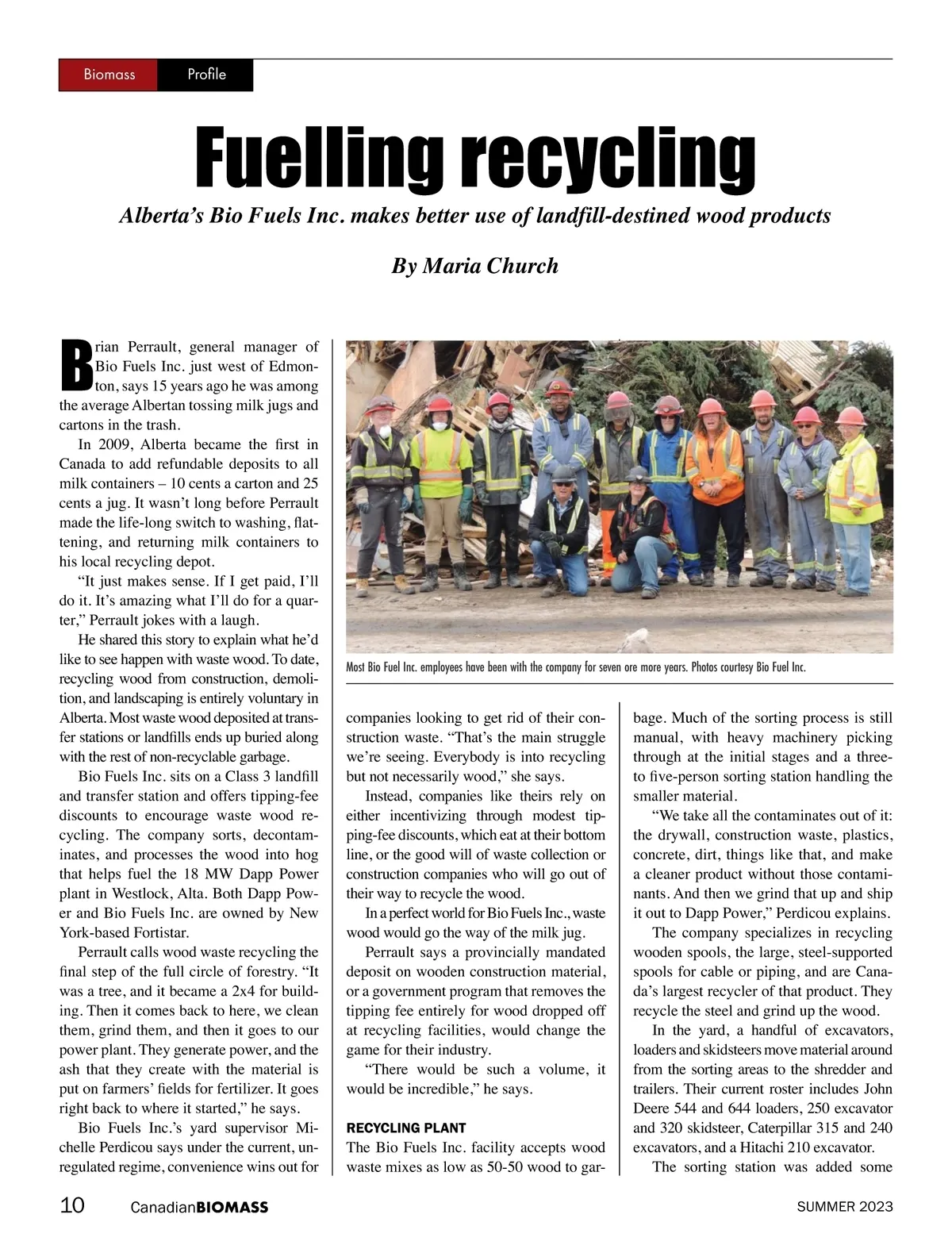
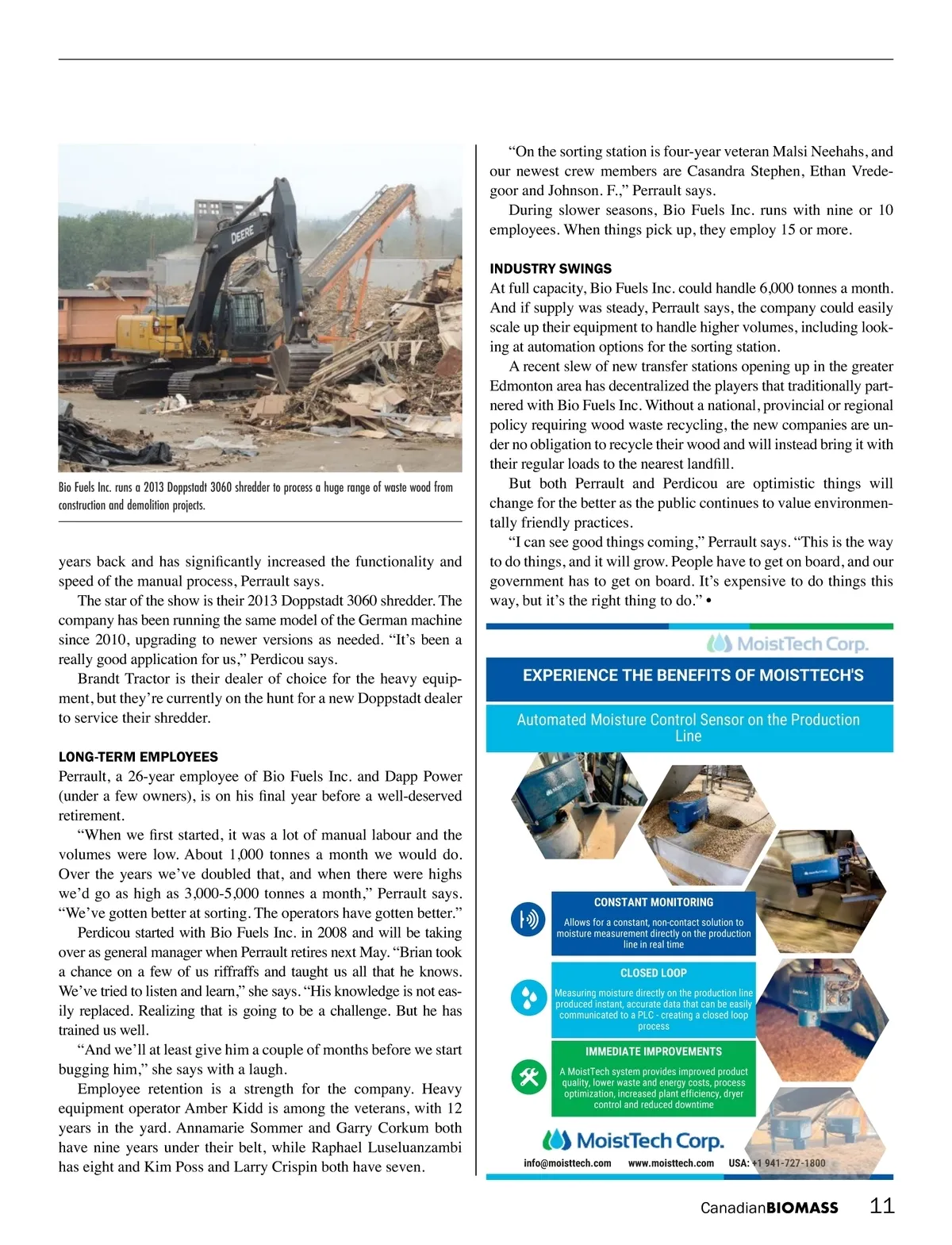
Biomass Profile Alberta’s Bio Fuels Inc. makes better use of landfill-destined wood products By Maria Church Fuelling recycling B rian Perrault, general manager of Bio Fuels Inc. just west of Edmon -ton, says 15 years ago he was among the average Albertan tossing milk jugs and cartons in the trash. In 2009, Alberta became the first in Canada to add refundable deposits to all milk containers – 10 cents a carton and 25 cents a jug. It wasn’t long before Perrault made the life-long switch to washing, flat -tening, and returning milk containers to his local recycling depot. “It just makes sense. If I get paid, I’ll do it. It’s amazing what I’ll do for a quar -ter,” Perrault jokes with a laugh. He shared this story to explain what he’d like to see happen with waste wood. To date, recycling wood from construction, demoli-tion, and landscaping is entirely voluntary in Alberta. Most waste wood deposited at trans -fer stations or landfills ends up buried along with the rest of non-recyclable garbage. Bio Fuels Inc. sits on a Class 3 landfill and transfer station and offers tipping-fee discounts to encourage waste wood re-cycling. The company sorts, decontam -inates, and processes the wood into hog that helps fuel the 18 MW Dapp Power plant in Westlock, Alta. Both Dapp Pow -er and Bio Fuels Inc. are owned by New York-based Fortistar. Perrault calls wood waste recycling the final step of the full circle of forestry. “It was a tree, and it became a 2x4 for build -ing. Then it comes back to here, we clean them, grind them, and then it goes to our power plant. They generate power, and the ash that they create with the material is put on farmers’ fields for fertilizer. It goes right back to where it started,” he says. Bio Fuels Inc.’s yard supervisor Mi -chelle Perdicou says under the current, un-regulated regime, convenience wins out for Most Bio Fuel Inc. employees have been with the company for seven ore more years. Photos courtesy Bio Fuel Inc. companies looking to get rid of their con-struction waste. “That’s the main struggle we’re seeing. Everybody is into recycling but not necessarily wood,” she says. Instead, companies like theirs rely on either incentivizing through modest tip-ping-fee discounts, which eat at their bottom line, or the good will of waste collection or construction companies who will go out of their way to recycle the wood. In a perfect world for Bio Fuels Inc., waste wood would go the way of the milk jug. Perrault says a provincially mandated deposit on wooden construction material, or a government program that removes the tipping fee entirely for wood dropped off at recycling facilities, would change the game for their industry. “There would be such a volume, it would be incredible,” he says. RECYCLING PLANT The Bio Fuels Inc. facility accepts wood waste mixes as low as 50-50 wood to gar-bage. Much of the sorting process is still manual, with heavy machinery picking through at the initial stages and a three-to five-person sorting station handling the smaller material. “We take all the contaminates out of it: the drywall, construction waste, plastics, concrete, dirt, things like that, and make a cleaner product without those contami-nants. And then we grind that up and ship it out to Dapp Power,” Perdicou explains. The company specializes in recycling wooden spools, the large, steel-supported spools for cable or piping, and are Cana-da’s largest recycler of that product. They recycle the steel and grind up the wood. In the yard, a handful of excavators, loaders and skidsteers move material around from the sorting areas to the shredder and trailers. Their current roster includes John Deere 544 and 644 loaders, 250 excavator and 320 skidsteer, Caterpillar 315 and 240 excavators, and a Hitachi 210 excavator. The sorting station was added some SUMMER 2023 10 Canadian BIOMASS
Canadian Biomass Summer 2023: Page 10