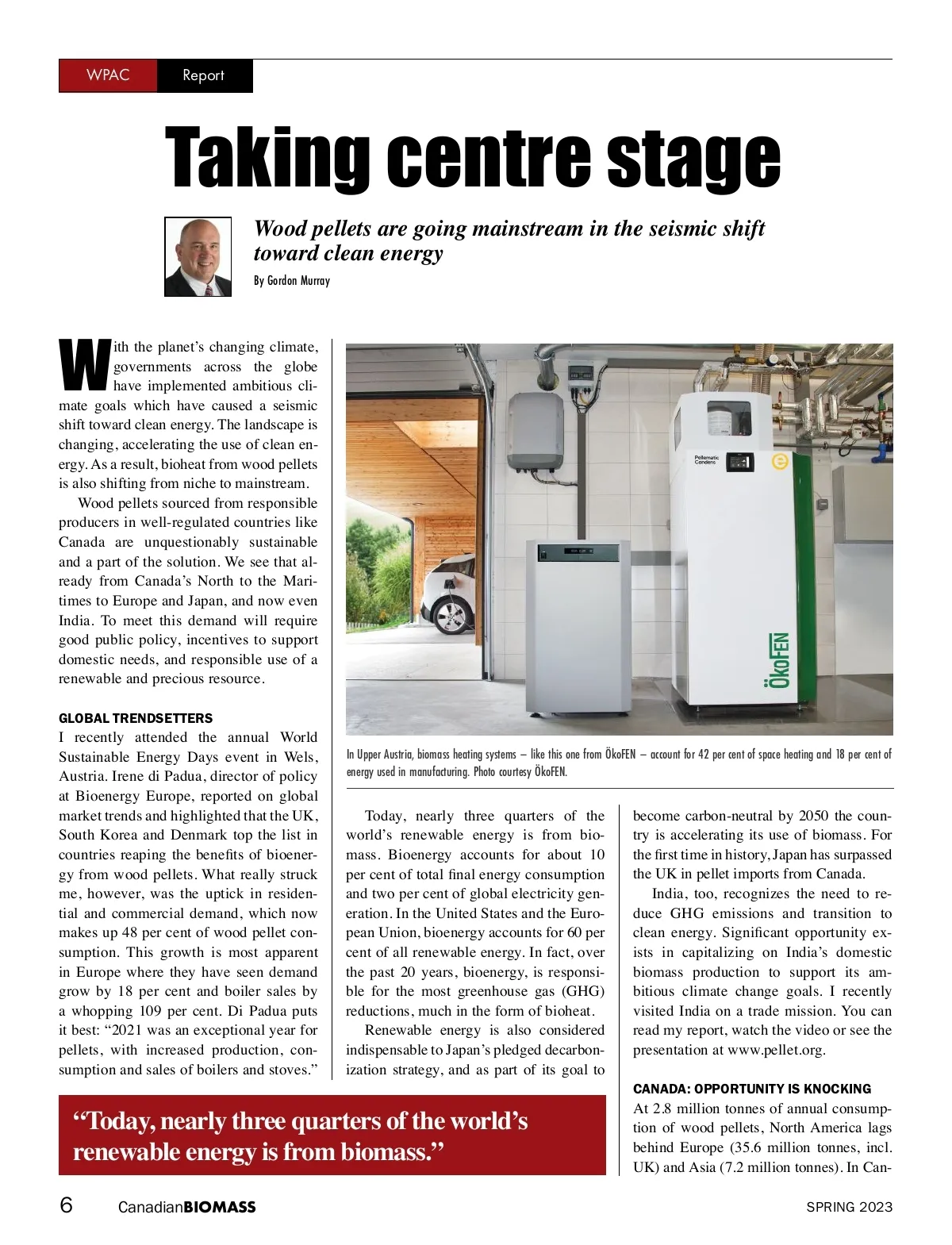
ada, in part, this is due to many of our prov-inces having access to hydro electricity and natural gas. But in some Maritime prov-inces and remote northern and Indigenous communities, energy poverty is a reality. Canada is the world’s second largest producer of wood pellets; but more than 90 per cent of our pellets are exported. Why? Yes, we have work to do on pro-moting wood pellets to make Canadians more aware; but the fact is we see publicly funded incentives for competing products, like heat pumps and investments in far-off solutions like hydrogen, when the solu-tions are in the sawmill and harvest resid-uals across Canada’s forests. There are examples of smaller markets leading the way on the use of bioheat. Take Upper Austria – about one-sixth the size of New Brunswick with 1.5 million people. According to Christiane Egger, deputy manager of the Energy Agency of Upper Austria, in her region, biomass accounts for 42 per cent of space heating and pro-vides 18 per cent of energy used in manu-facturing. The use of fossil fuels for heat-ing is banned in all new home construction and heating system replacements – a key driver behind the 72,000 modern auto-matic biomass and 360 biomass district heating plants now operating in the region. Austria has succeeded in making biomass a mainstream fuel. The good news is that significant in -roads to biomass has already been made in Canada’s Maritime provinces and North-ern and remote communities, and you can read about some of those projects on our website. MAINSTREAM SHIFT NEEDS POLICY In British Columbia we are already seeing the province’s commitment to re-duce “waste” through projects funded by the Forest Enhancement Society of B.C. that will help get more fire-damaged wood and logging waste to the mills that need it. The Government of Canada also rec-ognizes the role of forest bioenergy in reducing Canada’s emissions under the 2030 Emissions Reduction Plan . Programs like the Clean Technology Investment Tax Credit are key to expanding clean technolo-gy solutions in places like New Brunswick and Nova Scotia, however, biomass boilers must be afforded a level playing field with other clean technologies like heat pumps. Over the next decade, both these prov-inces’ electricity capacity is forecasted to drop by 50 per cent. Heat pumps alone will not solve the problem which will require the current fossil fuel grid to run the heat pumps. Including biomass from wood pellets is good for Canadians’ pock-etbooks; it’s good for the environment; and it’s good for local economies. We’ve also got work to do on removing trade barriers that restrict the importation of European boilers into Canada. Current-ly, we don’t make boilers in Canada, and we can’t import them as they are manufac-tured, so the only significant markets for our pellets is offshore, to be used in homes and businesses around the world as a sus-tainable source of renewable energy and heat. Canada’s wood pellet consumption is tiny by global standards, entirely due to the lack of access to modern highly auto-mated wood pellet boilers. We’re making good progress on this front. DOMESTIC OPPORTUNITIES Today, biomass is recognized by the Gov-ernment of Canada as low-carbon tech-nology, typically saving 90 per cent GHG emissions over fossil alternatives. It can contribute to the elimination of heating oil and natural gas heating in Canada and mitigate the effect of closing coal power plants by providing high efficiency, low carbon heat energy in replacement for fos-sil-derived electric heating. But to reach its full potential, good public policy from the ground up and fair incentives from governments are needed. My recent trips to India and Europe have left me inspired. The benefits of bioheat are now accepted as mainstream and the focus is now on how to grow markets, improve technology and to continue to promote the benefits of bioheat. Here in Canada, we have work to do, but it’s also clear to me that there is a groundswell of support and increasing awareness of the potential of lo-cal bioheat solutions. • Gordon Murray is the executive director of the Wood Pellet Association of Canada. Canadian BIOMASS Untitled-2 1 7 2023-03-27 8:50 AM
Canadian Biomass Spring 2023: Page 7