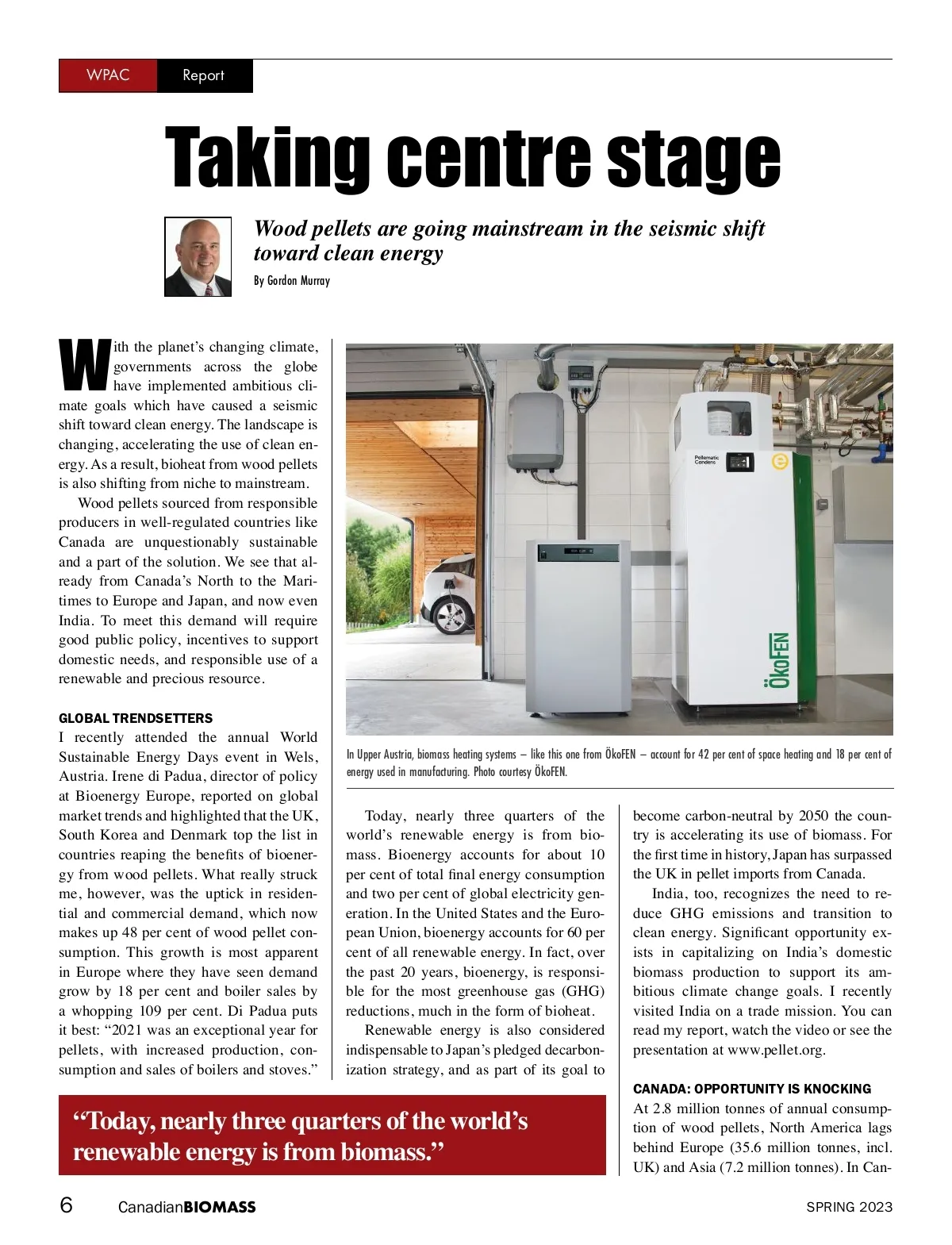
WPAC Report Taking centre stage Wood pellets are going mainstream in the seismic shift toward clean energy By Gordon Murray W ith the planet’s changing climate, governments across the globe have implemented ambitious cli-mate goals which have caused a seismic shift toward clean energy. The landscape is changing, accelerating the use of clean en-ergy. As a result, bioheat from wood pellets is also shifting from niche to mainstream. Wood pellets sourced from responsible producers in well-regulated countries like Canada are unquestionably sustainable and a part of the solution. We see that al-ready from Canada’s North to the Mari-times to Europe and Japan, and now even India. To meet this demand will require good public policy, incentives to support domestic needs, and responsible use of a renewable and precious resource. GLOBAL TRENDSETTERS I recently attended the annual World Sustainable Energy Days event in Wels, Austria. Irene di Padua, director of policy at Bioenergy Europe, reported on global market trends and highlighted that the UK, South Korea and Denmark top the list in countries reaping the benefits of bioener -gy from wood pellets. What really struck me, however, was the uptick in residen-tial and commercial demand, which now makes up 48 per cent of wood pellet con-sumption. This growth is most apparent in Europe where they have seen demand grow by 18 per cent and boiler sales by a whopping 109 per cent. Di Padua puts it best: “2021 was an exceptional year for pellets, with increased production, con-sumption and sales of boilers and stoves.” In Upper Austria, biomass heating systems – like this one from ÖkoFEN – account for 42 per cent of space heating and 18 per cent of energy used in manufacturing. Photo courtesy ÖkoFEN. Today, nearly three quarters of the world’s renewable energy is from bio-mass. Bioenergy accounts for about 10 per cent of total final energy consumption and two per cent of global electricity gen-eration. In the United States and the Euro-pean Union, bioenergy accounts for 60 per cent of all renewable energy. In fact, over the past 20 years, bioenergy, is responsi-ble for the most greenhouse gas (GHG) reductions, much in the form of bioheat. Renewable energy is also considered indispensable to Japan’s pledged decarbon-ization strategy, and as part of its goal to become carbon-neutral by 2050 the coun-try is accelerating its use of biomass. For the first time in history, Japan has surpassed the UK in pellet imports from Canada. India, too, recognizes the need to re-duce GHG emissions and transition to clean energy. Significant opportunity ex -ists in capitalizing on India’s domestic biomass production to support its am-bitious climate change goals. I recently visited India on a trade mission. You can read my report, watch the video or see the presentation at www.pellet.org. CANADA: OPPORTUNITY IS KNOCKING “Today, nearly three quarters of the world’s renewable energy is from biomass.” 6 Canadian BIOMASS At 2.8 million tonnes of annual consump-tion of wood pellets, North America lags behind Europe (35.6 million tonnes, incl. UK) and Asia (7.2 million tonnes). In Can-SPRING 2023
Canadian Biomass Spring 2023: Page 6